Facts
The petitioner-company, engaged in manufacturing CNC machines, filed its return for A.Y. 2019–20 declaring total income of ₹45,05,86,190, which was processed under Section 143(1) of the Income-tax Act, 1961.
Source reference: para. 3–3.1The assessment was subsequently reopened on the basis of Investigation Wing information alleging an accommodation entry received from M/s GSD Trading and Financial Services Pvt. Ltd.; reassessment proceedings culminated in an order dated 16 March 2024 under Sections 147 and 143(3), against which the petitioner preferred an appeal.
Source reference: para. 3–3.1Thereafter, the Assessing Officer issued a notice dated 30 March 2025 under Section 148A(1), alleging escapement of income of ₹27,46,30,215 through certain purchase and other transactions.
Source reference: paras. 3.2–3.3The petitioner was supplied only screenshots from the Insight Portal containing Case Related Information Details, without the underlying dissemination reports and other material relied upon by the Revenue.
Source reference: paras. 3.2–3.3, 7–8.1In its reply dated 17 April 2025, the petitioner contended that the transactions were duly recorded in its books and supported by ledger accounts, invoices, bank statements, E-way bills and other documents.
Source reference: para. 4.2The Assessing Officer nevertheless passed an order dated 28 June 2025 under Section 148A(3) and issued a consequential notice under Section 148.
Source reference: paras. 3.3, 11.1Issues
Whether a notice under Section 148A(1) of the Income-tax Act is sustainable when it does not disclose the names, nature and particulars of the alleged transactions and does not furnish the underlying material relied upon by the Assessing Officer?
Source reference: paras. 8–8.2, 10.3–10.4Whether the order under Section 148A(3) is valid when the Assessing Officer fails to meaningfully consider the assessee’s documentary reply and proceeds without demonstrating independent application of mind to the material allegedly connecting the assessee with fictitious or accommodation transactions?
Source reference: paras. 9–10.3Whether the subsequent production of the underlying reports during the writ proceedings could cure the defects in the original notice and proceedings under Sections 148A and 148?
Source reference: para. 11Law Applied
Section 148A(1) of the Income-tax Act requires the Assessing Officer, before issuing a notice under Section 148, to provide the assessee with an opportunity of being heard on the basis of information suggesting escapement of income; this opportunity must be meaningful and must include sufficient particulars and the material relied upon.
Source reference: paras. 4.1, 8.2Section 148A(3) requires the Assessing Officer to consider the assessee’s reply and decide, on the basis of the material available, whether issuance of notice under Section 148 is warranted.
Source reference: paras. 4.1, 10.3–10.4The Court relied on the principles concerning disclosure of relied-upon material and meaningful opportunity of hearing discussed in Filco Trade Centre (P.) Ltd. v. Deputy Commissioner of Income-tax, [2024] 169 taxmann.com 401 (Guj.), and Bhagwati Polyfill Private Limited v. Assistant Commissioner of Income Tax, Special Civil Application No. 17669 of 2019.
Source reference: paras. 8.2, 10.3–10.4The Court further applied the principle that proceedings founded on undisclosed material, non-application of mind, or borrowed satisfaction cannot be sustained.
Source reference: paras. 10.3–10.4Reasoning
The Court found that the Section 148A(1) notice merely quantified the alleged escapement under broad headings—“Purchases” and “Others”—without disclosing the concerned parties, the nature of the transactions, or the material particulars necessary for an effective response.
Source reference: paras. 7–8Although screenshots referring to three entities were supplied, the underlying dissemination reports, which formed the basis of the Revenue’s allegations, were not furnished until the writ proceedings.
Source reference: paras. 8.1–8.2The Court further held that the Assessing Officer had failed to meaningfully address the petitioner’s reply and supporting documents.
Source reference: para. 9The order under Section 148A(3) reproduced portions of the petitioner’s response but did not properly deal with its substantive objections or demonstrate independent examination of the dissemination reports.
Source reference: paras. 9–10.2Since those reports primarily concerned another entity, M/s Alfara’s Infraprojects Pvt. Ltd., the Assessing Officer was required to identify the specific material linking the petitioner to the alleged accommodation transactions.
Source reference: paras. 10–10.2The subsequent production of the reports during the writ proceedings could not cure the original denial of a meaningful opportunity under Section 148A(1), because the petitioner had been required to respond without access to the material relied upon.
Source reference: paras. 10.3–11.2Holding
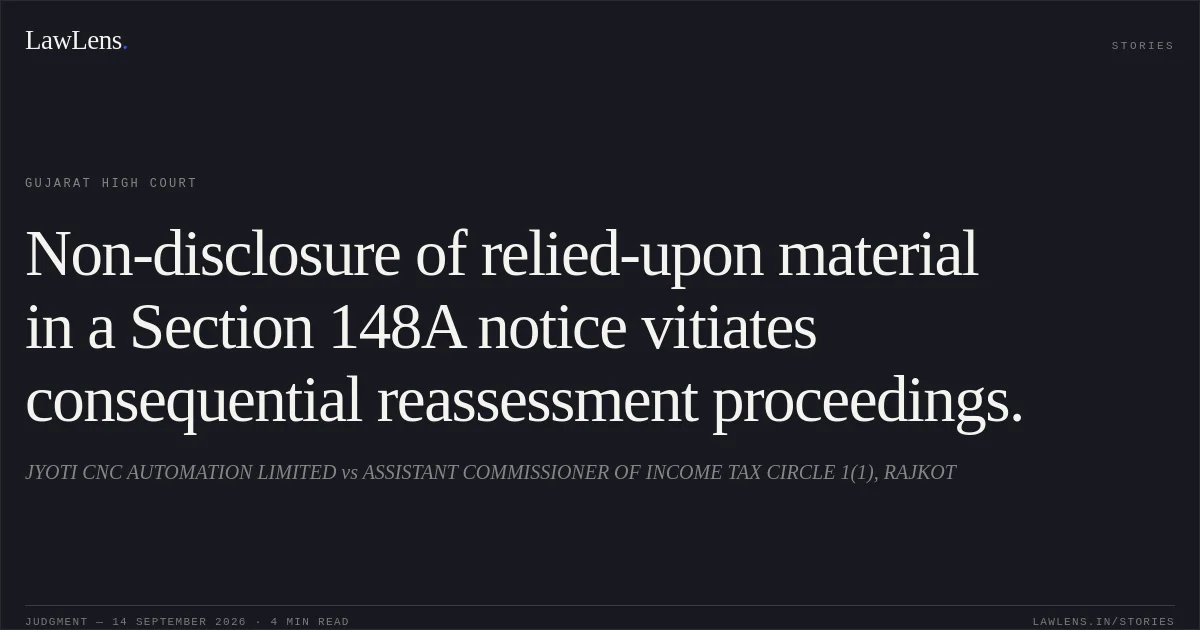
The Gujarat High Court held that the notice dated 30 March 2025 under Section 148A(1) was invalid because it failed to disclose the material particulars and underlying documents relied upon to allege escapement of income.
The consequential order dated 28 June 2025 under Section 148A(3) was also unsustainable for non-consideration of the petitioner’s reply and absence of independent application of mind.
Source reference: paras. 11.1–12Consequently, the notice dated 28 June 2025 issued under Section 148 was quashed and set aside.
Source reference: paras. 11.1–12The Court declined to remand the matter, holding that the foundational defect could not be cured by granting the Revenue a further opportunity.
Source reference: paras. 11.1–12The writ petition was allowed and the Rule was made absolute.
Source reference: paras. 11.1–12Acts & Sections Cited
4 provisions across 1 statute referred to in this judgment. Linked provisions open on LawLens.
Income Tax Act, 19614
Original Court PDF
JYOTI CNC AUTOMATION LIMITEDvsASSISTANT COMMISSIONER OF INCOME TAX CIRCLE 1(1), RAJKOT
Click to open original judgment
Original judgment, available to read, download and summarize on LawLens.in