Facts
On the intervening night of 18/19 May 2016, Amit Panchal was allegedly travelling from Saharanpur to Modi Nagar by Train No. 18238, Amritsar–Bilaspur Chhattisgarh Express, on a valid second-class journey ticket.
Source reference: p.2; para. 2The appellants claimed that, while the train was approaching Modi Nagar Railway Station, the deceased accidentally fell from the running train, sustained fatal injuries, and died.
Source reference: p.2; para. 2His body was discovered at approximately 6:00 a.m.
Source reference: p.2; para. 2The Railway Claims Tribunal dismissed the claim application, holding that the deceased was not proved to be a bona fide passenger and that the incident did not constitute an “untoward incident” under the Railways Act, 1989.
Source reference: p.2; para. 3The appellants challenged that decision under Section 23 of the Railway Claims Tribunal Act, 1987, contending that the journey ticket had been lost in the accident and that the deceased had fallen because of jostling inside the compartment.
Source reference: p.2; para. 4The Union of India argued that the deceased may have been run over while trespassing, particularly because his body was discovered several hours after the train had passed Modi Nagar and was not reported by the loco pilots of three intervening trains.
Source reference: pp.2–3; para. 5Issues
Whether the deceased was a bona fide passenger despite the non-recovery of his journey ticket?
Source reference: p.3; paras. 7–10Whether the deceased’s death resulted from an “untoward incident” under the Railways Act, 1989, namely, an accidental fall from a running train?
Source reference: pp.4–5; paras. 7, 11–13Law Applied
The Court applied Section 23 of the Railway Claims Tribunal Act, 1987, governing appeals from decisions of the Railway Claims Tribunal, and the provisions of the Railways Act, 1989 concerning “untoward incidents.”
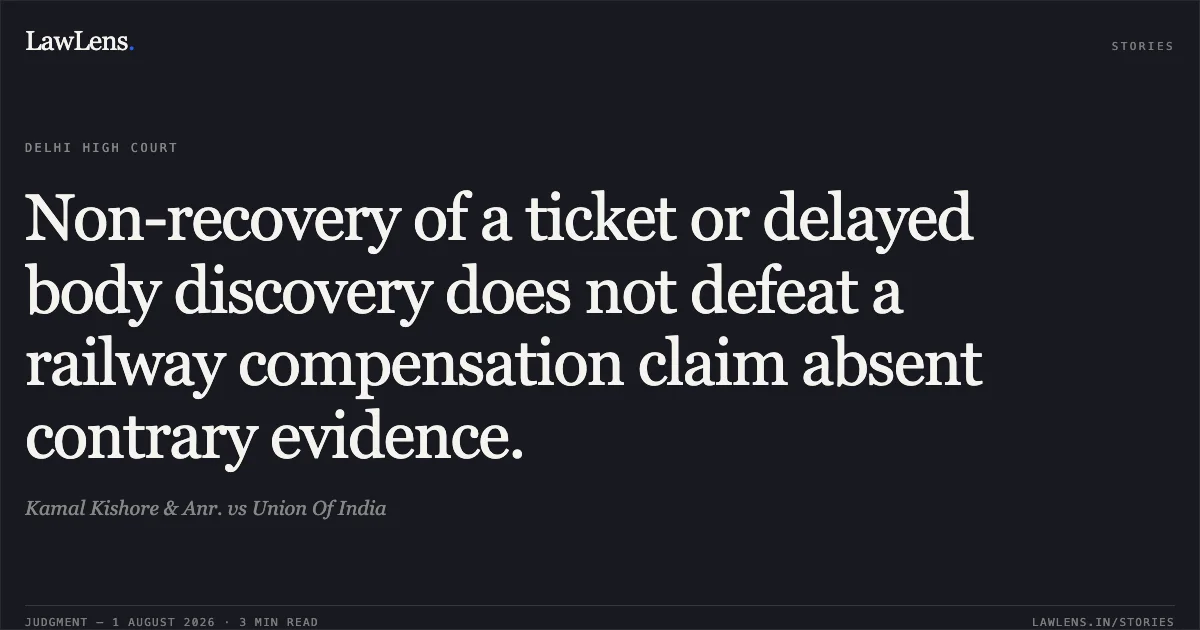
Source reference: pp.3–4; paras. 8–10Relying on Union of India v. Rina Devi, (2019) 3 SCC 572, and its subsequent application in Lata v. Union of India, 2026 SCC OnLine SC 1350, the Court held that mere non-recovery of a railway ticket is not conclusive proof that the deceased was not a bona fide passenger; the claimant’s initial burden may be discharged through an affidavit or other evidence, in the absence of cogent rebuttal.
Source reference: pp.3–4; paras. 8–10The Court also relied on Doli Rani Saha v. Union of India, as referred to in Lata, for the same principle.
Source reference: p.4; para. 9Further, following Surendra Prasad Verma v. Union of India, 2014 SCC OnLine Del 2917, the Court held that delay in discovering or recovering the body, by itself, cannot disprove an accidental fall, particularly where there is no cogent evidence establishing trespass or death by being run over.
Source reference: p.5; paras. 11–12Reasoning
The Court held that the appellants’ witness, AW-1, had discharged the initial burden by filing an affidavit and stating that the deceased had purchased a valid second-class ticket for the relevant journey.
Source reference: p.4; para. 10The fact that AW-1 was not an eyewitness did not invalidate his testimony, since he had not claimed to have witnessed either the ticket purchase or the accident.
Source reference: p.4; para. 10In the absence of cogent evidence rebutting that testimony, the Tribunal erred in denying the deceased bona fide passenger status, particularly because non-recovery of the ticket was not determinative under Rina Devi and Lata.
Source reference: p.4; para. 10On the second issue, the Court found that the body’s discovery at 6:00 a.m., despite the passage of three trains between 3:02 a.m. and 6:00 a.m., did not by itself negate the possibility of an accidental fall.
Source reference: p.5; para. 11The Union of India produced no cogent evidence proving that the deceased had trespassed onto the railway track or had been run over.
Source reference: p.5; paras. 12–13Applying Surendra Prasad Verma, the Court held that the delay in noticing the body could not, standing alone, justify rejection of the appellants’ account.
Source reference: p.5; paras. 12–13The incident therefore fell within the scope of an “untoward incident” under the Act.
Source reference: p.5; para. 13Holding
The High Court allowed the appeal and set aside the Tribunal’s judgment dated 14 October 2020.
It held that the deceased was a bona fide passenger and that his death resulted from an untoward incident under the Railways Act, 1989.
Source reference: p.5; paras. 13–15The matter was remanded to the Railway Claims Tribunal to assess the compensation payable in accordance with law and to direct disbursement by the concerned authorities within two months of receiving the High Court’s order.
Source reference: p.5; para. 14The matter was directed to be listed before the Tribunal on 18 August 2026.
Source reference: p.5; para. 14Original Court PDF
Kamal Kishore & Anr.vsUnion Of India
Click to open original judgment
Original judgment, available to read, download and summarize on LawLens.in