Facts
The respondent served as Deputy Commissioner, Karol Bagh Zone, Municipal Corporation of Delhi, from 28 April 2006 to 26 February 2007.
Source reference: paras. 1–2A charge-sheet was issued to him under Rule 14 of the Central Civil Services (Classification, Control and Appeal) Rules, 1965, and the Inquiry Officer found the charges unproved.
Source reference: paras. 1–2The Disciplinary Authority disagreed, issued a disagreement note, and thereafter imposed a penalty of reduction in pay by two stages for two years.
Source reference: paras. 1–2The penalty order relied upon advice obtained from the Union Public Service Commission (“UPSC”), but the advice was not supplied to the respondent before the penalty was imposed; it was furnished only along with the final punishment order.
Source reference: paras. 1–2The respondent’s review petition and subsequent representations were rejected after further consideration by the UPSC and the Department of Personnel and Training.
Source reference: paras. 4–5The Central Administrative Tribunal allowed the respondent’s OA No. 542/2018, holding that the punishment was vitiated by the non-supply of the UPSC advice before the punishment order.
Source reference: paras. 6–8The Union of India challenged that decision under Article 226 of the Constitution.
Source reference: para. 3Issues
Whether a disciplinary authority must furnish the UPSC’s advice to the charged officer before passing a punishment order where the punishment is based upon that advice.
Source reference: paras. 11–18Whether subsequent furnishing of the UPSC advice, along with or after the punishment order, and later opportunities of representation cure the initial breach of natural justice.
Source reference: paras. 13–15, 20Whether the punishment order could be sustained on the ground that the respondent suffered no demonstrable prejudice from the non-supply of the UPSC advice before the order.
Source reference: paras. 10–13Law Applied
The Court applied Rule 14 of the CCS (CCA) Rules, 1965 governing disciplinary proceedings and Rule 29A concerning review of disciplinary orders.
Source reference: paras. 1, 4It held that where the disciplinary authority relies upon UPSC advice in imposing punishment, the advice must be supplied to the charged officer before the punishment order, as an essential requirement of natural justice; the requirement is absolute and is not conditional upon proof of prejudice.
Source reference: paras. 12–14Relying on S.N. Narula v. Union of India, (2011) 4 SCC 591, and the Delhi High Court decisions in Ministry of Railways v. Mohan Singh Sandhu, 2024 SCC OnLine Del 9599, and Union of India v. Mahender Singh, 2025 SCC OnLine Del 208, the Court held that non-supply of the UPSC advice vitiates the punishment order.
Source reference: paras. 17–19Following Union Territory of Ladakh v. Jammu & Kashmir National Conference, 2023 SCC OnLine SC 1140, it further held that a High Court must apply the extant law and should not defer adjudication merely because a conflicting issue is pending before, or has been referred to, a larger Bench of the Supreme Court.
Source reference: paras. 17–19The Court also relied on the principle, reaffirmed in Krishnadatt Awasthy v. State of M.P., (2025) 7 SCC 545, that a violation of natural justice at the stage of the original decision cannot generally be cured by compliance at a later stage.
Source reference: para. 20Reasoning
The punishment order expressly relied on the UPSC’s advice, yet the respondent was not given that advice an opportunity to respond before the operative decision was made.
Source reference: paras. 1–2Applying S.N. Narula and the subsequent Delhi High Court authorities, the Court treated prior disclosure as a mandatory procedural safeguard, not a discretionary requirement dependent on whether actual prejudice could be shown.
Source reference: paras. 12–18The respondent’s later receipt of the advice and opportunities to file a review or further representations did not cure the defect, because those opportunities arose only after the punishment had already been imposed; the natural justice violation therefore occurred at the legally relevant stage and was inherent in the punishment order itself.
Source reference: paras. 13–15, 20The Court consequently rejected the Union’s contention that subsequent consideration by the UPSC and DOPT eliminated prejudice.
Source reference: paras. 10, 20Holding
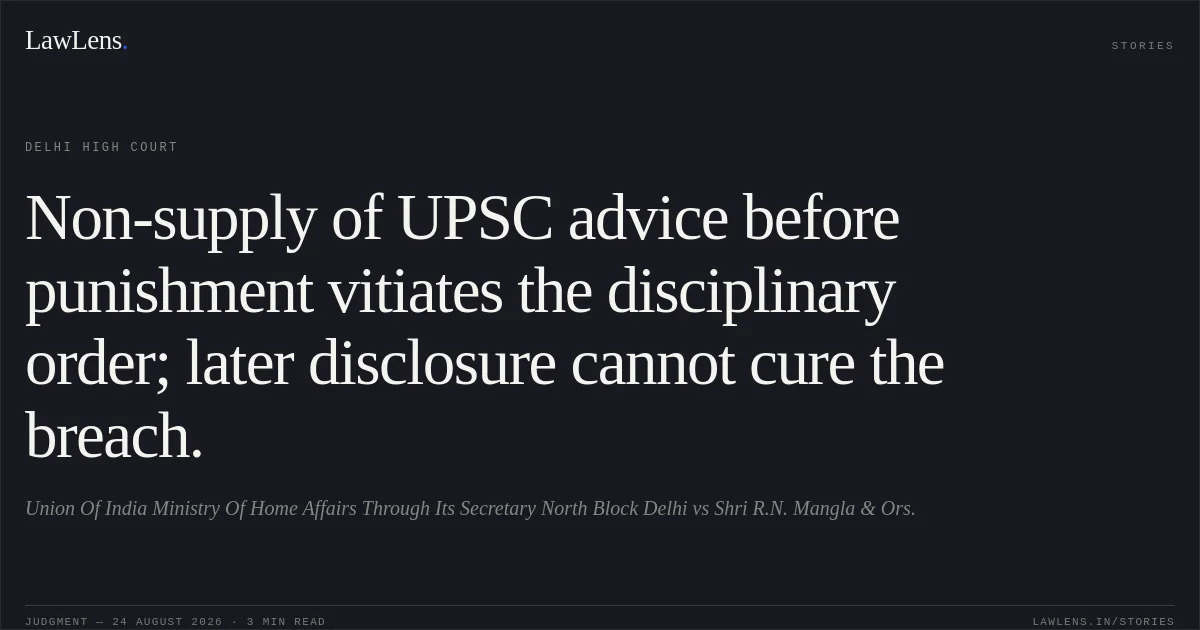
The Court held that the UPSC advice had to be supplied to the respondent before the punishment order because the Disciplinary Authority relied upon it in imposing the penalty.
Supplying the advice with or after the punishment order, and providing later opportunities of representation, did not cure the violation of natural justice.
Source reference: para. 21The Tribunal’s decision was upheld, and the Union of India’s writ petition was dismissed.
Source reference: para. 21Original Court PDF
Union Of India Ministry Of Home Affairs Through Its Secretary North Block DelhivsShri R.N. Mangla & Ors.
Click to open original judgment
Original judgment, available to read, download and summarize on LawLens.in