01Facts
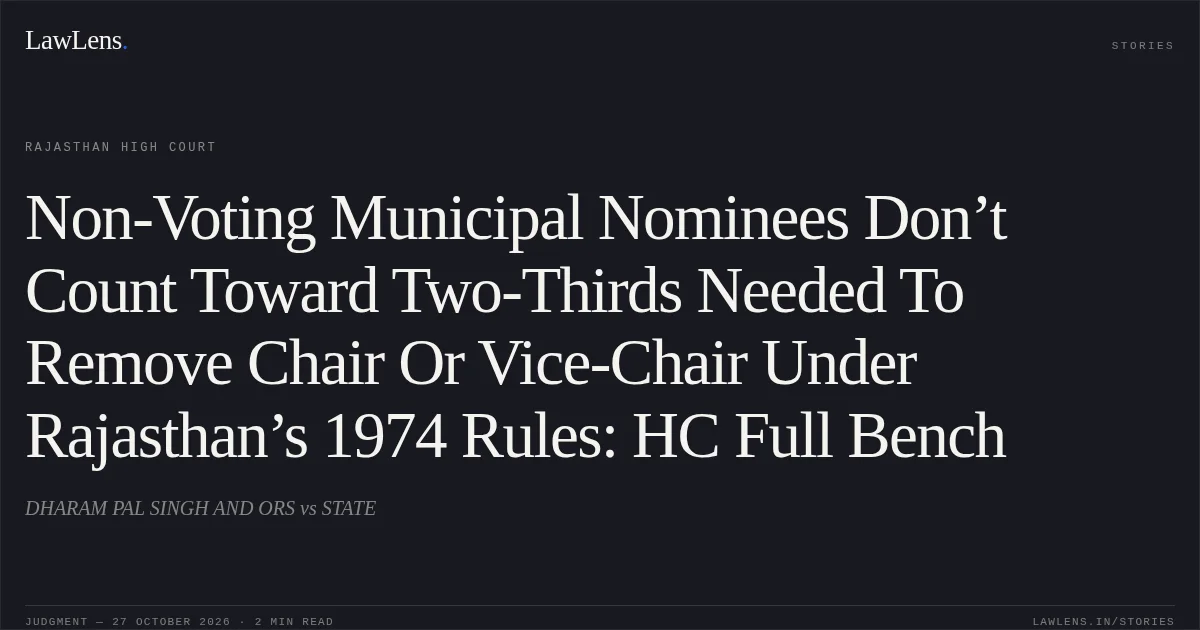
On 13 September 2001, a no-confidence motion against the Vice-Chairman of the Municipal Board, Mangrole, was carried.
pp. 4–5The State Government allowed the Vice-Chairman’s revision, holding that nominated members had to be included in calculating the two-thirds majority under the Rajasthan Municipalities (Motion of No Confidence against Chairman or Vice Chairman) Rules, 1974, and set aside the motion.
pp. 4–5The writ petitions challenging that order were dismissed by a Single Judge.
pp. 4–5In the resulting special appeals, a Division Bench referred to a Full Bench the question whether nominated members could be excluded when calculating the requisite majority.
pp. 4–502Issues
i.1. Whether nominated members, who have no right to vote, must be included in the “whole number” or “total number” of members for calculating the two-thirds majority required to carry a no-confidence motion under the 1974 Rules
pp. 4, 7–803Law Applied
Article 243R(2)(a)(i) of the Constitution permits the State Legislature to provide for the representation of persons with special knowledge or experience in municipal administration, but its proviso denies those persons the right to vote in municipal meetings.
p. 6Under the Rajasthan Municipalities Act, 1959 and Rule 3 of the 1974 Rules, the expression “whole number of members” must be read in the statutory and constitutional context of the motion; it refers to members entitled to vote on it.
pp. 8–11In Ramesh Mehta v. Sanwal Chand Singhvi, (2004) 5 SCC 409, the Supreme Court held that the requisite majority is calculated by reference to members having voting rights and that nominated members without such rights are excluded.
pp. 8–12Raees Ahmad v. State of U.P., AIR 2000 SC 583, was distinguished because it concerned a different statutory scheme in which the Chairman was directly elected.
pp. 10, 12–13Provisions in the judgment · 1 · Linked ones open on LawLens
RAJASTHAN MUNICIPALITIES ACT,2009 Section 6
04Reasoning
The Full Bench considered Ramesh Mehta controlling because it interpreted the same Rajasthan Act and 1974 Rules and held that the motion must be determined by members entitled to vote.
pp. 6, 8–13Since nominated members could not vote, including them in the denominator would count them toward a decision in which they could not participate.
pp. 6, 8–13The Court therefore rejected reliance on Raees Ahmad, which arose under a different statutory scheme.
pp. 10, 12–13It also noted that the later Rajasthan Municipalities Act, 2009 and the 2007 Rules expressly excluded nominated members from voting or from the category of eligible members, though the reference concerned the earlier statutory framework.
pp. 6, 8–1305Holding
The Full Bench answered the reference in the affirmative: nominated members without voting rights are excluded from the “whole number” or “total number” used to calculate the requisite majority for a no-confidence motion under the Rajasthan scheme.
pp. 13–14It held that Prem Raj Bohra was correctly decided on that point.
pp. 13–14Because the motion had been carried in 2001, remitting the appeals for decision would serve no useful purpose; the appeals were disposed of as infructuous, with parties bearing their own costs.
pp. 13–14Original Court PDF
DHARAM PAL SINGH AND ORSvsSTATE OF RAJASTHAN
Click to open original judgment
Original judgment, available to read, download and summarize on LawLens.in