01Facts
The appellant filed Indian Patent Application No. 89/CHE/2011, titled "Battery Mounting Structure for a Two Wheeler," with a provisional specification in 2011 and a complete specification in 2012.
¶ 3 · p. 2The First Examination Report objected on novelty and inventive step. The appellant amended the claims and responded, and cited documents D1 to D3 were raised at the hearing.
¶ 3 · p. 2By order dated 20.07.2021 under Section 15 of the Patents Act, the Controller held the invention novel but rejected it as obvious over the prior art, treating it as an improvement on known technology.
¶ 4 · p. 3The Controller relied chiefly on D2, which discloses mounting a battery on a mono-tube structure using two brackets instead of three, and treated this as a mere workshop improvement.
¶ 5–6 · pp. 3–4The Controller understood D2 to teach a hybrid-vehicle battery arrangement with batteries placed on the left and right sides alongside the drive motor to achieve a centreline zero around the storage box, thereby neutralising the centre of gravity in the lateral section.
¶ 8 · pp. 4–5The appellant contended that the placement of the battery on the vehicle's main frame is the core inventive step and that the bracket configuration is merely subsidiary.
¶ 5 · p. 3The respondent contended that placing the battery with two brackets on a mono-tube motorcycle structure is an obvious workshop improvement.
¶ 6 · pp. 3–402Issues
i.1. Whether the Controller was justified in holding that an invention found novel lacked an inventive step merely because it was an obvious workshop improvement over D2 (two brackets instead of three on a mono-tube structure).
¶ 4, 6, 8 · pp. 3–5ii.2. Whether the placement of the battery on the main frame of a mono-tube structure addresses a distinct technical problem and thereby constitutes an inventive step over D2.
¶ 8 · pp. 4–5 · ¶ 9 · p. 503Law Applied
The Court's jurisdiction arises under Section 117A of the Patents Act, read with the Tribunals Reforms (Rationalisation and Conditions of Service) Ordinance, 2021, against an order passed under Section 15.
p. 1An invention is not patentable merely because it is novel; it must involve an inventive step, assessed by whether it is obvious to a person skilled in the art and whether it solves a technical problem beyond the prior art.
¶ 8 · pp. 4–5 · ¶ 9 · p. 5The respondent's reasoning is reviewable where it fails to identify the technical contribution of the claimed invention.
¶ 8–9 · pp. 4–5Provisions in the judgment · 1 · Linked ones open on LawLens
Patents Act, 1970 Section 15
04Reasoning
The Court accepted that novelty was not disputed, since the respondent had found the invention novel.
¶ 8 · p. 4The Court also accepted the respondent's reading of D2 as a teaching of lateral battery placement for centre-of-gravity control in a hybrid vehicle.
¶ 8 · pp. 4–5However, the Court found that the respondent failed to appreciate the technical problem addressed by the claimed invention: mounting a battery on a mono-tube structure. The claimed invention houses the battery on the main frame to achieve the centre of gravity, whereas D2 achieves it by placing the battery and drive motor on either side of the vehicle.
¶ 8 · p. 5On this distinction, the Court held that the respondent had failed to notice that the novelty led to an inventive step.
¶ 9 · p. 5The reasoning is brief and does not separately analyse D1 or D3, nor does it expressly address the obviousness of the bracket configuration beyond noting the appellant's position that it is subsidiary.
¶ 5 · p. 3 · ¶ 8 · p. 505Holding
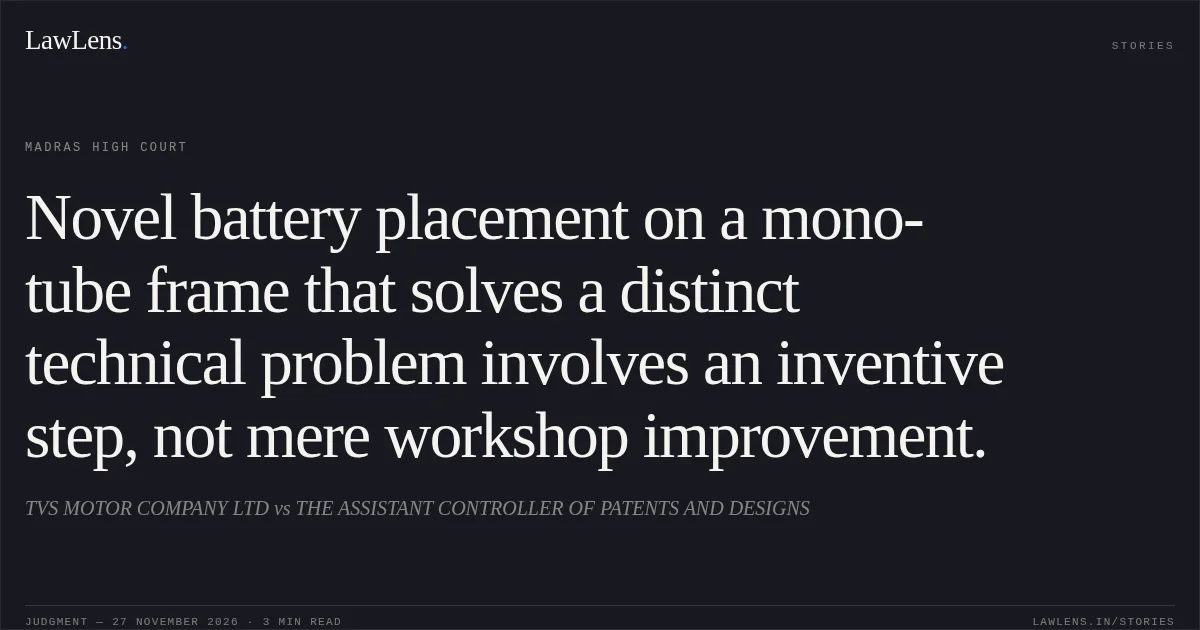
The Controller erred in treating the invention as an obvious workshop improvement over D2, because the claimed placement of the battery on the main frame of a mono-tube structure solves a technical problem distinct from D2's lateral-placement approach.
¶ 8–9 · pp. 4–5The impugned order dated 20.07.2021 was set aside, and the appeal was allowed with a direction to the respondent to grant the patent as claimed. No order as to costs was made.
¶ 10 · p. 5Original Court PDF
TVS MOTOR COMPANY LTDvsTHE ASSISTANT CONTROLLER OF PATENTS AND DESIGNS
Click to open original judgment
Original judgment, available to read, download and summarize on LawLens.in