Facts
The petitioners, relatives of the informant’s husband, invoked the High Court’s inherent jurisdiction under Section 528 of the Bharatiya Nagarik Suraksha Sanhita, 2023, seeking quashing of the FIR, charge-sheet, cognizance order, and order framing charges in Lohardaga (Mahila) P.S. Case No. 14 of 2024, corresponding to G.R. Case No. 310 of 2025.
Source reference: para. 2The informant alleged that after her marriage, her husband repeatedly returned home intoxicated, quarrelled with and assaulted her, demanded dowry, and periodically left her at her parental home.
Source reference: para. 3She further alleged that when she complained to Petitioner Nos. 3 and 5, they advised her to “mend herself,” and that the petitioners also subjected her to cruelty.
Source reference: para. 3Following investigation, police submitted Charge-sheet No. 24 of 2025 for offences under Sections 498A, 323, 504, 506/34 IPC and Sections 3 and 4 of the Dowry Prohibition Act; the Chief Judicial Magistrate took cognizance on 21 August 2025 and framed charges on 1 July 2026.
Source reference: para. 4The FIR was lodged after the informant received a notice from her husband seeking dissolution of the marriage.
Source reference: paras. 9, 12Issues
Whether the allegations in the FIR, charge-sheet, and accompanying materials disclosed the ingredients of offences under Sections 498A, 323, 504, 506/34 IPC and Section 4 of the Dowry Prohibition Act against the petitioners?
Source reference: paras. 12–18Whether continuation of the criminal proceeding against the petitioners would amount to an abuse of the process of law warranting exercise of the High Court’s inherent jurisdiction under Section 528 BNSS?
Source reference: paras. 19–21Law Applied
The Court applied Section 528 BNSS, which preserves the High Court’s inherent power to prevent abuse of process and secure the ends of justice.
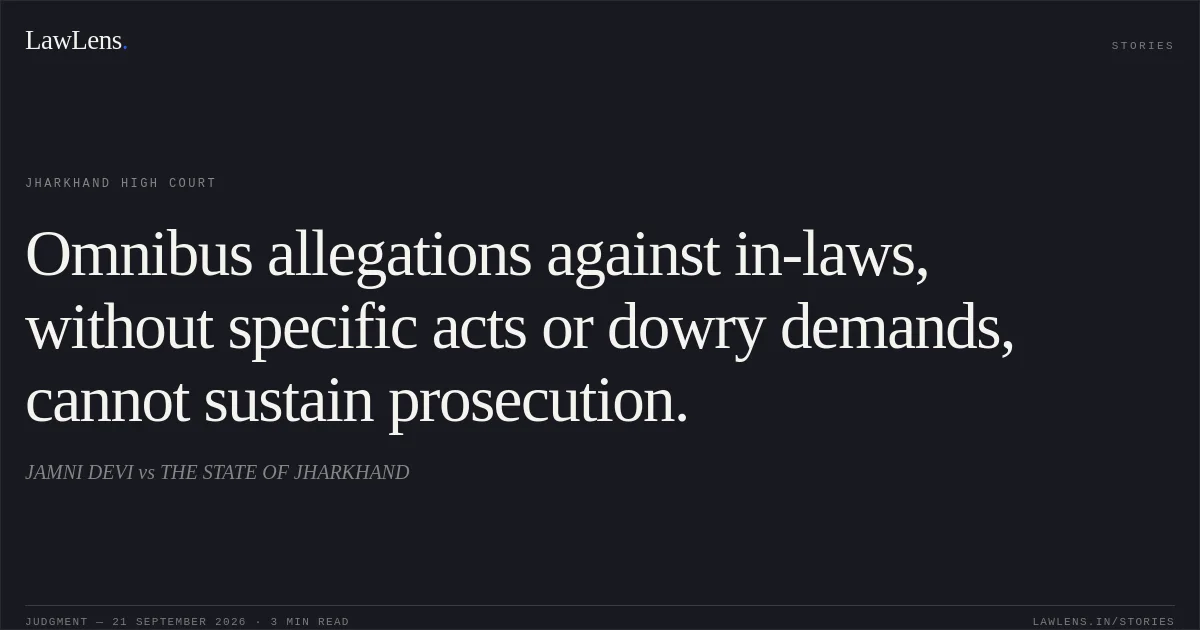
Source reference: para. 2For Section 498A IPC, the Court relied on Digambar v. State of Maharashtra, Dara Lakshmi Narayana v. State of Telangana, Jayedeepsinh Pravinsinh Chavda v. State of Gujarat, and Sanjay D. Jain v. State of Maharashtra, holding that omnibus allegations and mere naming of the husband’s relatives are insufficient; cruelty must involve conduct intended to cause grave injury, drive the woman to suicide, or coerce her or her relatives to meet an unlawful demand.
Source reference: paras. 6–8The Court further held that Section 323 IPC requires a specific allegation of voluntarily causing hurt; Section 504 IPC requires intentional insult, intent to provoke a breach of peace or commission of an offence, and knowledge of the likely consequence.
Source reference: paras. 14–16Section 506 IPC requires a specific threat intended to cause alarm or compel the victim to act or refrain from acting unlawfully.
Source reference: paras. 17–18A prosecution under Section 4 of the Dowry Prohibition Act requires a specific allegation concerning the dowry demanded.
Source reference: paras. 12–13Reasoning
The Court found that the principal allegations concerned the husband’s conduct—his intoxication, assaults, quarrels, and alleged matrimonial discord—rather than any specific criminal act by the petitioners.
Source reference: para. 12The only attributed conduct against Petitioner Nos. 3 and 5 was that they advised the informant to “mend herself” after she complained about her husband; the remaining allegations merely included the petitioners in a general assertion that they had treated her cruelly.
Source reference: para. 12The FIR did not identify the nature or amount of dowry demanded, nor did it allege that the petitioners’ conduct was intended to cause grave injury, drive the informant to suicide, or coerce her to satisfy an unlawful demand.
Source reference: paras. 12–13There was also no specific allegation that any petitioner caused hurt, intentionally insulted the informant with the requisite intent, or threatened her so as to cause alarm.
Source reference: paras. 14–18In addition, the timing of the FIR, after the husband initiated dissolution proceedings, reinforced the Court’s concern that the relatives had been implicated through generalized allegations.
Source reference: paras. 11–12Even accepting the prosecution case in its entirety, the statutory ingredients of the charged offences were therefore absent, making continuation of the proceeding an abuse of process.
Source reference: para. 19Holding
The High Court held that the allegations, even if taken at face value, did not constitute offences under Sections 498A, 323, 504, or 506/34 IPC or Section 4 of the Dowry Prohibition Act against the petitioners.
Exercising its inherent jurisdiction under Section 528 BNSS, the Court quashed, qua the petitioners only, the FIR in Lohardaga (Mahila) P.S. Case No. 14 of 2024, Charge-sheet No. 24 of 2025, the cognizance order dated 21 August 2025, and the charge-framing order dated 1 July 2026.
Source reference: paras. 19–21The Criminal Miscellaneous Petition was accordingly allowed to that extent.
Source reference: para. 21Acts & Sections Cited
7 provisions across 3 statutes referred to in this judgment. Each provision opens on LawLens.
Bharatiya Nagarik Suraksha Sanhita, 20231
Indian Penal Code, 18604
Original Court PDF
JAMNI DEVIvsTHE STATE OF JHARKHAND
Click to open original judgment
Original judgment, available to read, download and summarize on LawLens.in