Facts
The petitioners, accused Nos. 2 and 3 and parents of accused No. 1, challenged the Sessions Court’s refusal to discharge them from charges under Section 498A read with Section 34 IPC and Sections 3 and 4 of the Dowry Prohibition Act, 1961.
Source reference: paras. 1, 7, 16; pp. 2, 6–8The deceased, who had married accused No. 1 about six and a half years earlier, died by hanging in the couple’s rented house at Karatagi.
Source reference: paras. 2–6; pp. 2–4The complaint initially alleged that accused No. 1 might have murdered her, while the charge-sheet alleged suicide following harassment and dowry-related demands.
Source reference: paras. 2–6; pp. 2–4The petitioners contended that they lived separately in Telangana, far from the couple, and that the allegations against them were general and unsupported by specific acts.
Source reference: paras. 8–11, 17–18; pp. 5–6, 8–11The Sessions Court rejected their application under Section 227 Cr.P.C., prompting this revision.
Source reference: paras. 8–11, 17–18; pp. 5–6, 8–11Issues
Whether the charge-sheet material disclosed sufficient grounds to proceed against the petitioners, or whether they were entitled to discharge under Section 227 Cr.P.C.
Source reference: paras. 23, 38–43; pp. 12, 19–22Whether the Sessions Court’s refusal to discharge the petitioners suffered from an illegality, perversity, or infirmity warranting revisional interference
Source reference: para. 23; p. 12Law Applied
Under Section 227 Cr.P.C., the court considers the prosecution record to determine whether there is sufficient ground to proceed against an accused.
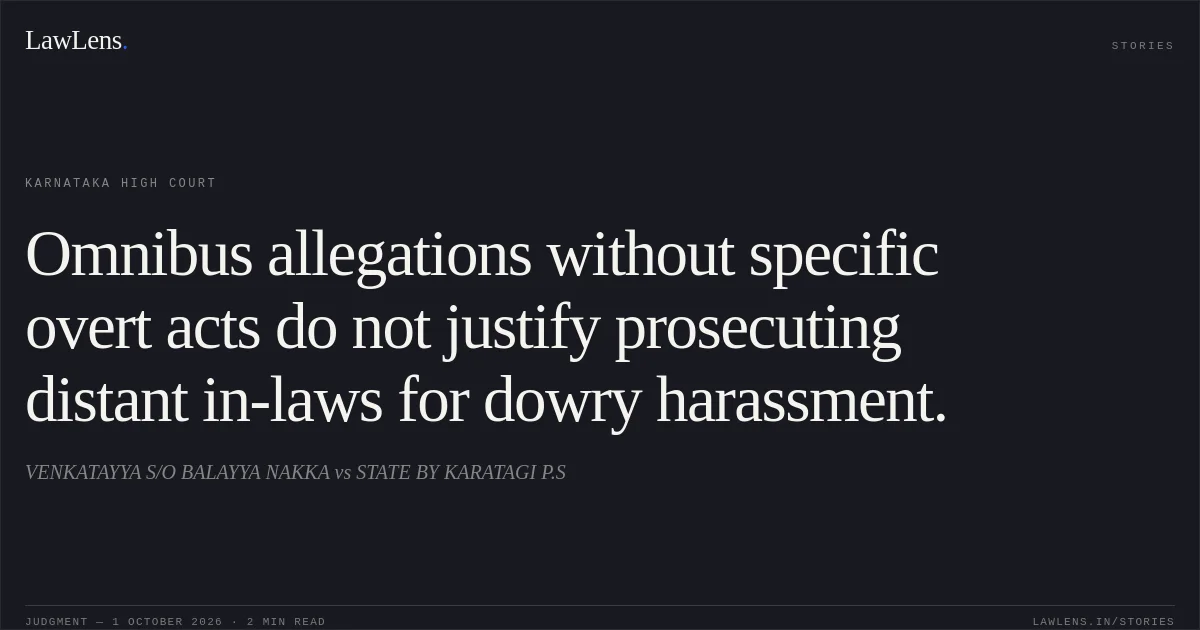
Source reference: paras. 26–29; pp. 13–16The court relied on Preeti Gupta v. State of Jharkhand, Geeta Mehrotra v. State of Uttar Pradesh, Kahkashan Kausar v. State of Bihar, and Mainoddin v. State of Karnataka for the principles that allegations against a spouse’s relatives should be scrutinised with care, and that general or omnibus allegations, without specific instances or overt acts—particularly against relatives living separately—may not justify proceeding against them.
Source reference: paras. 26–29; pp. 13–16The alleged offences were Section 498A read with Section 34 IPC and Sections 3 and 4 of the Dowry Prohibition Act.
Source reference: para. 1; p. 2Reasoning
The Court found that the petitioners did not reside with accused No. 1 and the deceased, but lived far away; the couple had lived together for about three years before the alleged harassment began.
Source reference: paras. 39, 42; pp. 20–21The demand for a plot immediately before the incident was specifically attributed to accused No. 1, while the material against the petitioners consisted of general allegations of harassment and dowry demands, without sufficient specific acts connecting them to the alleged offences.
Source reference: paras. 40–43; pp. 20–22Applying the cited principles on specific allegations against relatives, the Court concluded that the charge-sheet material did not disclose sufficient grounds to proceed against the petitioners.
Source reference: para. 43; p. 22Holding
The Court answered the issue in the petitioners’ favour and allowed the revision.
It set aside the Sessions Court’s order insofar as it concerned accused Nos. 2 and 3, allowed their Section 227 Cr.P.C. application, and discharged them from the charges under Section 498A read with Section 34 IPC and Sections 3 and 4 of the Dowry Prohibition Act.
Source reference: para. 44; pp. 22–23The Court clarified that its observations would not prejudice the prosecution against the other accused.
Source reference: para. 44; pp. 22–23Acts & Sections Cited
9 provisions across 3 statutes referred to in this judgment. Each provision opens on LawLens.
Code of Criminal Procedure, 19734
Indian Penal Code, 18602
Original Court PDF
VENKATAYYA S/O BALAYYA NAKKAvsSTATE BY KARATAGI P.S
Click to open original judgment
Original judgment, available to read, download and summarize on LawLens.in