Facts
The petitioners sought to quash proceedings in C.C. No. 30805/2025, arising from Crime No. 23/2023 registered by Bagalagunte Police.
Source reference: p. 4The police filed a ‘B’ report; respondent No. 2 filed a protest petition and an affidavit in the form of an examination-in-chief.
Source reference: pp. 4–5The Magistrate rejected the ‘B’ report, took cognizance and issued summons on the basis of that affidavit.
Source reference: pp. 4–5The petitioners challenged the procedure, including the absence of a speaking order.
Source reference: p. 5It was also noted that the police complaint named only accused Nos. 1 to 3, whereas the private complaint named seven accused.
Source reference: p. 5Issues
1. Whether the Magistrate’s rejection of the ‘B’ report and issuance of process on the basis of an affidavit, without recording the complainant’s sworn statement, constituted an erroneous procedure
Source reference: pp. 4–62. Whether that procedural error warranted quashing the entire proceedings, and what steps the Trial Court was required to take thereafter
Source reference: pp. 5–73. Whether the Trial Court should consider the basis for including accused Nos. 4 to 7, who were not named in the police complaint
Source reference: p. 7Law Applied
The petition invoked the High Court’s inherent jurisdiction under Section 482 of the Code of Criminal Procedure, 1973 (also identified in the petition as Section 528 of the Bharatiya Nagarik Suraksha Sanhita) to seek quashing of the proceedings.
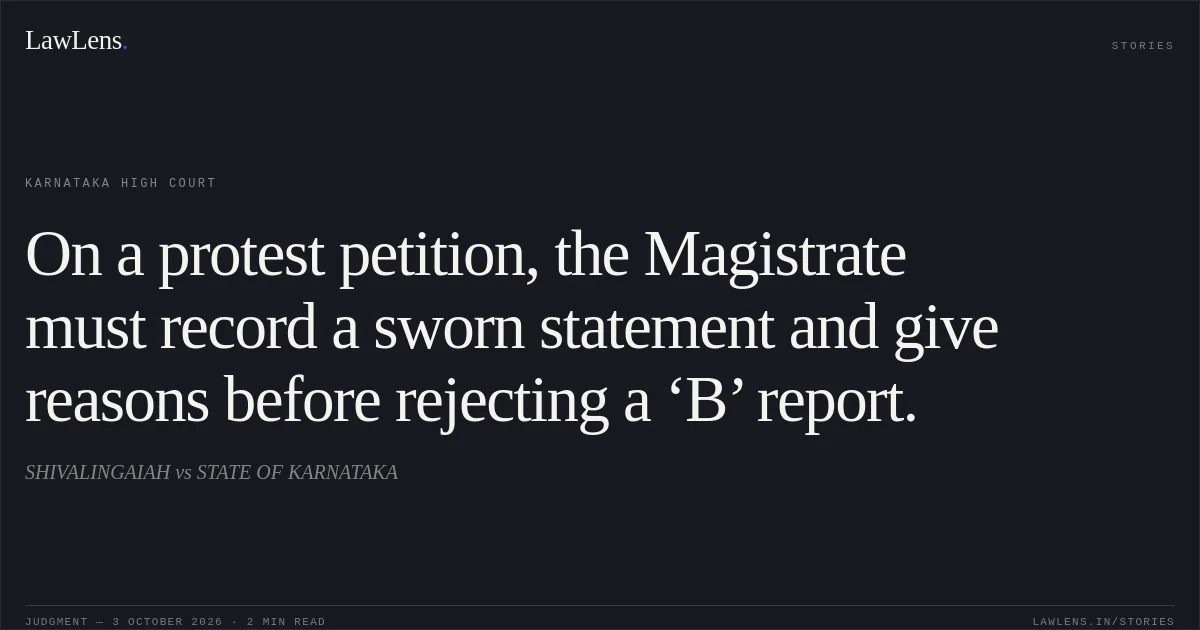
Source reference: p. 3The Court held that, after a protest petition against a ‘B’ report, the complainant should be permitted to record a sworn statement and the Trial Court must pass an order giving reasons for accepting or rejecting the ‘B’ report and, where applicable, for issuing process.
Source reference: pp. 6–7The judgment cites no precedent or further statutory provision for this procedural direction.
Source reference: pp. 6–7Reasoning
The Court found that the Magistrate had rejected the ‘B’ report and issued summons based on the complainant’s affidavit, rather than first recording the complainant’s sworn statement.
Source reference: p. 6It considered that procedure erroneous, but concluded that the defect did not justify finally terminating the complaint.
Source reference: p. 6The appropriate course was to quash the existing proceedings while allowing the complainant to give a sworn statement and requiring the Trial Court to reconsider the matter through a reasoned order.
Source reference: pp. 6–7The Trial Court was also directed to consider the justification for impleading accused Nos. 4 to 7.
Source reference: pp. 6–7Holding
The petition was allowed and the proceedings in C.C. No. 30805/2025 were quashed.
The complainant was permitted to record a sworn statement before the Trial Court.
Source reference: p. 7The Court must then consider that statement and any other material, give reasons if it accepts or rejects the ‘B’ report and if it issues process, and address whether there are justifiable grounds to implead accused Nos. 4 to 7.
Source reference: p. 7Acts & Sections Cited
9 provisions across 3 statutes referred to in this judgment. Each provision opens on LawLens.
Code of Criminal Procedure, 19731
Bharatiya Nagarik Suraksha Sanhita, 20231
Indian Penal Code, 18607
Original Court PDF
SHIVALINGAIAHvsSTATE OF KARNATAKA
Click to open original judgment
Original judgment, available to read, download and summarize on LawLens.in