01Facts
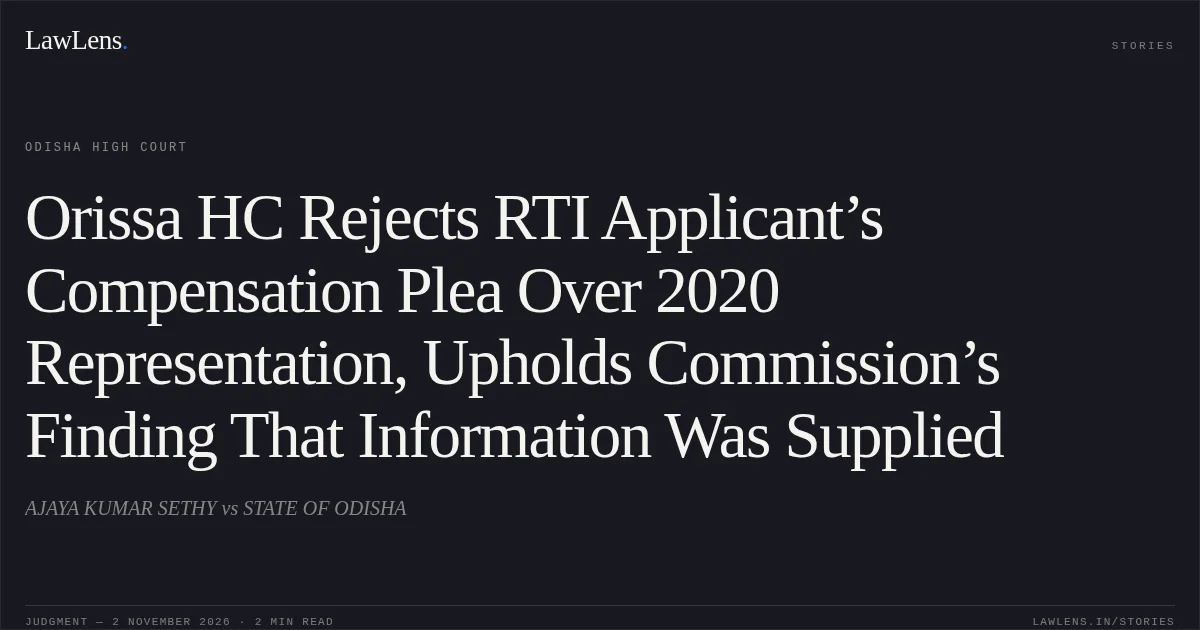
The petitioner sought information concerning action taken on his representation dated 20 February 2020.
pp. 3–5In a second appeal, the Odisha Information Commission recorded that the RTI application had been transferred to the Home Department and directed that the petitioner could file a first appeal before that Department; it also noted delays in the appeal process and transfer of the application.
pp. 3–5The petitioner’s writ petition sought the information, punishment, penalty and compensation for an allegedly false contempt compliance report, and quashing of that report.
p. 2The contempt proceeding had been disposed of.
p. 2, 5The petitioner also challenged the Information Commission’s decision and relied on its observations concerning the handling of his first appeal.
pp. 2, 5–602Issues
i.Whether the Court should interfere with the Information Commission’s decision concerning the petitioner’s request for information and action on his representation.
pp. 3–6ii.Whether the petitioner could seek punishment, penalty, compensation, or quashing of the compliance report after the contempt proceeding had been disposed of.
p. 2, 5iii.Whether the petitioner was entitled to compensation or costs based on the Commission’s observations about the delay in handling his appeal.
pp. 5–603Law Applied
Article 226 and 227 of the Constitution govern the High Court’s writ and supervisory jurisdiction; the Court stated that it could not re-examine the factual aspect of information supplied by the respondent PIO in exercising that jurisdiction.
p. 5Section 6(3) of the Right to Information Act requires transfer of an RTI application within five days; the Commission noted delay in the transfer and warned the concerned PIO.
p. 5Relying on Dollar Company v. Collector, Madras, AIR 1975 SC 1670, the Court applied the principle that an appellate court interferes not merely because a decision may not be right, but when it is shown to be wrong.
p. 6Provisions in the judgment · 1 · Linked ones open on LawLens
Right to Information Act, 2005 Section 6
04Reasoning
The Commission had considered the parties’ submissions and the record, including the PIO’s account of the application’s transfer and the steps taken on the first appeal; it also addressed the delay by permitting the petitioner to appeal to the Home Department and directing that delay to be condoned.
pp. 3–5The High Court declined to revisit the underlying factual finding concerning supply of information and found no basis to hold the Commission’s decision incorrect under the principle stated in Dollar Company.
pp. 5–6It further held that the requested reliefs concerning the contempt compliance report and punishment or compensation were not maintainable after the contempt proceeding had been disposed of.
p. 3, 505Holding
The Court found no ground to interfere with the Information Commission’s decision and held that the petitioner was not entitled to the reliefs sought.
p. 6The writ petition was disposed of without granting relief.
p. 6Original Court PDF
AJAYA KUMAR SETHYvsSTATE OF ODISHA
Click to open original judgment
Original judgment, available to read, download and summarize on LawLens.in