01Facts
The dispute concerned Schedule-B property, including Consolidation Plot No. 896, over which the plaintiffs and petitioner No. 1 claimed through competing chains of title.
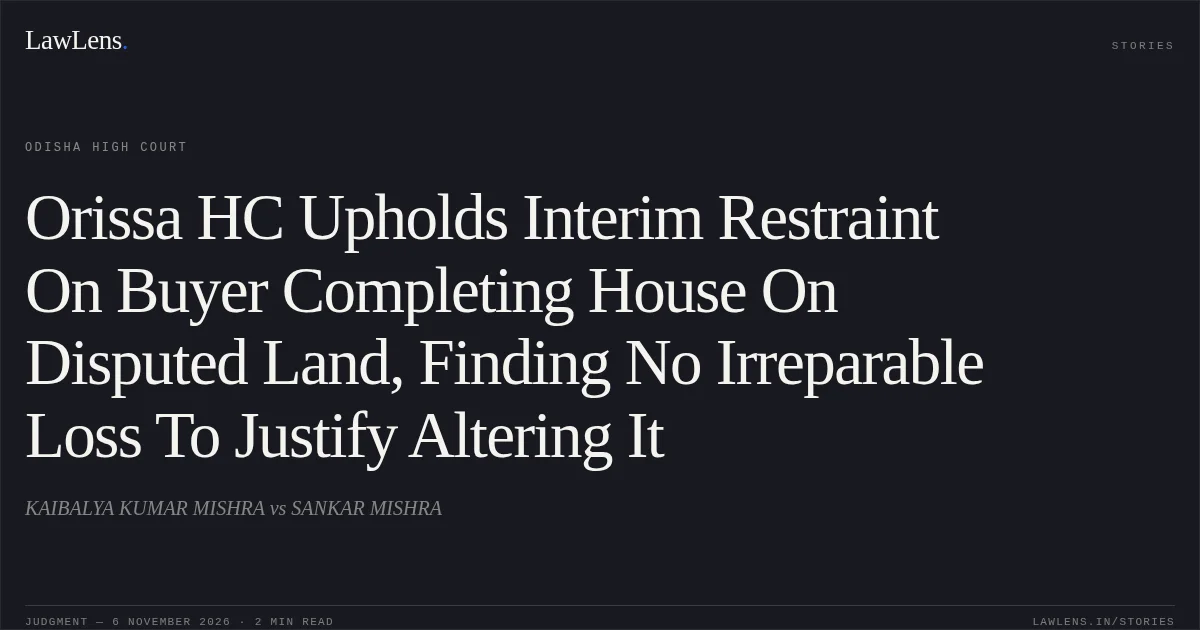
¶ 1–2Petitioner No. 1 purchased the property by registered sale deed dated 19.04.2024 and began construction; the plaintiffs’ civil suit sought a permanent injunction, with an interlocutory application to restrain construction.
¶ 1–2The trial court found a prima facie case for the plaintiffs but permitted petitioner No. 1 to complete the existing construction to roof level, subject to conditions and an undertaking. On appeal, the Additional District Judge set aside that permission and restrained construction changing the property’s nature and character pending the suit.
¶ 2(iv), 5(v)Petitioner No. 1 challenged the appellate order under Article 227.
¶ 702Issues
i.Whether the appellate court was justified in setting aside the trial court’s discretionary permission to complete construction on disputed property.
¶ 9–10, 14–19ii.Whether the appellate judgment disclosed jurisdictional error or manifest perversity warranting interference under Article 227.
¶ 7–10, 27–2903Law Applied
Article 227 confers supervisory, not appellate, jurisdiction; interference is warranted for jurisdictional error, disregard of fundamental legal principles, or perverse findings, not merely to reweigh evidence or substitute conclusions (Garment Craft v. Prakash Chand Goel).
¶ 8, 10Temporary injunction requires a prima facie case, irreparable injury, and balance of convenience; a prima facie case is not proof of title (Dalpat Kumar v. Prahlad Singh).
¶ 11Appellate interference with an injunction order is ordinarily limited to cases where the trial court exercised discretion arbitrarily, capriciously or perversely, or ignored settled principles (Wander Ltd. v. Antox India (P) Ltd.; Skyline Education Institute v. S.L. Vaswani).
¶ 9A court should generally preserve disputed property and not permit a change in its nature absent a demonstrated case of irreparable loss; an undertaking to restore the property does not necessarily justify construction (Maharwal Khewaji Trust v. Baldev Dass).
¶ 13, 16Mutation entries do not confer or extinguish title (Balwant Singh v. Daulat Singh; Suraj Bhan v. Financial Commissioner).
¶ 21–22Provisions in the judgment · 3
Orissa Consolidation of Holdings and Prevention of Fragmentation of Land Act, 1972 Section 51Section 36Section 35
04Reasoning
The trial court had found a prima facie case for the plaintiffs and recognised that the plot on which construction was occurring was disputed.
¶ 12, 27Its permission to build to roof level rested principally on the hardship of leaving the structure unfinished, but the record did not establish that completion was necessary to prevent irreparable injury, such as deprivation of an existing residential occupation.
¶ 15Further construction would alter the physical condition of the disputed property, and the petitioner’s undertaking did not remove the risk of further disputes or multiplicity of proceedings.
¶ 16The appellate court therefore applied a permissible preservation-based approach under Maharwal Khewaji Trust; its order did not determine title, and the competing claims, Section 51 objection and effect of the consolidation proceedings remained open for adjudication.
¶ 19–25, 28–2905Holding
The High Court held that the appellate court had not exceeded its jurisdiction and that no ground for supervisory interference under Article 227 was established.
¶ 27–29The CMP was dismissed, the appellate order restraining further construction was left undisturbed, and any earlier interim order was vacated.
¶ 30–31Original Court PDF
KAIBALYA KUMAR MISHRAvsSANKAR MISHRA
Click to open original judgment
Original judgment, available to read, download and summarize on LawLens.in