Facts
The five applicants were engaged as casual or contingent employees by the Department of Revenue between 1991 and 2000.
Source reference: p.3They sought conferment of Temporary Status and regularization based on the 1993 DoPT Scheme and subsequent judicial interventions.
Source reference: p.3After initial litigations in 2005 and 2006, they claimed parity with the "Rita Mary case" (WP No. 16733/2009), wherein the Madras High Court directed the respondents to frame a regularization scheme for casual laborers.
Source reference: p.4, 10Consequently, the respondents framed the “Part-Time Casual Labourers (Regularization) Scheme of CBIC, 2020”.
Source reference: p.4The applicants’ representations for inclusion in this scheme were rejected via an impugned order dated 29.07.2022.
Source reference: p.5The respondents contended that the applicants were transitioned to private contractors (outsourced) in 2005, thereby severing the employer-employee relationship, and that they failed to meet the scheme's eligibility criteria regarding continuous service and educational qualifications.
Source reference: p.7-8, 13Issues
1. Whether the applicants are entitled to the benefit of regularization under the "Part-Time Casual Labourers Regularization Scheme of CBIC, 2020" framed pursuant to the Rita Mary judgment.
Source reference: p.9, para 112. Whether the applicants met the eligibility criteria of 10 years of continuous service as of 19.07.2011 and the requisite educational qualifications.
Source reference: p.7, 13Law Applied
The court applied the "Part-Time Casual Labourers Regularization Scheme of CBIC, 2020," which stipulates three mandatory criteria: 10 years of continuous service as of 19.07.2011, possession of educational qualifications as per Recruitment Rules, and fulfillment of age limits.
Source reference: p.7The Tribunal relied on the precedent set in Union of India v. Limo Devi (2021) 10 SCC 315, which restricts the High Court's power to direct the government to frame regularization schemes.
Source reference: p.9It further adhered to the principles in State of Karnataka v. Umadevi, as reaffirmed in Vibuti Shankar Pandey v. State of Madhya Pradesh (2023), holding that daily wage employees do not have an automatic right to regularization outside of prescribed rules and transparent recruitment processes.
Source reference: p.9, 13Reasoning
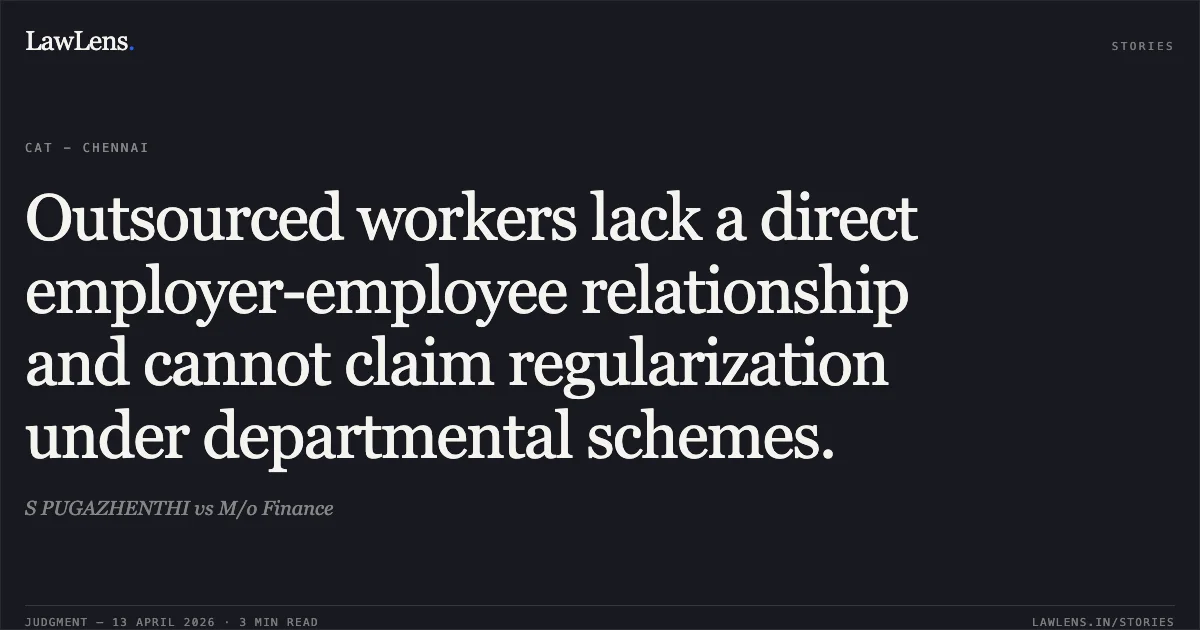
The Tribunal found that the applicants failed to satisfy the "continuous service" requirement because their direct engagement as casual laborers ceased in 2005, after which they were employed through private contractors.
Source reference: p.12, 13This shift created a third-party contractual relationship rather than a direct employer-employee bond with the respondents.
Source reference: p.13Specifically, Applicants 1, 2, and 3 only served directly from 2000 to 2005, while Applicants 4 and 5 lacked the minimum educational qualification (10th standard pass) required for Group ‘C’ posts.
Source reference: p.7-8Regarding the Rita Mary precedent, the Tribunal clarified that the judgment was in personam (applicable only to the parties involved) and not in rem, and the 2020 Scheme was specifically tailored for those who met strict eligibility criteria.
Source reference: p.12Furthermore, the Tribunal noted that the 1993 DoPT Scheme was a one-time measure and was not operational when the applicants joined.
Source reference: p.11-12Significantly, the Tribunal discovered that an appointment letter dated 21.08.2025 relied upon by the applicants was a "fabricated document".
Source reference: p.12-13Holding
The Tribunal dismissed the Original Application, holding that the applicants were not entitled to regularization as they did not meet the criteria of the 2020 Scheme and were outsourced employees after 2005.
The Tribunal ruled that the applicants had no locus standi to claim benefits reserved for government servants.
Source reference: p.13Additionally, the Tribunal directed the respondents to initiate legal action against those responsible for the creation of the forged appointment letter.
Source reference: p.13No order as to costs was made.
Source reference: p.14Acts & Sections Cited
1 provisions across 1 statute referred to in this judgment. Each provision opens on LawLens.
Administrative Tribunals Act, 19851
Original Court PDF
S PUGAZHENTHIvsM/o Finance
Click to open original judgment
Original judgment, available to read, download and summarize on LawLens.in