01Facts
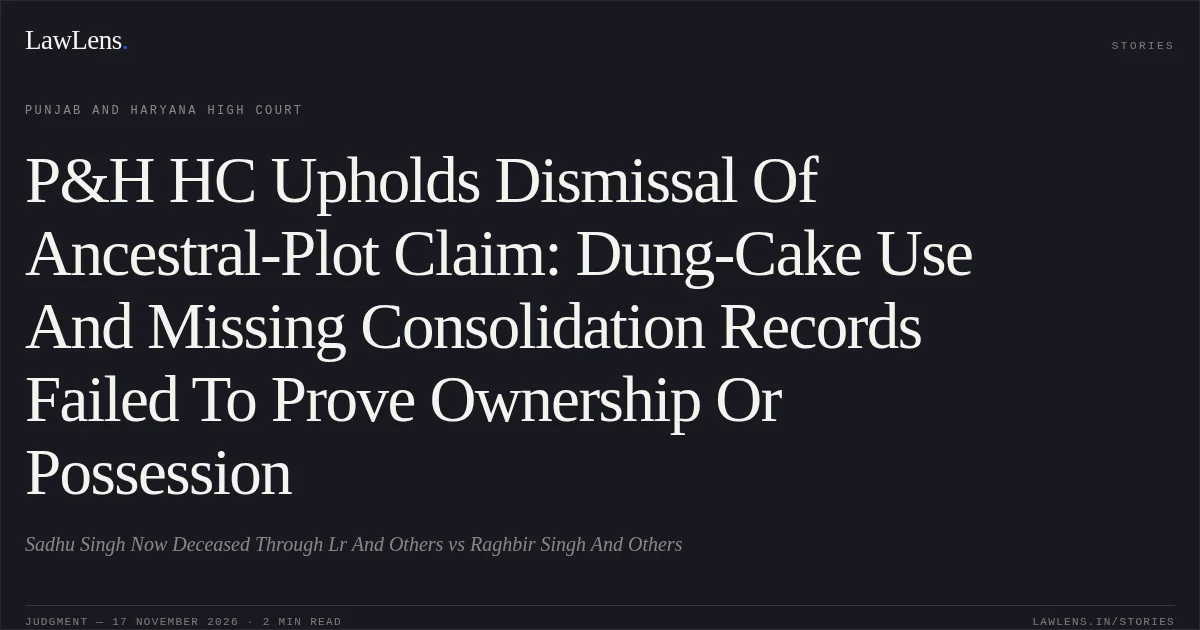
The plaintiffs sought a declaration of ownership and possession over a site said to form part of Khasra Nos. 798 and 423, correction of consolidation-era revenue entries, and permanent injunction.
They claimed ancestral possession and relied, among other things, on use of the site for dung cakes and refuse. The defendants disputed the plaintiffs’ title and possession.
The Trial Court dismissed the suit, finding that the plaintiffs had not produced key consolidation records linking the pre-consolidation holdings to the post-consolidation entries; the First Appellate Court affirmed, also finding that the plaintiffs had not established exclusive possession.
¶ 3–4, 7–8, 13–14The plaintiffs brought a regular second appeal.
¶ 902Issues
i.1. Whether the concurrent findings that the plaintiffs failed to prove their claimed ownership and entitlement to correction of the consolidation revenue entries were perverse or otherwise legally unsustainable
¶ 12–16ii.2. Whether the plaintiffs’ evidence of use of the site, including placing dung cakes and refuse, established possession sufficient to support their claim for relief
¶ 14, especially paras. 31–34iii.3. Whether the appeal raised a substantial question of law warranting interference under Section 100 CPC
¶ 16–1803Law Applied
Under Section 100 CPC, a High Court may interfere in a second appeal only where a substantial question of law arises; it cannot substitute its view for the First Appellate Court’s factual findings unless those findings are contrary to mandatory law or settled legal principles, based on inadmissible evidence, or reached without evidence.
The Court relied on Jaichand v. Sahnulal, 2025(2) Apex Court Judgments (SC) 336, which reiterates these limits and the requirement of a substantial question of law.
¶ 17For claims concerning consolidation entries, Kashmir Singh v. Joint Development Commissioner (IRD), Punjab, Chandigarh, 2006(7) RCR (Civil) 42, describes the consolidation record sequence and the documents used to connect pre- and post-consolidation holdings.
¶ 11The Court also accepted the lower courts’ application of the principle that mere use of land, such as placing refuse or dung cakes, does not by itself establish exclusive possession.
¶ 14, especially paras. 33–34Provisions in the judgment · 1 · Linked ones open on LawLens
Code of Civil Procedure, 1908 Section 100
04Reasoning
The plaintiffs did not establish the required link between the alleged pre-consolidation rights and the post-consolidation revenue record: the key documents, including the relevant Khatoni Ishtemal, Register Karwai, and Khatoni Paimaish, were not proved, and the lower courts drew an adverse inference from the withholding of the best evidence.
¶ 13, 14Their evidence of placing dung cakes and refuse likewise did not establish exclusive possession, particularly in light of admissions concerning existing houses and boundary walls on the site.
¶ 14The High Court found no demonstration that the concurrent findings were illegal, perverse, or based on misreading or misappreciation of material evidence.
¶ 16Reappreciating the facts was therefore not justified in second appeal.
¶ 17–1805Holding
The Court held that the appeal lacked merit and raised no substantial question of law.
¶ 18–20It dismissed the regular second appeal, leaving the concurrent judgments and decrees dismissing the suit undisturbed; any pending applications were also closed.
¶ 18–20Original Court PDF
Sadhu Singh Now Deceased Through Lr And OthersvsRaghbir Singh And Others
Click to open original judgment
Original judgment, available to read, download and summarize on LawLens.in