Facts
The petitioner had filed O.S. No. 4/2020 seeking an injunction concerning property bearing Panchayat Nos. 10-88 and 10-96, with open space, adjoining property owned by respondents 1–3.
Source reference: p.4He alleged that, during the suit, respondents 1–3 began construction without authority or permission and submitted a representation to the Panchayat Development Officer (respondent 4), seeking action to stop it.
Source reference: pp.4–5At the hearing, the petitioner stated that construction had stopped, but sought consideration of his representation.
Source reference: p.5He did not press the writ petition’s prayers other than prayer 2.
Source reference: p.4Issues
1. Whether respondent 4 should be directed to consider the petitioner’s representation concerning the construction on the adjacent property.
Source reference: pp.5–62. Whether the Court should itself direct that construction be stopped when the petitioner stated that construction had already ceased.
Source reference: p.5Law Applied
The petition invoked Articles 226 and 227 of the Constitution of India.
Source reference: p.2The Court applied the principle that mandamus may require a public authority to consider a representation and act in accordance with law, while leaving the factual and legal determination—including whether construction lacks a sanctioned plan or contravenes applicable law—to that authority.
Source reference: p.6Reasoning
Since construction had stopped, the Court did not grant a direction to stop it.
Source reference: p.5However, the representation raised a matter within respondent 4’s authority.
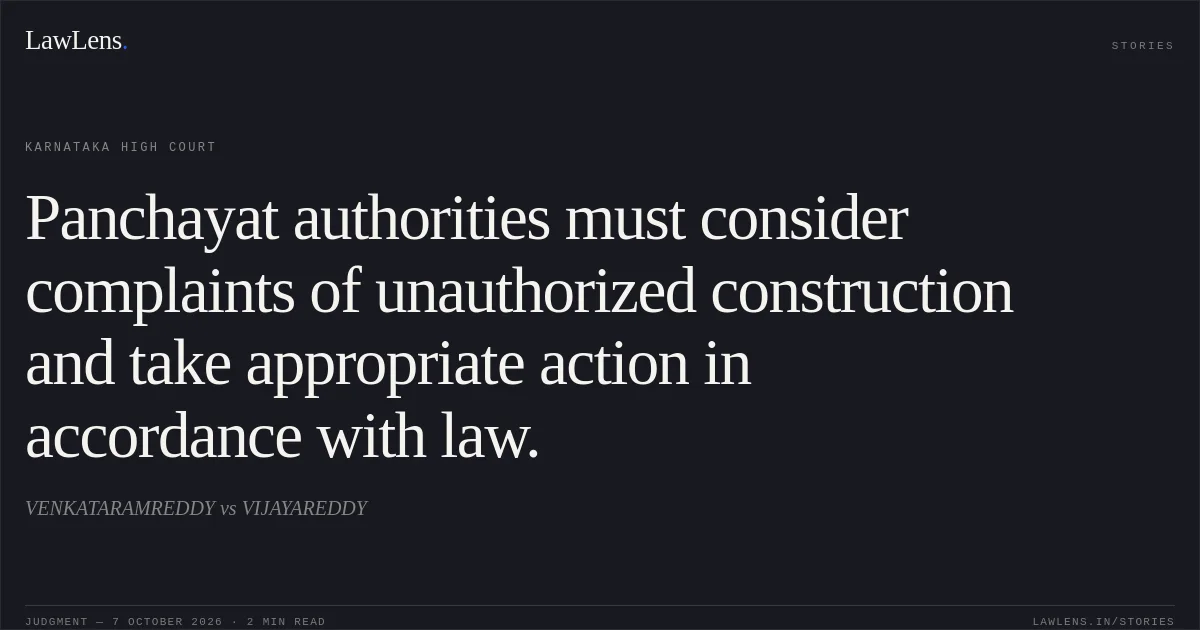
Source reference: pp.5–6The Court therefore directed respondent 4 to consider it and take appropriate action if the authority found that the construction lacked a sanctioned plan or was otherwise contrary to law.
Source reference: pp.5–6The Court did not decide the legality of the construction itself.
Source reference: pp.5–6Holding
The writ petition was allowed in part.
The Court issued mandamus directing respondent 4 to consider the representation and decide it within four months of receiving a copy of the order.
Source reference: p.6The order identifies the representation as dated 30 March 2023, although the petition and preceding discussion refer to it as dated 30 March 2025.
Source reference: pp.2, 5–6For the remaining prayers, the petitioner was given liberty to pursue remedies in accordance with law.
Source reference: p.7Original Court PDF
VENKATARAMREDDYvsVIJAYAREDDY
Click to open original judgment
Original judgment, available to read, download and summarize on LawLens.in