Facts
The Appellant and her husband obtained a vehicle loan of Rs. 2,90,000 from Respondent No. 1 on July 1, 2011, governed by a Loan-cum-Hypothecation Agreement
Source reference: para. 4, 8After defaulting on installments, Respondent No. 1 invoked the arbitration clause, leading to an arbitral award dated July 15, 2014, which directed the Appellant to pay Rs. 5,71,000 plus 18% interest per annum
Source reference: para. 2, 4The Appellant challenged the award under Section 34 of the Arbitration and Conciliation Act, 1996 (the "Act"), claiming she was unaware of the proceedings and that the interest rate was unreasonable
Source reference: para. 5, 6The Section 34 petition was dismissed on October 13, 2016, by the Trial Court
Source reference: para. 1The Appellant subsequently preferred this appeal under Section 37 of the Act
Source reference: para. 1Issues
1. Whether the arbitral proceedings suffered from procedural impropriety or a violation of the principles of natural justice
Source reference: para. 72. Whether the 18% per annum interest rate awarded by the arbitrator was unreasonable or perverse, justifying interference under the Act
Source reference: para. 7Law Applied
The court primarily applied Section 31(7) of the Arbitration and Conciliation Act, 1996, as it existed prior to the 2015 Amendment
Source reference: para. 11Section 31(7)(a) grants the arbitrator discretion to award reasonable interest for the pre-award period, while Section 31(7)(b) establishes a statutory default rate of 18% per annum for post-award interest unless the award directs otherwise
Source reference: para. 11The court further relied on the Supreme Court precedent in Larsen Air Conditioning and Refrigeration Company v. Union of India (2023), which held that for arbitrations governed by the unamended Act, the 18% statutory interest rate is the standard and should generally not be interfered with by Courts
Source reference: para. 12Reasoning
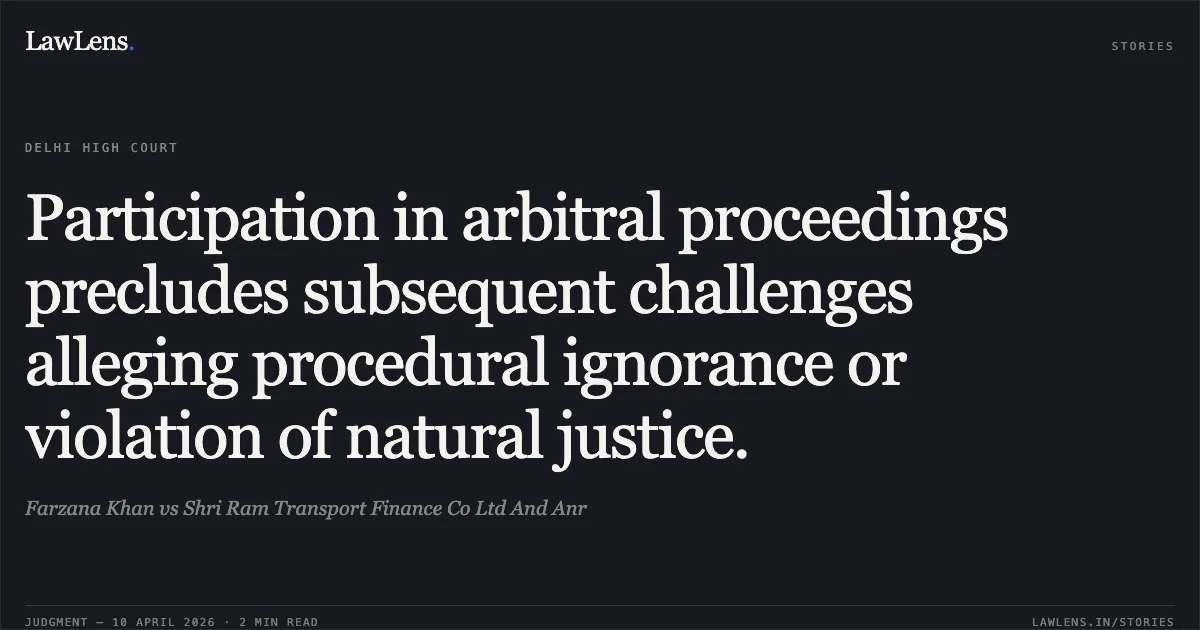
Regarding procedural impropriety, the court found the Appellant’s plea of ignorance to be "per se false" because the record indicated that notices were sent via registered post and that the Appellant’s son and daughter (accompanied by counsel) had appeared before the arbitrator
Source reference: para. 9Crucially, the Appellant had submitted a proposal during the arbitral hearings to settle the debt in 10 installments, which proved her active participation and prior knowledge of the dispute
Source reference: para. 10On the issue of interest, the court determined that the arbitrator’s award of 18% per annum was within the statutory framework of the unamended Section 31(7)(b)
Source reference: para. 12The court noted that the arbitrator exercised balanced discretion by awarding 18%, which was significantly lower than the 36% claimed by the Respondent
Source reference: para. 13Given the narrow scope of interference permitted under Section 37, the court found no perversity or unconscionability in the award
Source reference: para. 13, 14Holding
The court dismissed the appeal, holding that there was no violation of natural justice as the Appellant had participated in the proceedings through her representatives
It further held that the 18% interest rate was legally sound and aligned with the legislative intent to deter delays in payment
Source reference: para. 13The High Court found no grounds to interfere with the Trial Court’s order or the arbitral award and disposed of the appeal and pending applications
Source reference: para. 14, 15Acts & Sections Cited
3 provisions across 1 statute referred to in this judgment. Each provision opens on LawLens.
Arbitration and Conciliation Act, 19963
Original Court PDF
Farzana KhanvsShri Ram Transport Finance Co Ltd And Anr
Click to open original judgment
Original judgment, available to read, download and summarize on LawLens.in