Facts
The respondents served as Assistant Public Prosecutors (APPs) on a contractual basis with the Directorate of Prosecution, GNCTD
Source reference: para. 3They applied for permanent recruitment to 80 APP posts advertised by the UPSC in 2021, seeking age relaxation under an Office Memorandum (OM) dated 11 June 2019
Source reference: para. 3Following a prior High Court directive to grant relaxation as a one-time measure, the GNCTD rejected the respondents' candidature.
Source reference: para. 4The rejection was based on the interpretation that the respondents failed to complete 180 days of service within a "calendar year" (January to December), as required by the OM
Source reference: para. 8The Central Administrative Tribunal (CAT) set aside this rejection, holding that "particular year" should not be restricted to "calendar year"
Source reference: para. 9The GNCTD challenged the CAT’s common judgment dated 1 July 2025 before the Delhi High Court
Source reference: para. 1Issues
1. Whether the expression “in a particular year” used in Para 2(II) of the OM dated 11 June 2019 must be strictly interpreted as a "calendar year" for the purpose of granting age relaxation to contractual employees
Source reference: para. 72. Whether the GNCTD’s interpretation of the OM was arbitrary or inconsistent with its own administrative practices
Source reference: para. 9-10Law Applied
The court examined Para 2(II) of the OM dated 11 June 2019, which grants contractual employees a one-time age relaxation of up to five years, provided they worked at least 180 days in a "particular year"
Source reference: para. 6the established principle of administrative law that if an ambiguity exists in a service rule or administrative instruction, the benefit of such ambiguity must be extended to the employee rather than the department
Source reference: para. 19Reasoning
The Court upheld the Tribunal’s finding that the OM does not explicitly define "particular year" as a "calendar year"
Source reference: para. 10It noted that the GNCTD’s own administrative records—including APARs, salary disbursements, and income tax deductions—are maintained on a financial year basis
Source reference: para. 10Additionally, the court observed that since contractual engagements are not strictly aligned with the start of a calendar year, a rigid interpretation would be unreasonable and would deny employees benefits based on arbitrary timelines
Source reference: para. 10The Court highlighted that experience certificates are often issued based on academic or financial years, making the respondent’s contention for a broader interpretation of "year" (as any continuous 12-month period) more consistent with departmental practice
Source reference: para. 10Since the petitioner could not produce any instruction or precedent requiring "year" to mean "calendar year," the court found the GNCTD's interpretation to be strained and unnatural
Source reference: para. 14, 18Holding
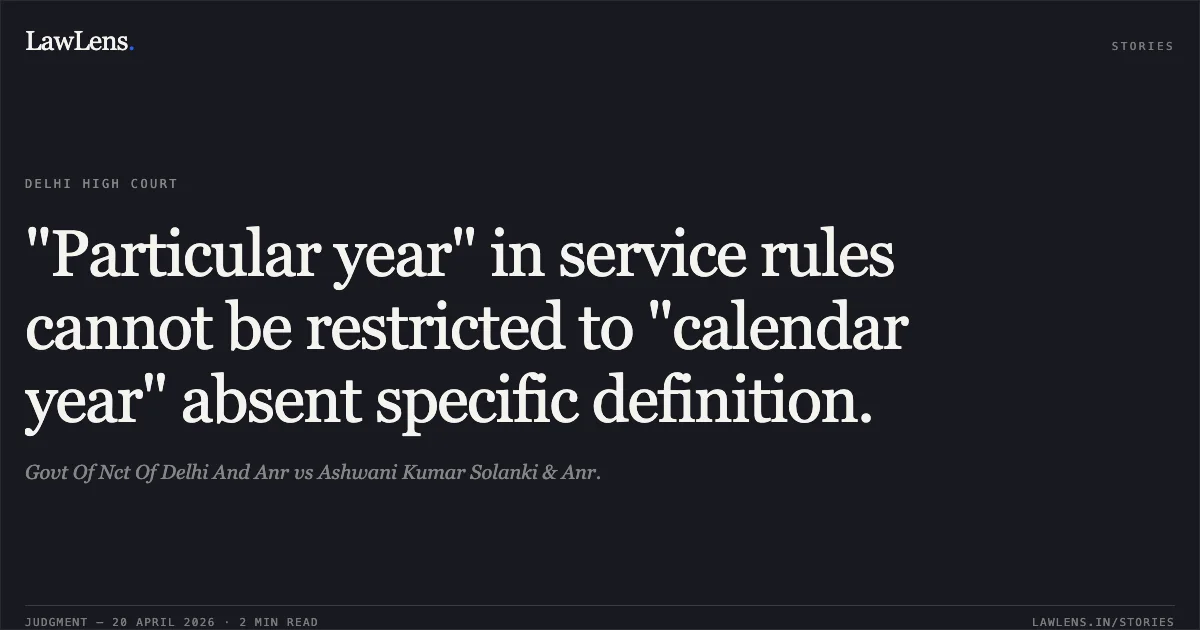
The Court held that the GNCTD was not justified in interpreting "particular year" exclusively as a "calendar year" and directed the reconsideration of the respondents’ eligibility by interpreting the term as a "financial year" or relevant 12-month period
The Court concluded that any ambiguity in the OM must result in a favorable construction for the employee
Source reference: para. 19-20The Delhi High Court dismissed the writ petitions in limine, affirming the Tribunal's decision
Source reference: para. 20-21Original Court PDF
Govt Of Nct Of Delhi And AnrvsAshwani Kumar Solanki & Anr.
Click to open original judgment
Original judgment, available to read, download and summarize on LawLens.in