01Facts
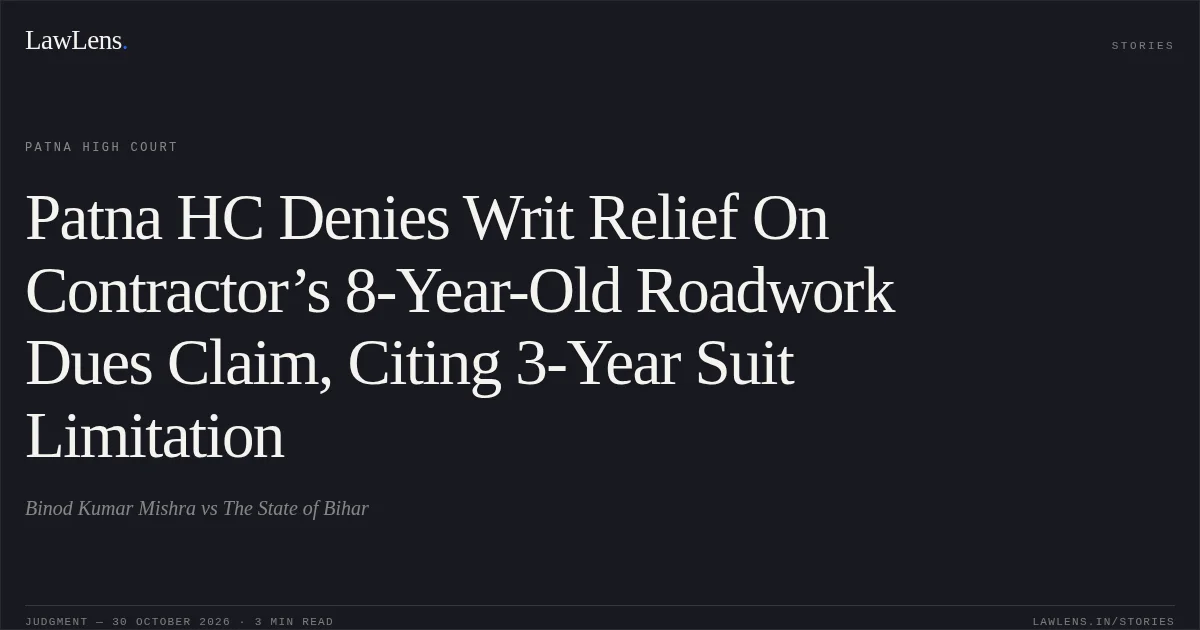
The appellant was awarded three public-works contracts by the District Urban Development Agency (DUDA), Rohtas, under work orders dated 14 November 2014 and agreements dated 27 December 2014.
pp. 2–3He claimed to have completed the works and received part-payments in 2015, but alleged that balances remained unpaid.
pp. 2–3After requesting payment in letters dated 29 August 2017, 12 September 2017, 10 November 2022 and 23 December 2022, he filed a writ petition in 2023 seeking the outstanding amounts.
p. 3The Single Judge dismissed the petition as not maintainable, holding that an alternative remedy was available under the Commercial Courts Act, 2015.
p. 1In appeal, the State relied, among other things, on the delay in bringing the claim; the Division Bench dismissed the appeal, finding the delay of about eight years unexplained.
pp. 9–10, 28–3002Issues
i.1. Whether the appellant’s unexplained delay of about eight years in seeking payment of contractual dues justified refusal of relief under Article 226.
pp. 20–21, 28–30ii.2. Whether the writ court should grant monetary relief for contractual dues where the claim had become time-barred and an ordinary remedy was available.
pp. 15–16, 28–3003Law Applied
Article 226 confers discretionary relief, and a writ court may refuse relief where a claimant has unreasonably delayed, particularly if the delay exceeds the period ordinarily available for a civil action.
pp. 13–17, 28–29In State of M.P. v. Bhailal Bhai, AIR 1964 SC 1006, the Supreme Court held that the limitation period for a civil suit may ordinarily guide the assessment of delay in writ proceedings; where delay exceeds that period, it will generally be unreasonable, though the decision remains discretionary.
pp. 13–17, 28–29The applicable period for recovery of contractual money was treated as three years.
p. 28ABL International Ltd. v. Export Credit Guarantee Corporation of India Ltd., (2004) 3 SCC 553, recognises that contractual disputes and monetary claims may be considered in writ proceedings in appropriate cases, but does not eliminate the court’s discretion to refuse relief.
pp. 4–7Joshi Technologies International Inc. v. Union of India, (2015) 7 SCC 728, states that disputes lying purely in the private-law field of contract ordinarily belong to civil remedies, with writ review depending on the facts and any public-law element.
pp. 18–20The Court also relied on the settled doctrine that delay and laches may bar discretionary relief under Article 226.
pp. 20–27Provisions in the judgment · 7 · Linked ones open on LawLens
Indian Penal Code, 1860 Section 419Section 420Section 409Section 467Section 468Section 47
Indian Contract Act, 1872 Section 72
04Reasoning
Although the appellant relied on completion of the works, part-payment and authorities permitting writ relief in contractual matters, his claim arose from work completed and partly paid for in 2015, while the writ petition was not filed until 2023.
pp. 2–3, 18The Court found no satisfactory or plausible explanation for the delay.
p. 18, 28Because the delay exceeded the three-year period for a civil money-recovery action, the claim was stale for purposes of discretionary writ relief under the principle in Bhailal Bhai.
pp. 28–30The possibility of writ relief in an appropriate contractual case did not require the Court to entertain this delayed claim.
pp. 4–7, 18–2005Holding
The Court held that the writ petition was barred by unreasonable delay and laches and was not liable to be entertained under Article 226.
pp. 29–30It dismissed the Letters Patent Appeal as without merit, leaving the appellant to pursue any remedy otherwise available under law.
pp. 29–30Original Court PDF
Binod Kumar MishravsThe State of Bihar
Click to open original judgment
Original judgment, available to read, download and summarize on LawLens.in