01Facts
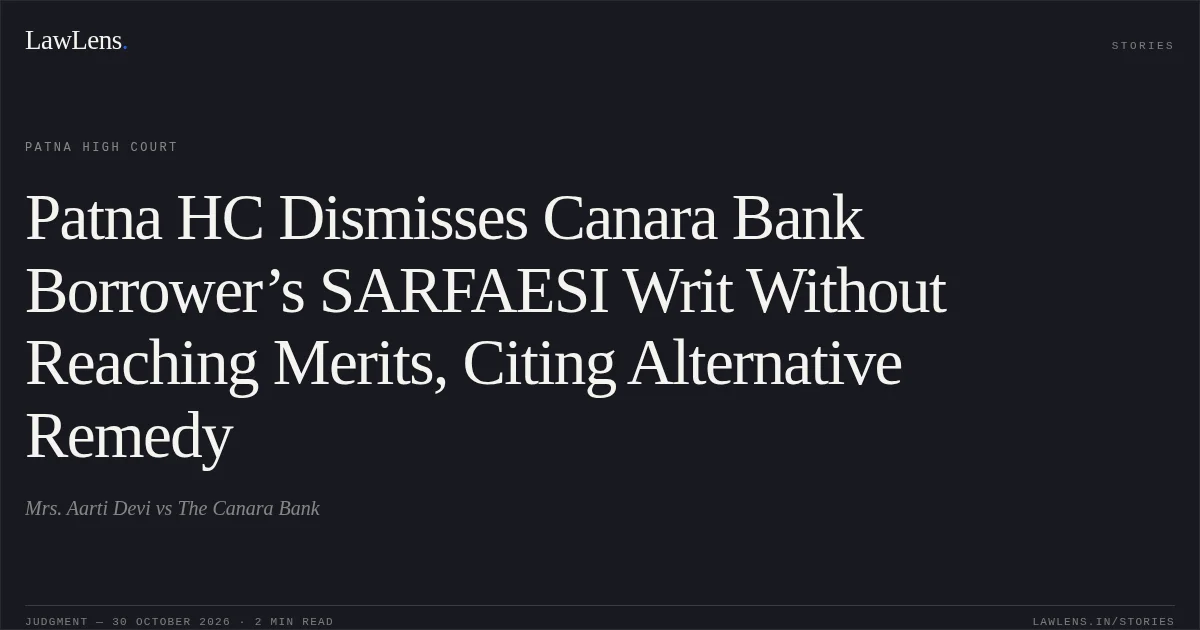
The petitioner challenged Canara Bank’s recovery proceedings under Sections 13(2) and 13(4) of the SARFAESI Act, including demand and possession/sale notices concerning her mortgaged property.
pp. 2–7She alleged defective service, disputed the Bank’s calculation of dues, and said a fire had damaged her business; she sought time and instalments to repay the loan.
pp. 2–7The Bank maintained that the notices had been duly served, the accounts had become NPAs, and an effective statutory remedy was available.
pp. 2–7During the writ proceedings, the Court made interim directions concerning a deposit of Rs. 15 lakh and access to the residential premises; the Bank’s appeal and special leave petition did not result in those directions being set aside on the merits.
pp. 8–15The Bank raised maintainability as a preliminary objection.
p. 1602Issues
i.1. Whether the High Court should entertain the Article 226 petition challenging SARFAESI recovery measures when an effective statutory remedy is available under the Act.
pp. 16, 21–22ii.2. Whether the petitioner’s challenges to notice service, the calculation of outstanding dues, and the recovery action should be determined in the writ petition.
pp. 3–7, 2203Law Applied
Under Article 226, the High Court ordinarily will not entertain a petition where an effective statutory remedy is available; the rule applies with particular force to proceedings for recovery of bank dues.
pp. 17, 20–21The Court relied on United Bank of India v. Satyawati Tondon, (2010) 8 SCC 110, and State Bank of Travancore v. Mathew K.C., (2018) 3 SCC 85, for the principle that statutory remedies should ordinarily be exhausted and that courts should be circumspect in granting relief that impedes recovery of public money.
pp. 17, 20–21It also relied on PHR Invent Educational Society v. UCO Bank (Civil Appeal No. 4845 of 2024) and Celir LLP v. Bafna Motors (Mumbai) Pvt. Ltd., (2024) 2 SCC 1, which reiterate restraint in entertaining Article 226 petitions where an effective SARFAESI remedy exists.
pp. 18–19The Court considered the petitioner’s challenge to measures taken under Sections 13(2) and 13(4) of the SARFAESI Act in light of that alternative-remedy principle.
p. 1, 16Provisions in the judgment · 1 · Linked ones open on LawLens
Securitisation and Reconstruction of Financial Assets and Enforcement of Security Interest Act, 2002 Section 13
04Reasoning
The petitioner’s objections concerned the Bank’s statutory recovery measures, including notice service and the amount due.
pp. 16–22The Court treated these matters as appropriate for determination through the available statutory remedy, rather than resolving them in the writ petition.
pp. 16–22Applying the Supreme Court’s guidance on alternative remedies in bank-recovery cases, the Court declined to examine the merits of the petitioner’s claims.
pp. 16–2205Holding
The Court dismissed the writ petition because an effective statutory remedy was available under the SARFAESI Act, without expressing any opinion on the merits of the petitioner’s claims.
p. 23It left the petitioner at liberty to pursue the appropriate statutory remedy in accordance with law; pending applications, if any, were disposed of.
p. 23Original Court PDF
Mrs. Aarti DevivsThe Canara Bank
Click to open original judgment
Original judgment, available to read, download and summarize on LawLens.in