01Facts
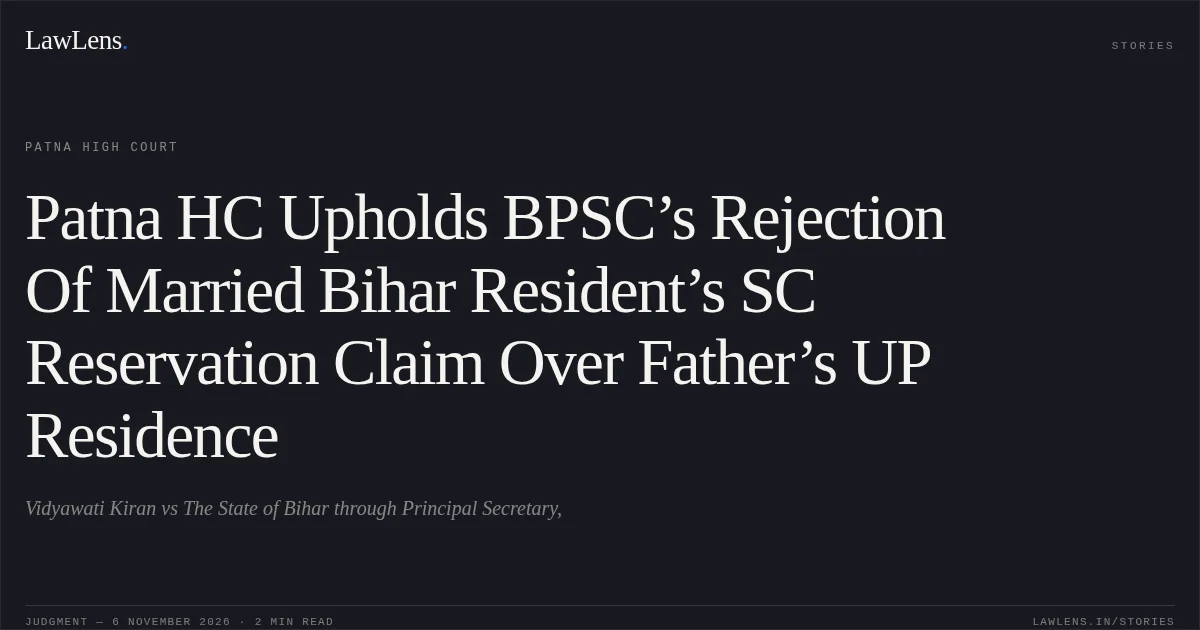
The appellant, a member of the Dusadh Scheduled Caste, was born in Uttar Pradesh, where her father permanently resided, and married in Bihar in 1996.
pp. 2–3 · ¶ 2–3She applied for the Bihar Public Service Commission’s Assistant Prosecution Officer recruitment, appeared in the preliminary and mains examinations, and attended the interview.
pp. 2–3 · ¶ 2–3The Commission later declared her unsuccessful because her caste and domicile certificates were not based on her father’s permanent residence.
pp. 2–3 · ¶ 2–3Her representation and review were rejected; the learned Single Judge dismissed her writ petition, leading to this appeal.
pp. 2–3 · ¶ 2–3The appellant argued that her marriage and long residence gave her Bihar domicile, relying on Sections 15 and 16 of the Indian Succession Act, 1925.
p. 4 · ¶ 4The Commission relied on the advertisement and interview instructions requiring Bihar residence for reservation and certificates in the father’s name and address.
pp. 3–4 · ¶ 5–602Issues
i.Whether the appellant could claim Bihar-specific Scheduled Caste reservation on the basis of her marriage to a Bihar resident and subsequent residence in Bihar, despite her father’s permanent residence being in Uttar Pradesh.
pp. 4–5 · ¶ 5–8ii.Whether the Commission’s rejection of her claim, under the recruitment conditions requiring Bihar residence and certificates linked to the father’s residence, warranted interference with the Single Judge’s judgment.
pp. 5–6 · ¶ 9–1103Law Applied
The Court held that civil domicile acquired upon marriage under Sections 15 and 16 of the Indian Succession Act, 1925 does not, by itself, confer entitlement to reservation under Article 16(4) of the Constitution.
p. 4 · ¶ 8Relying on Action Committee on Issue of Caste Certificate to Scheduled Castes and Scheduled Tribes in the State of Maharashtra v. Union of India, (1994) 5 SCC 244, and Bir Singh v. Delhi Jal Board, (2018) 10 SCC 312, it applied the principle that Scheduled Caste status in one State does not automatically entitle a person to reservation benefits in another State.
p. 5 · ¶ 8The Court also applied the recruitment conditions and the principle that candidates are bound by the rules of the selection process fixed before it begins, relying on Awinash Kumar v. State of Bihar, 2026 (6) BLJ 249.
pp. 3–4, 5–6 · ¶ 5–6, 10Provisions in the judgment · 2 · Linked ones open on LawLens
Indian Succession Act, 1925 Section 15Section 16
04Reasoning
The Court rejected the appellant’s reliance on marital domicile, reasoning that it did not establish entitlement to Bihar’s reservation benefits.
pp. 4–6 · ¶ 5–10It found that the advertisement restricted reservation to Bihar permanent or original residents and required the relevant certificates; the interview instructions further required certificates in the father’s name and address.
pp. 4–6 · ¶ 5–10Because the appellant’s father was admittedly a resident of Uttar Pradesh, and those conditions had been stated before the selection process, the Commission had applied the announced requirements.
pp. 4–6 · ¶ 5–10The appellant had not shown that those conditions or the Commission’s decision contravened an applicable rule, Act, or constitutional provision.
pp. 4–6 · ¶ 5–1005Holding
The Court held that the appellant was not entitled to claim Bihar-specific reservation on the basis of marriage or subsequent residence and found no perversity or illegality in the Single Judge’s decision or the Commission’s action.
p. 6 · ¶ 11–12The Letters Patent Appeal was dismissed.
p. 6 · ¶ 11–12The Court also waived the earlier direction requiring the Commission to pay Rs. 10,000 to the High Court Legal Services Committee.
p. 1 · ¶ 1Original Court PDF
Vidyawati KiranvsThe State of Bihar through Principal Secretary,
Click to open original judgment
Original judgment, available to read, download and summarize on LawLens.in