Facts
The appellant, a child in conflict with law (“CICL”), aged approximately 17½ years at the time of the alleged occurrence, was accused of offences under Sections 354, 354B, 354D, 376 and 504/34 IPC.
Source reference: p.2The prosecution alleged that he had recorded the victim while she was bathing, sexually assaulted her in a room, recorded the incident, threatened to circulate the recording, and subsequently photographed her and applied vermilion on her forehead.
Source reference: p.2The appellant asserted that he and the victim were involved in a consensual relationship and that the case had been instituted due to opposition from the victim’s family and an earlier land dispute.
Source reference: pp.3–5The Children Court rejected his application for bail under Section 12 of the Juvenile Justice (Care and Protection of Children) Act, 2015 (“J.J. Act”), principally on the grounds that he might repeat the offence, face moral, physical or psychological danger, and that his release would defeat the ends of justice.
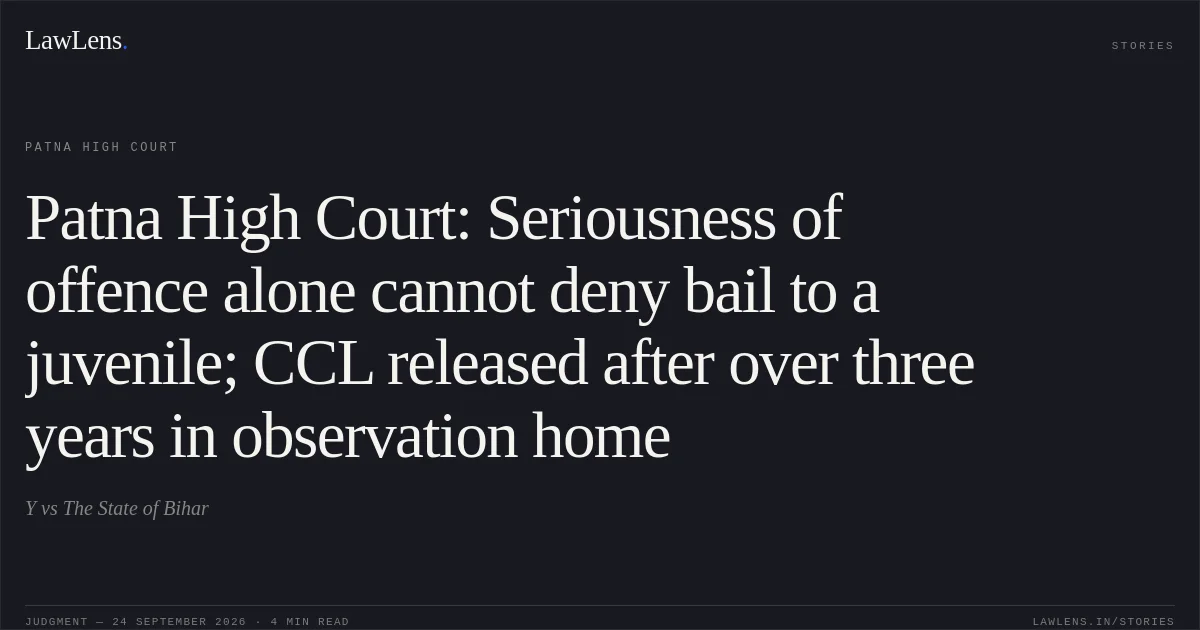
Source reference: p.1The appellant had remained in the Observation Home since 20 July 2023, for more than three years by the time of the High Court’s decision.
Source reference: para. 30Issues
1. Whether bail to a child in conflict with law may be denied under Section 12 of the J.J. Act merely on the basis of the seriousness of the alleged offence, the possibility of repetition, or the general assertion that release would defeat the ends of justice.
Source reference: paras. 11–19, 29(2), 29(5)2. Whether the materials in the Social Background Report and Social Investigation Report disclosed any of the statutory grounds under the proviso to Section 12(1)—association with a known criminal, exposure to moral, physical or psychological danger, or defeat of the ends of justice—so as to justify denial of bail.
Source reference: paras. 29(6), 30–353. Whether the Children Court’s order rejecting bail was legally sustainable.
Source reference: paras. 31–35Law Applied
Section 12(1) of the J.J. Act mandates the release of a child in conflict with law on bail, with or without surety, or under the supervision of a probation officer or the care of a fit person, irrespective of whether the alleged offence is bailable or non-bailable; refusal is permissible only where the proviso establishes reasonable grounds for believing that release would bring the child into association with a known criminal, expose the child to moral, physical or psychological danger, or defeat the ends of justice.
Source reference: p.6The court relied on Juvenile in Conflict with Law v. State of Rajasthan, 2024 SCC OnLine SC 5297, and Re: Exploitation of Children in Orphanages in the State of T.N. v. Union of India, (2020) 14 SCC 327, for the mandatory and exceptional nature of bail under Section 12.
Source reference: pp.7–9It further held that the gravity or nature of the alleged offence and the child’s age are not, by themselves, relevant grounds for denying bail.
Source reference: paras. 16, 29(2)Under Section 3 of the J.J. Act, decisions must advance the child’s best interests, family responsibility, positive development, rehabilitation, reintegration and institutionalisation only as a measure of last resort.
Source reference: pp.14–18, paras. 21–27Denial of bail must be supported by a reasoned finding based on relevant material, particularly the Social Investigation Report.
Source reference: para. 29(6)Reasoning
The High Court found that the Children Court had relied substantially on the seriousness of the allegations and speculative conclusions that the appellant might repeat the offence, rather than demonstrating the applicability of any statutory exception under Section 12(1).
Source reference: paras. 30–31The Social Background Report and Social Investigation Report showed that neither the appellant nor his family, apart from his mother being a co-accused in the same case, had criminal antecedents; the reports did not indicate that release would expose the appellant to moral, physical or psychological danger or bring him into contact with known criminals.
Source reference: para. 32The appellant’s father was willing to furnish an undertaking to supervise him, prevent contact with criminal persons, ensure his education and facilitate vocational training.
Source reference: paras. 33, 36The court also held that “ends of justice” under the J.J. Act must be understood in the context of the child’s welfare, rehabilitation and development, and not as a punitive justification for continued institutional detention.
Source reference: paras. 25, 35Since family care is the preferred institution and institutionalisation is a last resort, the continued detention of the appellant was not shown to advance the purposes of the J.J. Act.
Source reference: paras. 26, 35Holding
The High Court allowed the appeal and set aside the Children Court’s order dated 4 April 2024 rejecting bail.
It directed that the appellant be released on bail on furnishing a bond of Rs. 10,000, together with an affidavit and undertaking from his father to supervise him, prevent his association with criminal persons, attend to his developmental needs, ensure his appearance before the court, continue his education and, if possible, undertake vocational training.
Source reference: para. 36The court reaffirmed that bail is the rule for a child in conflict with law under Section 12 of the J.J. Act and may be refused only upon a reasoned, evidence-based finding that one of the statutory exceptions applies.
Source reference: paras. 29(5)–(7), 35–36Acts & Sections Cited
10 provisions across 3 statutes referred to in this judgment. Each provision opens on LawLens.
Juvenile Justice (Care and Protection of Children) Act, 2015.5
Code of Criminal Procedure, 19731
Indian Penal Code, 18604
Original Court PDF
YvsThe State of Bihar
Click to open original judgment
Original judgment, available to read, download and summarize on LawLens.in