Facts
The respondent, an Assistant Teacher who served the petitioner institution from 1998 to 2022, filed a claim for gratuity after her retirement
Source reference: p. 3The Controlling Authority, vide order dated 04.05.2023, directed the petitioner to pay ₹1,73,303/- with 10% interest
Source reference: p. 3-4The petitioner challenged this before the Appellate Authority, claiming that a prior payment of ₹40,000/- made to the respondent should be set off as "lump-sum gratuity"
Source reference: p. 3The Appellate Authority dismissed the appeal on 07.02.2024, confirming the Controlling Authority’s findings
Source reference: p. 3-4The petitioner moved the High Court under Articles 226 and 227 of the Constitution to quash these orders and seek a set-off for the ₹40,000/-
Source reference: p. 1-2Issues
1. Whether the amount of ₹40,000/- paid by the petitioner institution to the respondent constitutes a lump-sum gratuity payment or a payment toward salary arrears
Source reference: p. 62. Whether the concurrent findings of the Controlling and Appellate Authorities regarding the nature of the payment warrant interference under writ jurisdiction
Source reference: p. 8Law Applied
The Court primarily applied the provisions of the Payment of Gratuity Act, 1972, which mandates the payment of gratuity within thirty days of retirement, failing which interest (typically at 10%) is exigible
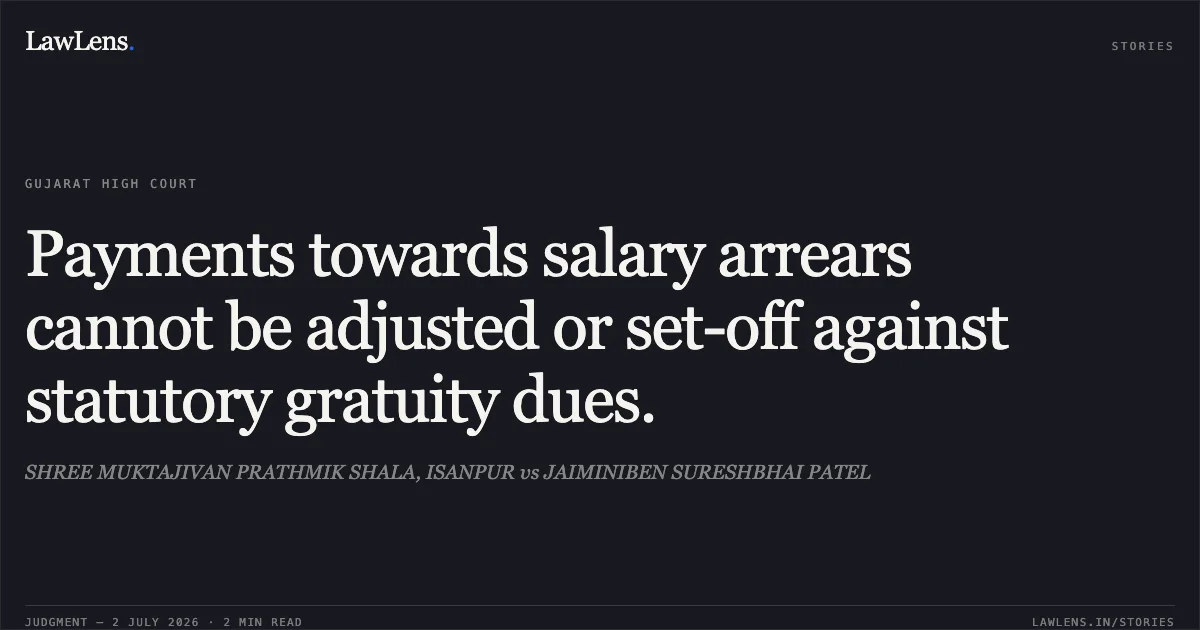
Source reference: p. 4It relied on the principle of stare decisis regarding a similar factual matrix in Shree Muktajivan Prathmik Shala Isanpur v. Ashokkumar Chhabiladas Khatri (SCA No. 1634 of 2024), which established that payments made toward salary differences cannot be adjusted against statutory gratuity dues
Source reference: p. 5-6, 7The Court applied the limited scope of judicial review under Articles 226 and 227 of the Constitution of India, holding that High Courts should not re-appreciate evidence or disturb concurrent findings of fact unless they are perverse
Source reference: p. 8Reasoning
The Court examined the petitioner’s contention that the ₹40,000/- was a gratuity installment. However, the respondent produced bank passbook records and an affidavit demonstrating that the specific amount received on 03.11.2022 was credited as "salary" for the period of March 2021
Source reference: p. 5The Court noted that the petitioner failed to provide any documentary evidence or a settlement agreement proving the respondent accepted this sum as a full or partial discharge of gratuity liabilities
Source reference: p. 8Leveraging the precedent set in the Ashokkumar Chhabiladas Khatri case involving the same petitioner, the Court found the institution had a history of mischaracterizing salary arrears as gratuity
Source reference: p. 7Since the lower authorities had already evaluated these facts and concluded the payment was non-gratuity related, the Court found no illegality or perversity in their reasoning
Source reference: p. 8Holding
The Court answered the issues in favor of the respondent, holding that the ₹40,000/- was toward salary and could not be set off against the gratuity award
The High Court dismissed the petition, discharged the rule, and upheld the orders of the Controlling and Appellate Authorities directing the payment of ₹1,73,303/- with 10% interest
Source reference: p. 8No stay was granted on the withdrawal of the deposited amount
Source reference: p. 8Acts & Sections Cited
1 provisions across 1 statute referred to in this judgment. Linked provisions open on LawLens.
PAYMENT OF GRATUITY ACT, 19721
Original Court PDF
SHREE MUKTAJIVAN PRATHMIK SHALA, ISANPURvsJAIMINIBEN SURESHBHAI PATEL
Click to open original judgment
Original judgment, available to read, download and summarize on LawLens.in