01Facts
The petitioners sought to quash proceedings in C.C. No. 18814/2019, arising from Crime No. 75/2019, for offences under Sections 341, 354, 447, 504 and 506 read with Section 149 of the IPC.
¶ 2–3The prosecution alleged that on 22 February 2019 the petitioners trespassed onto premises associated with an educational trust, abused and threatened persons present, and that some petitioners restrained and dragged female staff members, thereby outraging their modesty.
¶ 2–3, 22–23The dispute between the parties also concerned competing trust deeds and rights to the property; civil proceedings were pending.
¶ 4–8, 22Police investigated and filed a charge-sheet; Section 354 IPC was added during the investigation.
¶ 16, 2302Issues
i.1. Whether the petitioners had established grounds for quashing the charge-sheet and criminal proceedings under Section 482 CrPC, including on the basis that the dispute was civil in nature.
¶ 20ii.2. Whether the second complaint and ensuing investigation were impermissible because an NCR had been issued on the earlier complaint concerning the same incident.
¶ 22, 2403Law Applied
Section 482 CrPC confers a limited power to prevent abuse of process; at this stage, the Court does not assess disputed facts or decide issues requiring trial.
¶ 22–23The Court relied on Lalita Kumari v. State of Uttar Pradesh, (2014) 2 SCC 1, for the rule that registration of an FIR is mandatory where information discloses a cognizable offence.
¶ 24It treated the alleged offences under Sections 341 and 447 IPC as cognizable and held that the earlier NCR did not bar a complaint and investigation concerning the same incident once cognizable offences were disclosed.
¶ 24Allegations concerning restraint, trespass, threats, abuse and outraging a woman’s modesty, supported by witness statements, could not be resolved by weighing disputed evidence in a Section 482 petition.
¶ 23, 25–30Provisions in the judgment · 11 · Linked ones open on LawLens
Code of Criminal Procedure, 1973 Section 482
Indian Penal Code, 1860 10 provisions
Section 34Section 149Section 323Section 324Section 341Section 353Section 354Section 447Section 504Section 50604Reasoning
The Court found that the complaint and charge-sheet identified a specific incident and contained allegations of wrongful restraint and trespass, as well as threats, abusive language and conduct directed at female staff members.
¶ 22–23, 25–27Witnesses had been cited and their statements recorded, so whether the alleged acts occurred—and whether they satisfied the ingredients of the offences—was a matter for trial, not summary determination under Section 482.
¶ 22–23, 25–27The Court rejected the NCR objection because the allegations included cognizable offences and the second complaint referred to the earlier complaint; it also noted there had been no suppression of that earlier complaint.
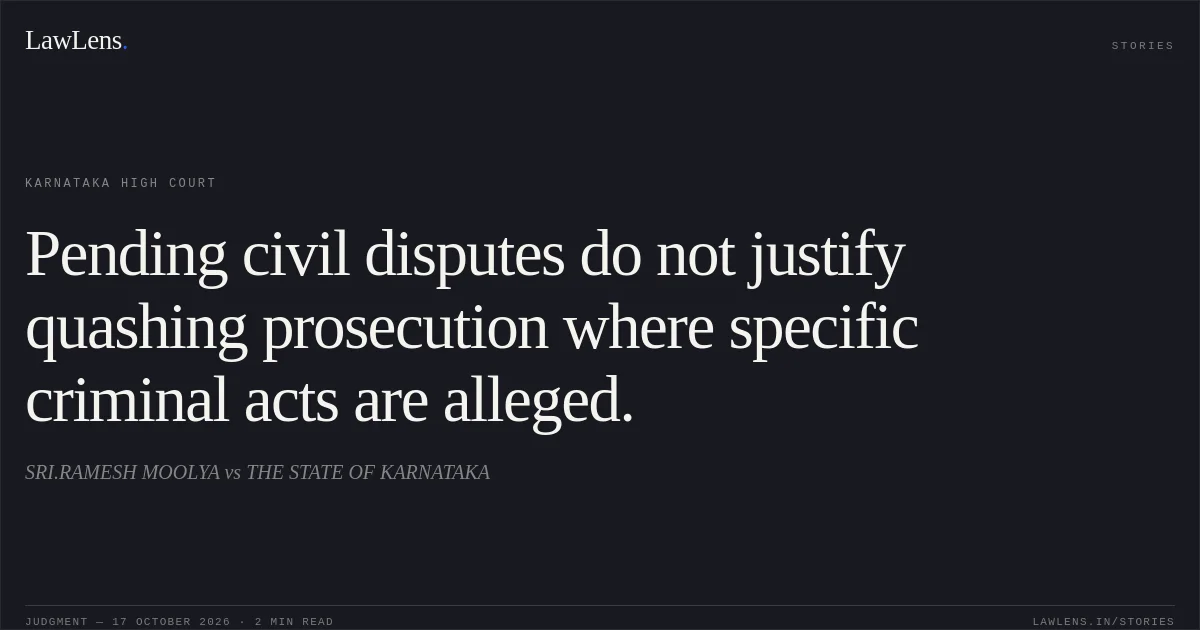
¶ 24The pending civil disputes and contested property or trust rights did not, in the Court’s view, negate the alleged criminal acts or justify quashing the prosecution.
¶ 29–3105Holding
The Court answered the principal issue in the negative, holding that the petitioners had not made out grounds to quash the charge-sheet or proceedings.
¶ 31–32It rejected the contention that the NCR barred the subsequent complaint and declined to treat the case as merely a civil dispute.
¶ 31–32The criminal petition was dismissed.
¶ 31–32Original Court PDF
SRI.RAMESH MOOLYAvsTHE STATE OF KARNATAKA
Click to open original judgment
Original judgment, available to read, download and summarize on LawLens.in