01Facts
The petitioner, appointed as Head Constable in 1997 and promoted to ASI in 2011, faced a departmental enquiry while posted at Police Station Badarwas, District Shivpuri.
¶ 2The IGP, Gwalior Range, imposed stoppage of one annual increment without cumulative effect by order dated 11.09.2014.
¶ 2The DGP, under Police Regulation 270(Ka), enhanced the punishment to stoppage of one annual increment with cumulative effect.
¶ 2The petitioner's challenge to the revisional order dated 17.08.2015 in W.P. No. 4672/2015 was allowed by the learned Single Judge on 22.07.2016 on limitation grounds.
¶ 3, 5On the State's Writ Appeal No. 227/2017, the Division Bench reversed on 03.08.2017, held the M.P. Civil Services (CCA) Rules, 1966 inapplicable to the petitioner, held that no limitation applies to revision under Police Regulation 270(4), and upheld the DGP's revisional order.
¶ 3, 5The State asserts that no SLP was filed against that judgment.
¶ 3W.P. No. 6066/2016 was dismissed as infructuous on 09.01.2026, with liberty to challenge the major punishment order.
¶ 3, 10The petitioner's appeal/representation to respondent No. 2 remained pending, and he sought a direction for its decision.
¶ 202Issues
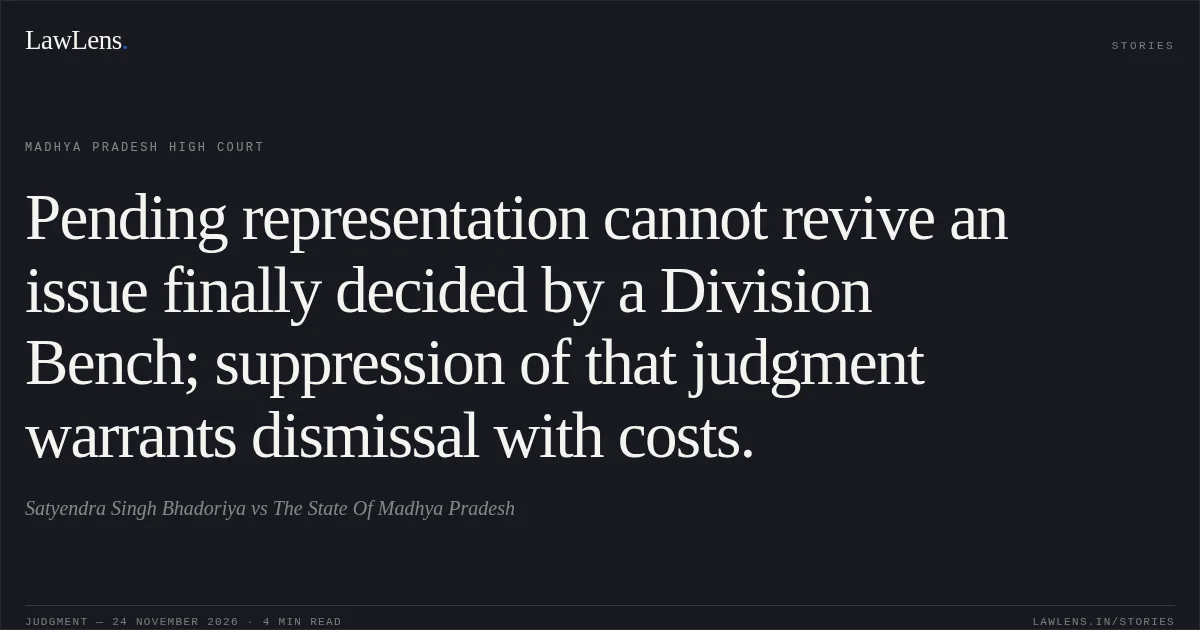
i.1. Whether a writ petition seeking a direction to decide a pending representation can be used to reopen the validity of the enhanced punishment already upheld by the Division Bench in W.A. No. 227/2017.
¶ 5, 6, 8ii.2. Whether the pendency of a representation, or the liberty granted in W.P. No. 6066/2016, creates a fresh cause of action enabling re-agitation of the settled issue.
¶ 9, 10iii.3. Whether suppression of the Division Bench judgment dated 03.08.2017 justifies dismissal of the petition and the imposition of costs.
¶ 11, 16, 1703Law Applied
The Court relied on the principle of finality of judicial decisions under the doctrine of res judicata, as laid down in Satyadhyan Ghosal v. Deorajin Debi, AIR 1960 SC 941, and Hope Plantations Ltd. v. Taluk Land Board, Peermade, (1999) 5 SCC 590, which hold that a matter finally decided between the parties cannot be reopened in subsequent proceedings and that the doctrine rests on public policy against repeated litigation.
¶ 7The Court applied the principle that a representation cannot revive a settled issue or create a fresh cause of action, and that an administrative authority cannot be compelled to reconsider a matter contrary to a binding Division Bench judgment.
¶ 6, 9On the writ court's extraordinary, equitable and discretionary jurisdiction under Article 226, the Court relied on K.D. Sharma v. Steel Authority of India Ltd., (2008) 12 SCC 481, requiring full and candid disclosure of material facts, and Kishore Samrite v. State of U.P., (2013) 2 SCC 398, barring litigants with unclean hands and repeated frivolous proceedings from discretionary relief.
¶ 12, 13The Court referred to the Division Bench's holding that the M.P. Police Regulations govern the petitioner and that Police Regulation 270(4) carries no limitation period.
¶ 3, 5Liberty granted in an infructuous writ is construed as confined to the controversy left undecided in that proceeding.
¶ 1004Reasoning
The Court held that the validity of the enhanced punishment had already been adjudicated by the Division Bench and upheld, so the controversy was res judicata between the parties.
¶ 5, 6, 8Because the petitioner did not challenge that judgment before the Supreme Court, he could not achieve the same result through a direction to decide a representation.
¶ 8The pending representation was therefore not a fresh cause of action, since it sought to revive a settled question.
¶ 6, 9The liberty in W.P. No. 6066/2016 was limited to the undecided controversy in that petition and could not override the Division Bench ruling.
¶ 10The Court further found that the petitioner failed to disclose the 03.08.2017 judgment, which went to the root of maintainability, and that this non-disclosure was an attempt to present a settled grievance as undecided, violating the candour required under K.D. Sharma.
¶ 11, 12, 14Although the Court acknowledged the financial and service consequences for a serving employee, it held that these could not justify reopening an adjudicated matter.
¶ 15The Court treated the conduct as repeated litigation and abuse of process, and found that the respondents were compelled to defend a proceeding that ought not to have been instituted, justifying costs.
¶ 16, 17, 1805Holding
The Court held that the petition is not maintainable, is devoid of merit, suffers from suppression of material facts, and amounts to abuse of process.
¶ 16The writ petition is dismissed. The petitioner is directed to pay costs of ₹10,000/- to the Madhya Pradesh State Legal Services Authority within 30 days of receipt of a certified copy of the order, failing which the authority may recover the amount in accordance with law. The dismissal does not reopen or modify the Division Bench judgment dated 03.08.2017 in W.A. No. 227/2017, which continues to operate. A copy of the order is to be forwarded to the MPSLSA for necessary action on the costs.
¶ 19, 20, 21, 22Original Court PDF
Satyendra Singh BhadoriyavsThe State Of Madhya Pradesh
Click to open original judgment
Original judgment, available to read, download and summarize on LawLens.in