Facts
The Petitioner was enrolled in the Central Reserve Police Force (CRPF) on 04.08.1966 and attained the rank of Inspector/Radio Operator (RO) in 1995
Source reference: para. 4He superannuated on 31.07.1997 after over 30 years of service
Source reference: para. 4At the time of retirement, his basic pay was Rs. 1,760 in the pre-revised Fourth CPC pay scale of Rs. 1640–2900
Source reference: para. 4Following the implementation of the Fifth CPC (effective 01.01.1996), the Respondents revised his pension based on the replacement scale of Rs. 5500–9000 (S-10)
Source reference: para. 4, 18The Petitioner challenged the Revisional Authority’s order dated 22.05.2018, which rejected his claim for a pension revision based on the higher scale of Rs. 6500–10500 (S-12) attached to the rank of Inspector and for benefits under the Assured Career Progression Scheme (ACPS)
Source reference: para. 1, 9Issues
1. Whether the Petitioner is entitled to the fixation of pension based on the higher pay scale of S-12 (Rs. 6500–10500) solely by virtue of holding the rank of Inspector/RO at the time of retirement, regardless of the scale he actually drew
Source reference: para. 2, 162. Whether the Petitioner is entitled to the benefits of the Assured Career Progression Scheme (ACPS) for pension revision despite retiring prior to the scheme’s introduction
Source reference: para. 2, 23Law Applied
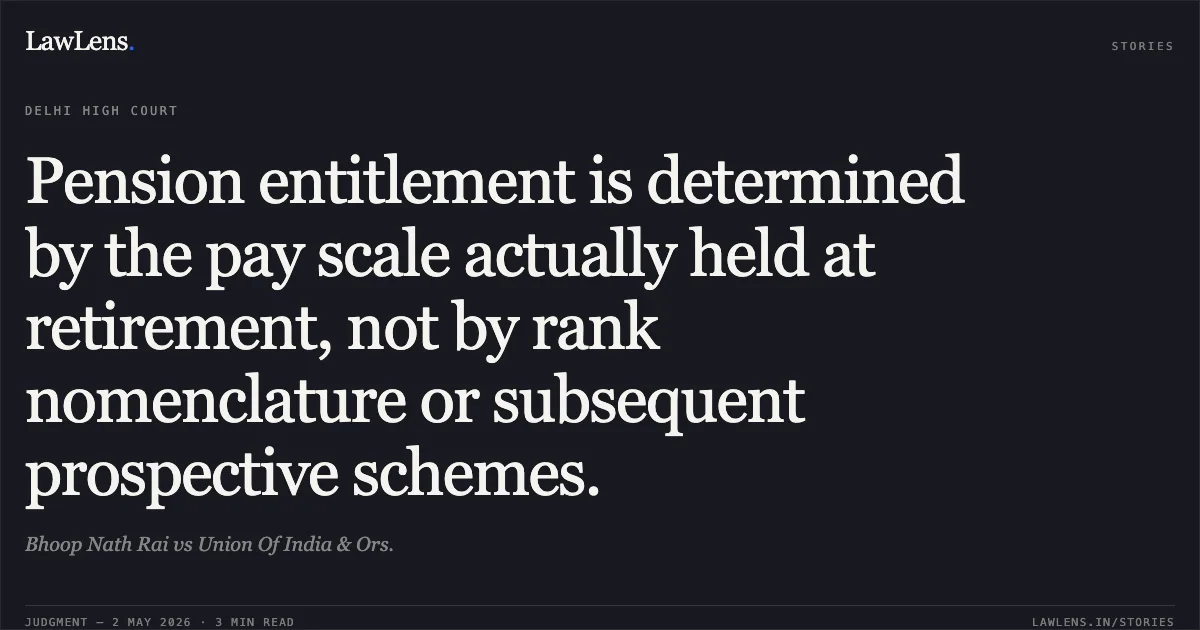
The court applied the principle that pensionary entitlement is determined by the last pay drawn and the pay scale actually held at the time of retirement, rather than by rank nomenclature
Source reference: para. 17, 25It interpreted the CCS (Revised Pay) Rules, 1997, asserting that pay revision rules operate through replacement scales of existing structures and do not automatically upgrade an employee to a higher scale without a formal promotion or financial upgradation
Source reference: para. 17Regarding the ACPS, the court applied the principle of prospectivity, noting that promotional or welfare schemes do not apply to past retirees unless expressly stated
Source reference: para. 23, 24The court distinguished Lal Bahadur Singh Ors. v. UoI Ors., noting it required a prior structural upgradation/rationalization of the pre-revised scale to apply
Source reference: para. 21-22Reasoning
The Court reasoned that the Petitioner’s identity card, while proving his rank as Inspector/RO, did not establish that he was formally placed in the S-12 pay scale during his service
Source reference: para. 19-20Since the Petitioner admittedly drew pay in the Rs. 1640–2900 scale, the Respondents correctly applied the corresponding S-10 replacement scale (Rs. 5500–9000) under the 1997 Rules
Source reference: para. 18The Court rejected the parity claim with Lal Bahadur Singh, observing that in this case, there was no executive decision or rationalization exercise that had upgraded the Petitioner’s pre-revised scale prior to his retirement
Source reference: para. 21-22Furthermore, the Court found the ACPS claim meritless because the scheme was introduced on 09.08.1999—two years after the Petitioner’s retirement—and was intended only for serving employees to alleviate stagnation
Source reference: para. 23The Court clarified that while pension is a continuing cause of action, this doctrine cannot be used to retrospectively claim benefits from schemes that did not exist during the employee's tenure
Source reference: para. 24Holding
The Court dismissed the Writ Petition, holding that there was no illegality in the fixation of the Petitioner’s pension
The Court concluded that pension must correspond to the pay scale actually held at the time of retirement, and since the Petitioner never drew the S-12 scale while in service, he could not claim it for pensionary purposes
Source reference: para. 25-26Additionally, the ACPS cannot be extended to those who demitted service prior to its introduction
Source reference: para. 23-24The orders of the Revisional Authority were upheld
Source reference: para. 25Original Court PDF
Bhoop Nath RaivsUnion Of India & Ors.
Click to open original judgment
Original judgment, available to read, download and summarize on LawLens.in