Facts
On October 10, 2025, police personnel intercepted a vehicle carrying bags of forest produce.
Source reference: para. 4, 6Based on an identification by a Forest Officer as the herb "Meda/Panja," the police seized the consignment and the vehicle under Sections 26, 41, and 42 of the Indian Forest Act, 1927, alleging the absence of a valid transit pass.
Source reference: para. 4, 6The applicant, a registered associate of the Herbal Research and Development Institute, contended the material was "Saalam Mishri"—a legally cultivated herb—and that a valid transit pass had been issued for its transportation.
Source reference: para. 5, 8The applicant moved for the release of the seized articles, but the Judicial Magistrate, Purola, rejected the application on December 2, 2025, citing the pending scientific report from the Forest Research Institute (FRI), Dehradun.
Source reference: para. 7, 9The applicant approached the High Court seeking quashing of the Magistrate's order and the release of the perishable goods.
Source reference: para. 3Issues
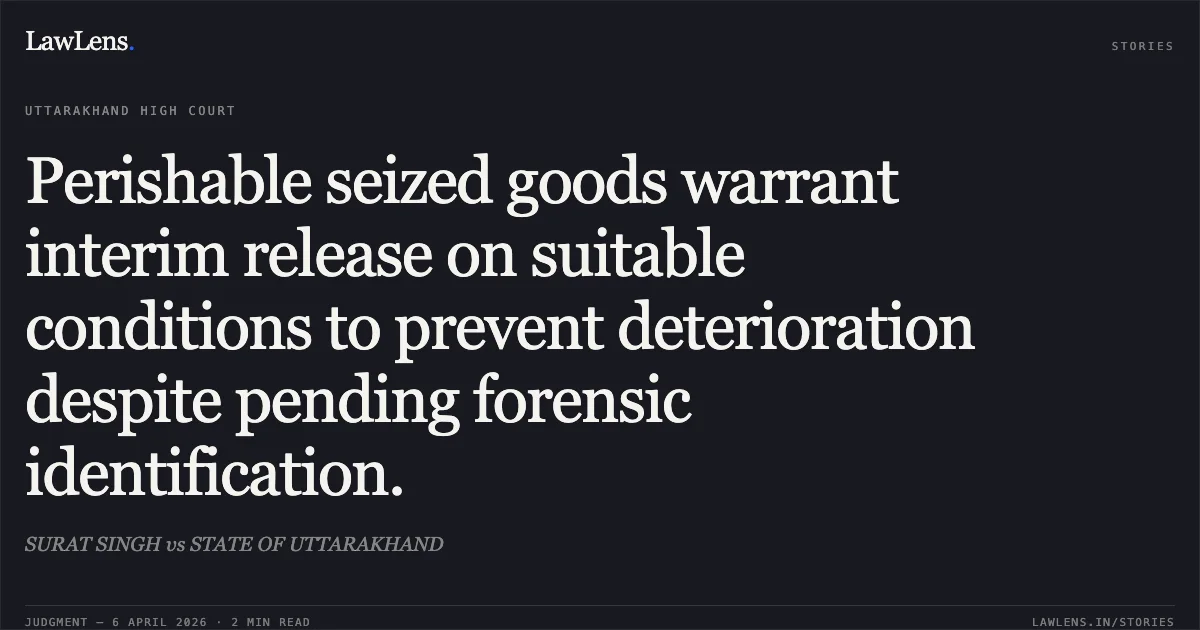
1. Whether the seized herbal material, being perishable in nature, should be released to the applicant pending the final scientific examination report and trial.
Source reference: para. 10, 122. Whether the trial court erred in rejecting the application for release of property solely because the scientific report was awaited.
Source reference: para. 13Law Applied
The Court applied the provisions of the Indian Forest Act, 1927 (Sections 26, 41, and 42) regarding the seizure of forest produce.
Source reference: para. 6The Court primarily relied on the legal principles established by the Hon’ble Supreme Court in Sunderbhai Ambalal Desai v. State of Gujarat (AIR 2003 SC 638), which mandates that seized property should not be kept in police custody for extended periods to prevent decay, damage, or loss of value, and should instead be released to the rightful claimant on appropriate conditions.
Source reference: para. 11Reasoning
The Court noted that while the identity of the herbs ("Saalam Mishri" vs. "Meda/Panja") remained disputed pending the FRI report, the perishable nature of the herbal produce was uncontested.
Source reference: para. 10The Court reasoned that allowing such material to remain in the police malkhana indefinitely would lead to its deterioration and total loss of commercial value.
Source reference: para. 12Applying the mandate of Sunderbhai Ambalal Desai, the Court observed that the interests of justice require interim release with safeguards rather than indefinite retention.
Source reference: para. 11-12Consequently, the Court found that the Magistrate’s refusal to consider the release of the goods on suitable conditions was unsustainable.
Source reference: para. 13The Court emphasized that a detailed inventory and sampling by the Investigating Officer would suffice to preserve evidence for trial while preventing economic waste.
Source reference: para. 14Holding
The High Court allowed the application and set aside the order dated December 2, 2025, to the extent that it denied the release of the herbs.
The Court directed the Judicial Magistrate, Purola, to release the seized material to the applicant subject to four conditions: (i) furnishing adequate security/bond equivalent to the assessed value; (ii) preparation of a detailed inventory, photographs, and representative samples by the Investigating Officer; (iii) an undertaking to produce the material if required during trial; and (iv) the release being subject to the final outcome of the proceedings.
Source reference: para. 14The Court clarified that these observations do not reflect an opinion on the merits of the underlying criminal case.
Source reference: para. 15Acts & Sections Cited
4 provisions across 2 statutes referred to in this judgment. Each provision opens on LawLens.
Indian Forest Act, 19273
Bharatiya Nagarik Suraksha Sanhita, 20231
Original Court PDF
SURAT SINGHvsSTATE OF UTTARAKHAND
Click to open original judgment
Original judgment, available to read, download and summarize on LawLens.in