Facts
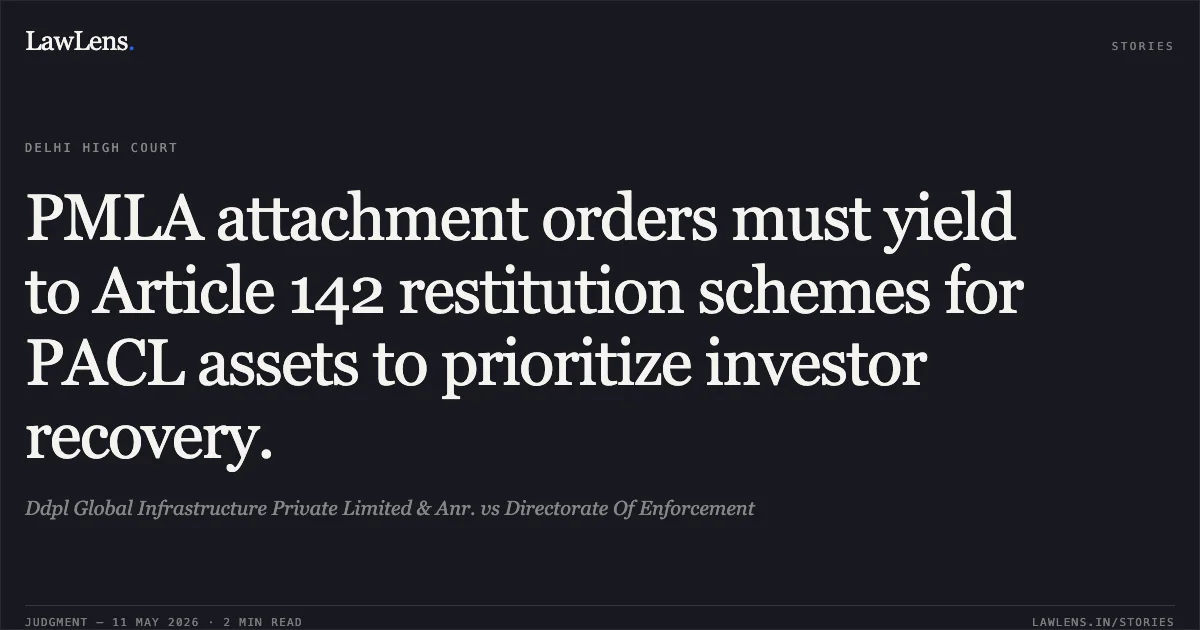
The Petitioners challenged provisional attachment orders issued by the Directorate of Enforcement (ED) in 2022.
Source reference: para. 1These assets were allegedly linked to a fraud involving PACL Ltd.
Source reference: para. 8Previously, the Supreme Court, exercising powers under Article 142, had appointed the Justice R.M. Lodha Committee to sell PACL-related assets and restitute investors.
Source reference: para. 8-9While the High Court had initially stayed the ED's attachment orders, the ED filed applications seeking to dispose of the writ petitions by offering to restore the attached properties to the Lodha Committee under the restitution scheme of Section 8(8) of the PMLA.
Source reference: para. 4The Petitioners agreed to the relegation but argued the attachment orders should be set aside first.
Source reference: para. 5Issues
1. Whether the statutory powers of attachment under the PMLA should yield to the special mechanism created by the Supreme Court under Article 142 for the restitution of PACL investors
Source reference: para. 6, 142. Whether the ED can invoke Section 8(8) of the PMLA to restore property to a Committee when the property was attached without prior consultation with said Committee
Source reference: para. 13, 26Law Applied
The court primarily considered the interaction between the Prevention of Money-Laundering Act, 2002 (PMLA)—specifically Section 5 (attachment), Section 8(8) (restitution), and Rule 3A of the Confiscation Rules, 2016—and the Supreme Court's directions under Article 142 of the Constitution.
Source reference: para. 14-16It relied on the precedent of Subrata Bhattacharya v. SEBI, which established that functions discharged in the interest of investors under Article 142 entrustment take priority over independent statutory functions to prevent overreaching the Court's jurisdiction.
Source reference: para. 14Reasoning
The Court reasoned that while statutory powers are generally not curtailed by courts, the "special scheme" for PACL mandates a modified application of the PMLA.
Source reference: para. 14It noted a "stark contrast" between the PMLA's goal (vesting property in the Central Government) and the Supreme Court's goal (restitution to investors).
Source reference: para. 15, 26The Court found that the ED’s attempt to use Section 8(8) was misplaced because that section is an exception requiring Special Court satisfaction post-charge sheet, whereas the Lodha Committee operates under a separate constitutional mandate.
Source reference: para. 17-18Furthermore, the ED’s own prior conduct—where it previously fed investigative findings to the Lodha Committee rather than invoking PMLA—showed an acknowledgment that the Committee was the proper venue.
Source reference: para. 22-25Since the attachment orders had served their preservative purpose and the petitioners provided undertakings not to alienate assets, the Court found that maintaining the PMLA proceedings would hinder rather than help the investors.
Source reference: para. 27-31Holding
The Court allowed the ED's applications but set aside the Impugned Attachment Orders.
It held that the matter must be relegated to the Justice R.M. Lodha Committee to be decided in accordance with the Supreme Court-mandated scheme.
Source reference: para. 32The Petitioners were directed not to dissipate, alienate, or create any encumbrance on the subject properties until the Lodha Committee completes its final adjudication.
Source reference: para. 33The writ petitions were disposed of accordingly.
Source reference: para. 35Acts & Sections Cited
6 provisions across 1 statute referred to in this judgment. Each provision opens on LawLens.
Prevention of Money-Laundering Act, 20026
Original Court PDF
Ddpl Global Infrastructure Private Limited & Anr.vsDirectorate Of Enforcement
Click to open original judgment
Original judgment, available to read, download and summarize on LawLens.in