Facts
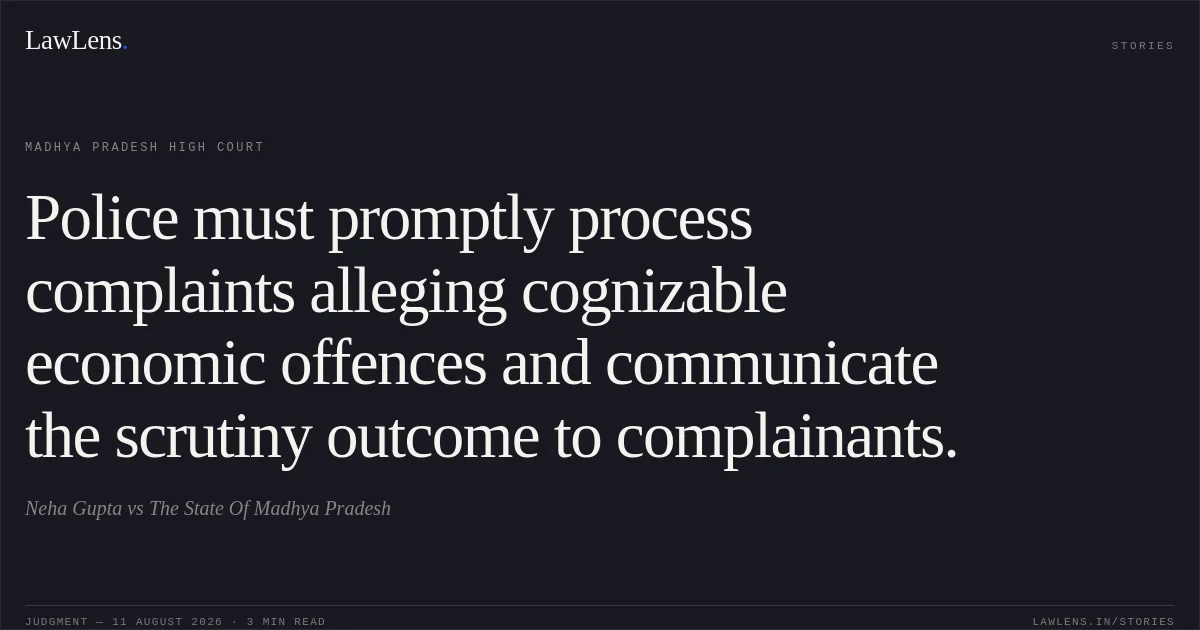
The petitioner, Neha Gupta, alleged that her husband, Lucky Vijayvargiya, had committed cognizable offences involving cyber fraud, cheating, criminal breach of trust, forgery and identity theft.
Source reference: para. 2She submitted a complaint before the competent police authorities, including Police Station Annapurna, Indore, alleging offences punishable under Sections 316(2) and 318(4) of the Bharatiya Nyaya Sanhita, 2023.
Source reference: para. 2The petitioner claimed that despite the lapse of more than three months, the police had neither registered an FIR nor taken appropriate action on her complaint.
Source reference: para. 2She therefore invoked Article 226 of the Constitution seeking registration of a separate FIR, a fair and time-bound investigation, protection of her financial and digital identity, and a direction that the allegations not be treated merely as a matrimonial dispute.
Source reference: para. 1Issues
Whether the police authorities were required to examine and take appropriate action on the petitioner’s complaint alleging cognizable offences under Sections 316(2) and 318(4) of the BNS, 2023, including registration of an FIR if a cognizable offence was disclosed.
Source reference: paras. 2–4Whether the police were required to process the complaint within the time limits and in accordance with the procedure laid down in Lalita Kumari and Rajendra Singh Pawar, and to communicate the outcome to the petitioner.
Source reference: paras. 2–4Law Applied
The Court applied Sections 316(2) and 318(4) of the Bharatiya Nyaya Sanhita, 2023, concerning the offences alleged by the petitioner.
Source reference: para. 2It relied on Lalita Kumari v. Government of Uttar Pradesh, (2014) 2 SCC 1, which requires registration of an FIR where the information discloses a cognizable offence, subject to the legally recognised scope of preliminary inquiry.
Source reference: para. 2The Court also relied on Rajendra Singh Pawar & Others v. State of Madhya Pradesh & Others, (2021) 2 MPLJ 100, which directs police authorities to examine complaints, conduct a preliminary inquiry where necessary, register an FIR if a cognizable offence is disclosed, or otherwise proceed under Section 156 of the CrPC and inform the complainant of the result.
Source reference: para. 3Complaints are ordinarily to be processed within 15 days and, for recorded reasons, within a maximum period of 42 days; complaints must also be entered in the General Diary under M.P. Police Regulation 634.
Source reference: para. 3Reasoning
The Court noted that the petitioner had alleged cognizable economic and cyber-related offences and that her complaint had remained unattended for an extended period.
Source reference: para. 2Applying the principles reiterated in Rajendra Singh Pawar, the Court held that the Station House Officer was required to scrutinise the complaint, undertake a preliminary inquiry if necessary, and either register an FIR where cognizable offences were disclosed or take the legally appropriate alternative action and communicate the result to the petitioner.
Source reference: paras. 3–4Rather than directly ordering registration of an FIR or directing a particular investigative agency, the Court required the competent police officer to consider the complaint and take appropriate action in accordance with the applicable law and the stated procedural safeguards.
Source reference: para. 4Holding
The writ petition was disposed of with a direction to Respondent No. 5, the Station House Officer, Police Station Annapurna, District Indore, to consider the petitioner’s complaint and take appropriate action in accordance with the principles set out above within 120 days from receipt of the certified copy of the order.
The police were further directed to communicate the result of the scrutiny and the action taken to the petitioner.
Source reference: para. 4The Court did not itself order registration of an FIR, but required the police to determine the complaint in accordance with law.
Source reference: para. 4Acts & Sections Cited
3 provisions across 2 statutes referred to in this judgment. Each provision opens on LawLens.
Bharatiya Nyaya Sanhita, 20232
Code of Criminal Procedure, 19731
Original Court PDF
Neha GuptavsThe State Of Madhya Pradesh
Click to open original judgment
Original judgment, available to read, download and summarize on LawLens.in