Facts
The appellants applied for Panchayat/Prakhand Teacher posts under the 2006 and 2008 Rules but were not initially appointed.
Source reference: para 4Years later (2012–2017), upon learning of vacancies caused by resignations or deaths of previously appointed teachers, the appellants approached District Appellate Authorities.
Source reference: para 5The District Authorities directed their appointment based on the old 2006/2008 merit lists, despite the 2012 Rules being in force, which required passing the Teacher Eligibility Test (TET).
Source reference: para 45.1, 46.4The State later challenged these appointments before the State Appellate Authority, which set aside the appointments with retrospective effect and ordered salary recovery.
Source reference: para 7A Single Judge upheld the State Authority's order, leading to these intra-court appeals.
Source reference: para 9Issues
1. Whether the State Appellate Authority order, passed in the absence of a Chairman (Judicial), suffers from the vice of coram non judice?
Source reference: para 412. Whether the delay of six years in filing appeals by the State could be condoned?
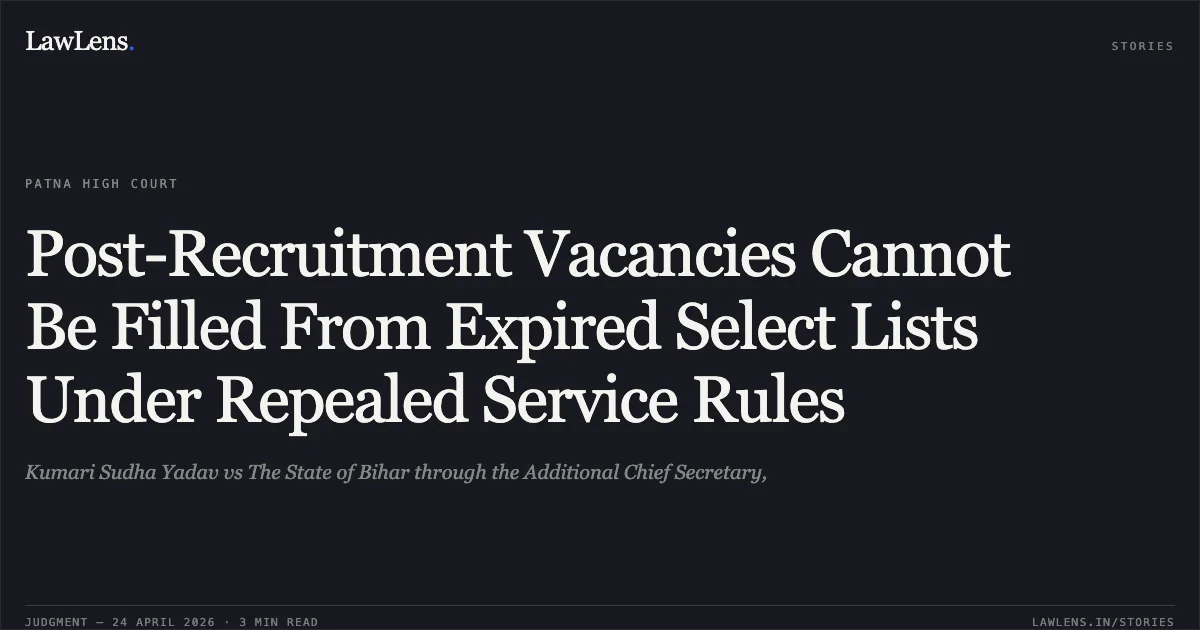
Source reference: para 423. Whether the life of a merit list from the 2006–2008 selection process can revive for vacancies arising in 2012 and onwards?
Source reference: para 444. Whether the direction for retrospective termination and recovery of salary is legally sustainable?
Source reference: para 46Law Applied
The court applied the Bihar State Teaching Institutions Teachers and Employees (Disputes Redressal and Appeal) Rules, 2020, specifically Rules 3 and 4 regarding the constitution of the State Appellate Authority.
Source reference: para 41.1-41.2It relied on L. Chandra Kumar v. Union of India regarding the necessity of judicial members in tribunals.
Source reference: para 41.4On limitation, it applied the principle that "substantial justice must prevail over technicalities" from Collector Land Acquisition v. Mst. Katiji.
Source reference: para 16, 42.4Regarding merit lists, it applied the doctrine that a panel's life is typically one year and cannot be a perennial reservoir for appointments, citing State of Orissa v. Rajkishore Nanda and Ali Hossain Mandal v. West Bengal Board of Primary Education.
Source reference: para 44.3, 44.4For salary recovery, it distinguished Rita Mishra v. Director, Primary Education and R. Vishwanatha Pillai v. State of Kerala, noting recovery is barred if the appointment wasn't based on forgery.
Source reference: para 46.6Reasoning
The court reasoned that Rule 4(iii) of the 2020 Rules allows the Chairman (Administrative) to function independently unless complex legal interpretations are required, thus the order was not coram non judice.
Source reference: para 41.9, 41.13Delay was condoned because the State was not impleaded in the original District Authority proceedings, and public interest warranted a merit-based review of illegal appointments.
Source reference: para 42.5On the merits, the court held that once the 2006/2008 recruitment process concluded, the merit lists evaporated; vacancies arising later (due to resignation/death) are "future vacancies" governed by the 2012 Rules, which mandate TET qualification—a requirement the appellants did not meet.
Source reference: para 11, 44.7, 45.1However, because the appellants' appointments were based on (erroneous) judicial orders rather than personal forgery or fraud, the court found the order for salary recovery and retrospective effect of termination to be inequitable.
Source reference: para 46.6, 50Holding
The Court dismissed the appeals but modified the impugned judgment.
(1) the State Appellate Authority order was validly constituted; (2) the appellants’ appointments were illegal as the merit lists had expired and they lacked TET qualifications; (3) the order for recovery of salary is set aside, and salary paid for services actually rendered shall not be recovered; and (4) the termination of the appellants shall take effect prospectively from the date of the State Appellate Authority’s order, rather than retrospectively.
Source reference: para 47, 49, 56-57, 56Acts & Sections Cited
10 provisions across 5 statutes referred to in this judgment. Each provision opens on LawLens.
BIHAR PANCHAYAT RAJ ACT, 20063
Right of Children to Free and Compulsory Education Act, 20091
Bihar Private Schools ( Fee Regulation) Act, 20191
Indian Penal Code, 18603
Original Court PDF
Kumari Sudha YadavvsThe State of Bihar through the Additional Chief Secretary,
Click to open original judgment
Original judgment, available to read, download and summarize on LawLens.in