Facts
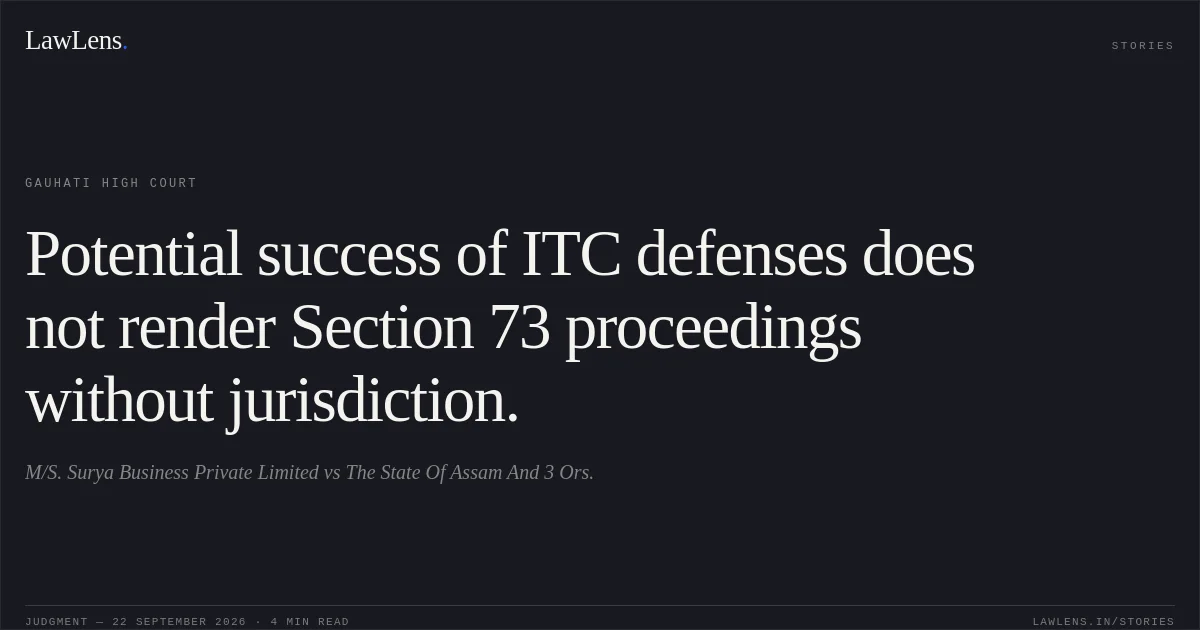
The appellant, a GST-registered private company carrying on business in Jorhat, Assam, was selected for audit under Section 65 of the Assam Goods and Services Tax Act, 2017 (“AGST Act”) for FY 2018–2019.
Source reference: p.3, para.3; p.4, para.4During the audit, the department alleged wrongful availment of Input Tax Credit (“ITC”) of approximately ₹27.25 lakh because invoices relating to inward supplies from M/s. Atikur Rahman did not appear in the appellant’s GSTR-2A.
Source reference: p.3, para.3; p.4, para.4The appellant contended that it possessed valid tax invoices, had received the supplies, and had paid the consideration, including GST, through banking channels.
Source reference: p.4, para.4It also argued that GSTR-2A was only a facilitative statement and could not, by itself, justify denial of ITC.
Source reference: p.4, para.4After issuance of the audit report in Form GST ADT-02 on 08.01.2024, the department issued a show-cause notice under Section 73(1) on 11.01.2024 proposing recovery of ITC, interest and penalty.
Source reference: p.4, para.5The learned Single Judge declined to quash the notice but granted the appellant 30 days to submit its reply and raise all factual and legal contentions before the proper officer.
Source reference: p.4, para.6; p.5, para.7The appellant challenged that decision in the intra-court appeal.
Source reference: no citationIssues
1. Whether the show-cause notice under Section 73(1) of the AGST Act was liable to be quashed because the alleged ITC mismatch was based principally on non-reflection of invoices in GSTR-2A, despite the appellant’s claim of valid invoices, receipt of supplies and payment of tax to the supplier?
Source reference: p.5, paras.10–142. Whether the existence of the appellant’s factual and legal defences, including the alleged default of the supplier and the decision in National Plasto Molding v. State of Assam, rendered the initiation of proceedings without jurisdiction?
Source reference: p.6, paras.12–14; p.8, paras.20–223. Whether the absence of a counter-affidavit by the respondents required the appellant’s assertions to be treated as undisputed and the show-cause notice to be quashed?
Source reference: p.7, paras.15–174. Whether the direction excluding the period from 12.01.2024 to 10.08.2026 while computing the limitation period under Section 73(10) of the AGST Act was sustainable?
Source reference: p.8, para.23; p.9, paras.24–25Law Applied
The Court applied Sections 65, 73(1), 73(10) and 75 of the AGST Act: Section 65 permits departmental audit; Section 73(1) authorises initiation of proceedings for tax not paid or short-paid, or ITC wrongly availed or utilised, without an allegation of fraud; Section 73(10) governs the limitation for passing the adjudication order; and Section 75 governs the adjudication process and consideration of the assessee’s defence.
Source reference: p.3, para.3; p.4, para.5; p.8, para.21; p.9, paras.23–25The Court held that a show-cause notice initiating statutory proceedings is not itself an adjudication of liability and ordinarily should not be quashed when the issuing authority has jurisdiction.
Source reference: p.5, paras.10–11; p.8, paras.20–22It further recognised that the appellant could rely before the proper officer on Union of India v. Bharti Airtel Ltd., (2022) 4 SCC 328, and National Plasto Molding v. State of Assam, 2024 SCC OnLine Gau 1595, concerning the evidentiary and legal significance of GSTR-2A and the position of a bona fide purchaser.
Source reference: p.4, para.4; p.6, paras.12–14Reasoning
The Court held that the appellant’s claims regarding valid invoices, actual receipt of goods, payment through banking channels, and the supplier’s compliance were matters requiring factual adjudication by the proper officer, not grounds for quashing the notice at the threshold.
Source reference: p.5, paras.10–11Although the Court accepted that ITC entitlement could not be determined merely by referring to a single electronic statement such as GSTR-2A, it declined to decide the ultimate ITC entitlement in writ jurisdiction while the statutory proceedings remained pending.
Source reference: p.5, para.10; p.6, para.14The alleged failure to first proceed against the supplier did not eliminate the department’s jurisdiction to examine the recipient’s alleged wrongful availment or utilisation of ITC; it was only a defence on the merits.
Source reference: p.8, paras.20–22Similarly, the absence of a counter-affidavit could not convert the appellant’s pleadings into a final adjudication because the statutory authority had not yet determined the show-cause notice.
Source reference: p.7, paras.15–17The short interval between the audit report and the show-cause notice did not, by itself, establish predetermination, since the audit findings could legitimately form the basis for initiating proceedings.
Source reference: p.7, paras.18–19Finally, because the appellant had obtained interim protection and the statutory proceedings could not progress during the writ proceedings, the Court upheld exclusion of that period for limitation purposes.
Source reference: p.9, paras.24–25Holding
The Division Bench dismissed the appeal and affirmed the learned Single Judge’s judgment dated 10.08.2026 in WP(C) No. 528/2024.
It held that the show-cause notice under Section 73(1) of the AGST Act was not without jurisdiction and that the appellant must raise its factual and legal defences, including its reliance on GSTR-2A-related principles and National Plasto Molding, before the proper officer.
Source reference: p.6, paras.13–14; p.10, paras.26–29The direction excluding the period from 12.01.2024 to 10.08.2026 while calculating limitation under Section 73(10) was also upheld.
Source reference: p.9, paras.23–25Acts & Sections Cited
3 provisions across 1 statute referred to in this judgment. Each provision opens on LawLens.
ASSAM GOODS AND SERVICES TAX ACT, 20173
Original Court PDF
M/S. Surya Business Private LimitedvsThe State Of Assam And 3 Ors.
Click to open original judgment
Original judgment, available to read, download and summarize on LawLens.in