01Facts
The respondents were employees of Government, semi-Government, cooperative, and other establishments covered by the EPF and EPS 1995.
¶ 2Their employers and they contributed on salary above the Rs. 6,500 ceiling, and EPFO accepted those contributions.
¶ 5(a)Several respondents retired before 01.09.2014, when Para 11 of the EPS was amended to introduce a fresh joint option regime and a Rs. 15,000 ceiling.
¶ 5(c), 16Pensions were initially fixed on the ceiling wage, but after R.C. Gupta v. RPFC, (2018) 14 SCC 809, EPFO issued a circular on 23.03.2017 directing revision of pensions, and revised PPOs were issued to many respondents.
¶ 5(e)–(f), 11.2On 20.03.2021, EPFO's Head Office directed Regional Offices to keep that circular in abeyance pending SLP(C) Nos. 8658–59/2019. Enhanced pensions were then withdrawn, and in several cases the withdrawal was based on the failure to produce the joint option.
¶ 20, 21, 13.3–13.4The Single Judge allowed the writ petitions on 15.06.2022 and dismissed EPFO's review petitions on 06.10.2023. Meanwhile, the Supreme Court in Sunil Kumar B. (Larger Bench, three judges) decided the matter on 04.11.2022. EPFO appealed on 01.12.2023.
¶ 15, 26, 25, 5(r)The respondents' stated retirement dates vary, and in many cases the record lacks the date of superannuation.
¶ 12–13.502Issues
i.1. Whether employees who retired before 01.09.2014 without exercising an option under the un-amended Para 11(3) of the EPS 1995 before cessation of membership can claim enhanced pension on actual wages under R.C. Gupta in light of Sunil Kumar B.
¶ 15, 27–28, 39–42, 54–57ii.2. Whether the Single Judge's orders dated 15.06.2022 and 06.10.2023 can be sustained in view of Sunil Kumar B., Para 50.
¶ 64–65iii.3. Whether individual employees whose joint options were exercised during service fall in a different category and require individual verification.
¶ 60–62, 66–6703Law Applied
Para 11(3) of the EPS 1995 (un-amended) allowed higher pensionable salary where the employer and employee opted for contributions above the ceiling and 8.33% was remitted to the Pension Fund.
¶ 33, 49R.C. Gupta v. RPFC, (2018) 14 SCC 809, held that the proviso to Para 11(3) had no cut-off date and that the option could be exercised during service.
¶ 32–33, 38–39Sunil Kumar B., (2023) 12 SCC 701, upheld the 2014 amendment, held that the R.C. Gupta cut-off principle stands but requires the option to be exercised during the subsistence of the employer-employee relationship, and directed under Para 50.3, 50.4, 50.7 and 50.8 that employees who retired before 01.09.2014 without exercising an option "have already exited from the membership" and are not entitled to the judgment's benefit, while those who retired after exercising the option remain governed by the pre-amendment Para 11(3).
¶ 50, 54–57The Explanation to Para 6 of the Amended EPS provides that membership ceases on attaining 58 years or on vesting of benefits.
¶ 52–53Krishena Kumar v. Union of India, (1990) 4 SCC 207, and Otis Elevators, (2003) 12 SCC 68, draw the distinction between PF and pension regimes.
¶ 24, 45The Supreme Court's order in Power Grid Retired Employees Association (W.P.(C) No. 97/2025, dated 19.03.2025) was referred to.
¶ 63Provisions in the judgment · 2
Employees’ Provident Funds And Miscellaneous Provisions Act, 1952 Section 6ASection 17
04Reasoning
The Court held that the Single Judge's reliance on R.C. Gupta overlooked the Sunil Kumar B. directions, which are binding under Article 141.
¶ 64The option under the pre-amendment Para 11(3) presupposes a subsisting employer-employee and membership relationship, and a retiree who has ceased to be a member cannot exercise it. The Court therefore rejected the argument that R.C. Gupta's no-cut-off principle permits post-retirement options.
¶ 37–41, 52The Single Judge's view that the EPFO's 23.03.2017 circular created a vested entitlement could not override the Supreme Court's direction that pre-01.09.2014 retirees without an option are excluded.
¶ 40, 42Considering the EPFO's own 2021 circular and the Supreme Court's categorisation, the Court found the Single Judge's orders inconsistent with Para 50.
¶ 64The Court noted that the enhanced benefits were in several cases "bounty" rather than a post-retirement sustenance amount, given arrears paid from the date of retirement.
¶ 59Where the joint option was exercised during service and the employer remitted contributions on actual salary, the case falls within the Sunil Kumar B. protection and the benefit was rightly extended. These cases were therefore left undisturbed.
¶ 60–62Because the record is incomplete for many respondents, the Court directed factual verification of each case rather than a blanket decision.
¶ 66–67The Court did not separately decide the natural-justice and promissory-estoppel contentions advanced by the respondents.
05Holding
The Single Judge's orders dated 15.06.2022 and 06.10.2023 are set aside to the extent they are inconsistent with Sunil Kumar B., Para 50.
¶ 65Employees who retired before 01.09.2014 without exercising an option under pre-amendment Para 11(3) have exited the membership and are not entitled to enhanced pension under this judgment.
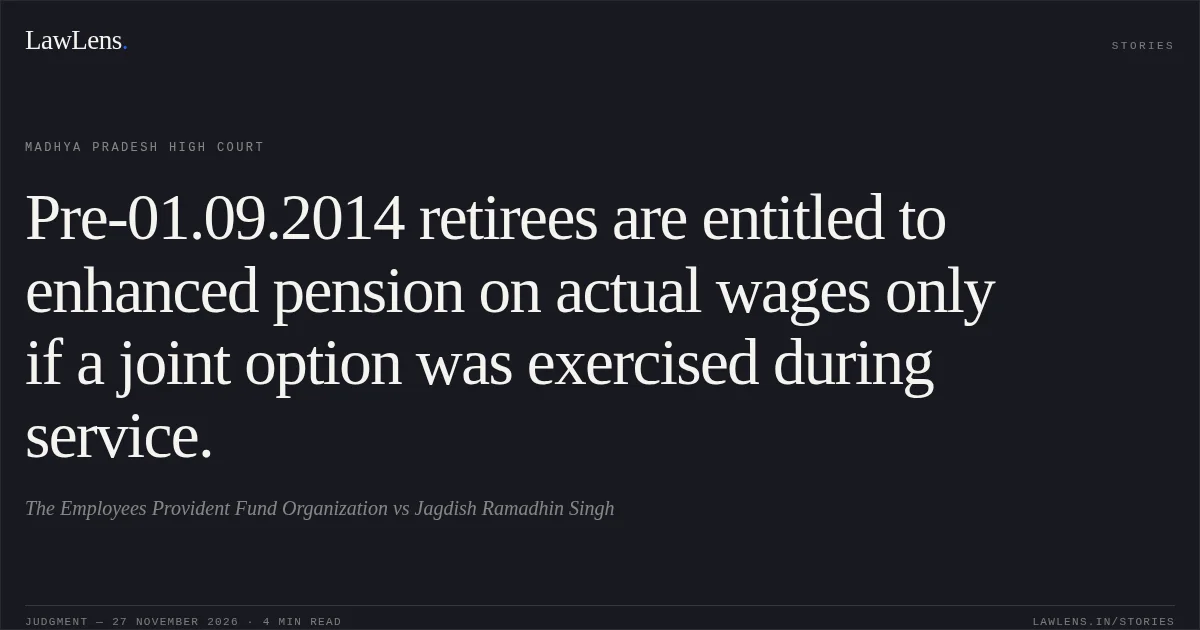
¶ 64–65 · Sunil Kumar B., Para 50.7Employees who exercised the option during service and whose employer also remitted contributions on actual salary are covered by Para 50.3, 50.4, 50.7 and 50.8 and are to be assessed individually.
¶ 66–67The EPFO is directed to undertake a factual verification of each petitioner/employee within three months of receipt of the judgment and to decide each case accordingly.
¶ 67The Writ Appeals are allowed and disposed of in these terms.
¶ 68Original Court PDF
The Employees Provident Fund OrganizationvsJagdish Ramadhin Singh
Click to open original judgment
Original judgment, available to read, download and summarize on LawLens.in