Facts
The appellant, a candidate with a benchmark locomotor disability (PwBD), applied for the post of Assistant Professor in Information Technology and Computer Science Engineering under two recruitment advertisements (Advertisement No. 1 dated 10.09.2021 and Advertisement No. 2 dated 27.02.2023)
Source reference: p. 2-6Prior to these advertisements, the University's Board of Management had approved a "Recruitment Document" on 20.07.2021, which mandated a minimum suitability threshold of 50% marks for selection
Source reference: p. 4-5Although the appellant participated in the screening, presentation, and interview, he scored 37.2% under the first advertisement and 38%/37% under the second
Source reference: p. 8, 11Consequently, the Selection Committee found him unsuitable as he failed to meet the 50% benchmark
Source reference: p. 8The appellant challenged his non-selection, arguing that the 50% threshold was not disclosed in the advertisements and constituted a "change in the rules of the game" after the process had commenced.
Source reference: p. 6, 8The learned Single Judge dismissed the writ petitions, leading to these intra-court appeals
Source reference: p. 6, 8Issues
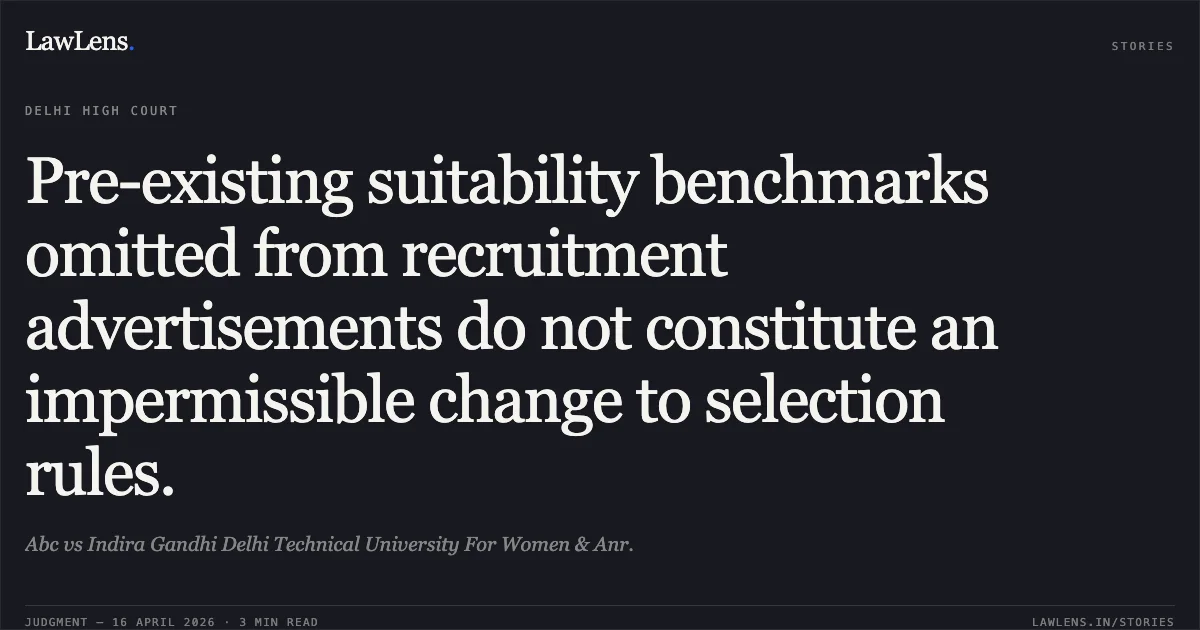
1. Whether applying a 50% suitability benchmark, which was not explicitly mentioned in the recruitment advertisement but existed in internal guidelines prior to the advertisement, constitutes an impermissible "change in the rules of the game"
Source reference: p. 8-92. Whether the non-selection of a PwBD candidate for failing to meet a suitability threshold violates the provisions of the Rights of Persons with Disabilities Act, 2016 (RPwD Act)
Source reference: p. 10, 15Law Applied
The court primarily applied the principle established by the Constitution Bench of the Supreme Court in Tej Prakash Pathak v. High Court of Rajasthan (2025), which mandates that the norms or rules of a recruitment process, including suitability criteria, cannot be altered once the process has commenced
Source reference: p. 9, 12The court also considered the Rights of Persons with Disabilities Act, 2016, regarding the statutory obligation to provide reservation and ensure non-discrimination for PwBD candidates
Source reference: p. 10, 15Furthermore, it upheld the University’s internal "Recruitment Document" approved by the Board of Management under the relevant Delhi Act No. 9 of 2012 as the governing regulatory framework for selection
Source reference: p. 4, 14Reasoning
The Court determined that there was no "change in the rules of the game" because the 50% suitability threshold was approved by the Board of Management on 20.07.2021, which predated both Advertisement No. 1 (10.09.2021) and Advertisement No. 2 (27.02.2023)
Source reference: p. 12-13Thus, the norm was already in existence at the time of recruitment, distinguishing this case from the facts in Tej Prakash Pathak
Source reference: p. 13The Court further reasoned that the absence of minor procedural details, such as the specific suitability score, in a general recruitment advertisement does not vitiate the selection process so long as the pre-existing guidelines are followed
Source reference: p. 14-15Regarding the RPwD Act, the Court observed that the University had fulfilled its statutory duty by reserving posts and allowing the appellant to participate; however, the Act does not mandate the appointment of a PwBD candidate who fails to meet the objectively prescribed suitability benchmark
Source reference: p. 15Holding
The Court dismissed the appeals, holding that the application of a pre-existing 50% suitability threshold was legally valid even if omitted from the advertisement text
The Court answered the issues by stating that no prejudice or discrimination occurred under the RPwD Act as the appellant was allowed to compete but failed to secure the minimum marks
Source reference: p. 15The condonation of delay was granted, but the underlying challenge to the selection process was rejected
Source reference: p. 2, 16No order as to costs was made
Source reference: p. 16Original Court PDF
AbcvsIndira Gandhi Delhi Technical University For Women & Anr.
Click to open original judgment
Original judgment, available to read, download and summarize on LawLens.in