Facts
The Plaintiff instituted a suit on 10.06.2013 seeking a declaration that a 25.05.2005 sale deed executed by his power-of-attorney holder was void, recovery of possession, mesne profits, and consequential reliefs.
Source reference: paras. 4, 7–10The Trial Court framed all issues, including limitation, on 08.07.2015. The Plaintiff thereafter completed his evidence and the Defendants had commenced their evidence.
Source reference: paras. 37–42At that stage, Defendant No. 2 applied under Order XIV Rule 2 CPC, read with Section 151 CPC, for the limitation issue to be tried as a preliminary issue.
Source reference: paras. 37–42The Trial Court allowed the application and dismissed the suit under Article 59 of the Limitation Act. The First Appellate Court affirmed the decision, modifying it as rejection of the plaint under Order VII Rule 11(d) CPC.
Source reference: paras. 37–42The High Court held that limitation involved mixed questions of fact and law and that the suit was governed by Article 65 of the Limitation Act, but remitted the matter for trial on merits.
Source reference: paras. 5, 45–46Issues
Whether an issue of limitation could be tried as a preliminary issue under Order XIV Rule 2(2) CPC after the Court had already embarked upon a common trial of all issues and evidence had been adduced?
Source reference: paras. 21–28, 37–44Whether the mere framing of all issues prevents the subsequent exercise of the power under Order XIV Rule 2(2) CPC to try a qualifying issue first?
Source reference: paras. 21–24, 27–32Whether the applicability of Article 59 or Article 65 of the Limitation Act, and the legal character of the sale deed, could be conclusively determined at the preliminary stage in the present proceedings?
Source reference: paras. 7–11, 45–46Law Applied
Order XIV Rule 2(1) CPC establishes the general rule that the Court must pronounce judgment on all issues, subject to Rule 2(2). Under Order XIV Rule 2(2), the Court may try an issue first only where it is an issue of law only, relates to the jurisdiction of the Court or a statutory bar to the suit, and is capable of disposing of the suit or part thereof without adjudication of disputed facts.
Source reference: para. 17Under Ramesh B. Desai v. Bipin Vadilal Mehta, Nusli Neville Wadia v. Ivory Properties, and Sukhbiri Devi v. Union of India, a mixed question of law and fact cannot ordinarily be tried as a preliminary issue; limitation may be so tried only where its foundational facts are admitted or undisputed.
Source reference: paras. 18–20Order XX Rule 5 CPC requires findings on each issue unless one or more issues are sufficient to decide the suit.
Source reference: para. 25The Court clarified Prithvi Raj Jhingta v. Gopal Singh, approving it only to the extent that once issues have entered a common trial, one issue cannot subsequently be severed and tried first, while rejecting the broader view that Rule 2(2) is available only when the qualifying issue alone was initially framed.
Source reference: paras. 29–32Sathyanath v. Sarojamani was confined to cases where the proposed preliminary issue was a mixed question of law and fact and therefore did not qualify under Rule 2(2).
Source reference: paras. 33–36Section 151 CPC cannot be used to circumvent the express conditions and temporal limits of Order XIV Rule 2.
Source reference: para. 40Reasoning
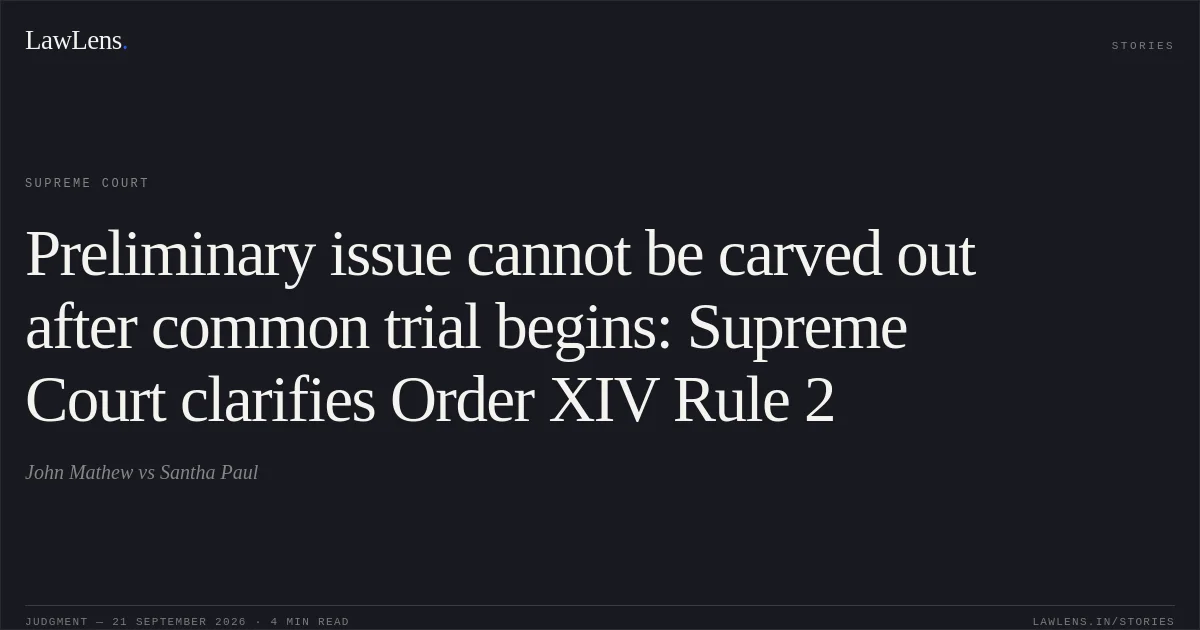
The Supreme Court held that the decisive question was not merely whether all issues had been framed, but whether the Court had already commenced a common trial of those issues.
Source reference: paras. 21–28Although framing all issues does not by itself exhaust the power under Order XIV Rule 2(2), the power to direct that an issue be “tried first” is prospective and cannot be exercised after evidence has been led on the issues generally.
Source reference: paras. 21–28In the present case, the Plaintiff had completed his evidence and the Defendants had entered upon theirs when the application for preliminary determination of limitation was filed. Issue No. 5 was therefore already being tried together with the other issues, and could not retrospectively be converted into a preliminary issue.
Source reference: paras. 37–39The Trial Court and First Appellate Court failed to consider this anterior procedural bar.
Source reference: paras. 41–46The High Court also failed to address the effect of the advanced stage of trial, although it correctly recognised that the limitation question could not be decided without examining disputed matters concerning the authority under the power of attorney.
Source reference: paras. 41–46Consequently, the Supreme Court left open whether Article 59 or Article 65 applied, whether the sale deed was void or voidable, and the ultimate merits of the limitation issue.
Source reference: para. 46Holding
The Supreme Court held that Order XIV Rule 2(2) CPC could not be invoked after the suit had entered a composite trial and evidence had been adduced on the issues generally.
The Trial Court’s order, the First Appellate Court’s judgment, and the High Court’s decision were set aside.
Source reference: para. 48The application seeking preliminary trial of the limitation issue was dismissed, and the suit was restored to the file of the Munsiff Court, Kottarakara, to resume from the stage immediately preceding the interruption caused by that application.
Source reference: para. 48The Trial Court was requested to decide the suit within three months of receiving the judgment.
Source reference: para. 48The Supreme Court clarified that it had expressed no opinion on the merits of the parties’ claims, the applicable limitation provision, or the validity of the sale deed.
Source reference: paras. 46, 49–51Acts & Sections Cited
4 provisions across 2 statutes referred to in this judgment. Each provision opens on LawLens.
Limitation Act, 19632
Code of Civil Procedure, 19082
Original Court PDF
John MathewvsSantha Paul
Click to open original judgment
Original judgment, available to read, download and summarize on LawLens.in