01Facts
The victim, aged approximately 14 years on the date of occurrence, was staying at the house of the respondent, who was her maternal uncle by marriage. On 27 May 2025, the respondent allegedly entered the room where the victim was sleeping, attempted to molest her, forcibly grabbed and touched her, and threatened her against disclosing the incident. The victim later narrated the incident to her brother, who lodged a written report on 13 June 2025.
¶ 2–3 · pp. 2–3Police Station Rajpora registered FIR No. 56/2025 initially under Sections 7/8 of the Protection of Children from Sexual Offences Act, 2012 (“POCSO Act”). During investigation, the victim’s minority was verified, her statement was recorded before a Magistrate under Section 183 of the BNSS, and Section 9 of the POCSO Act was invoked in place of Section 8. The respondent was arrested and subsequently granted bail by the Principal Sessions Judge, Pulwama, by order dated 11 July 2025, during the pendency of investigation.
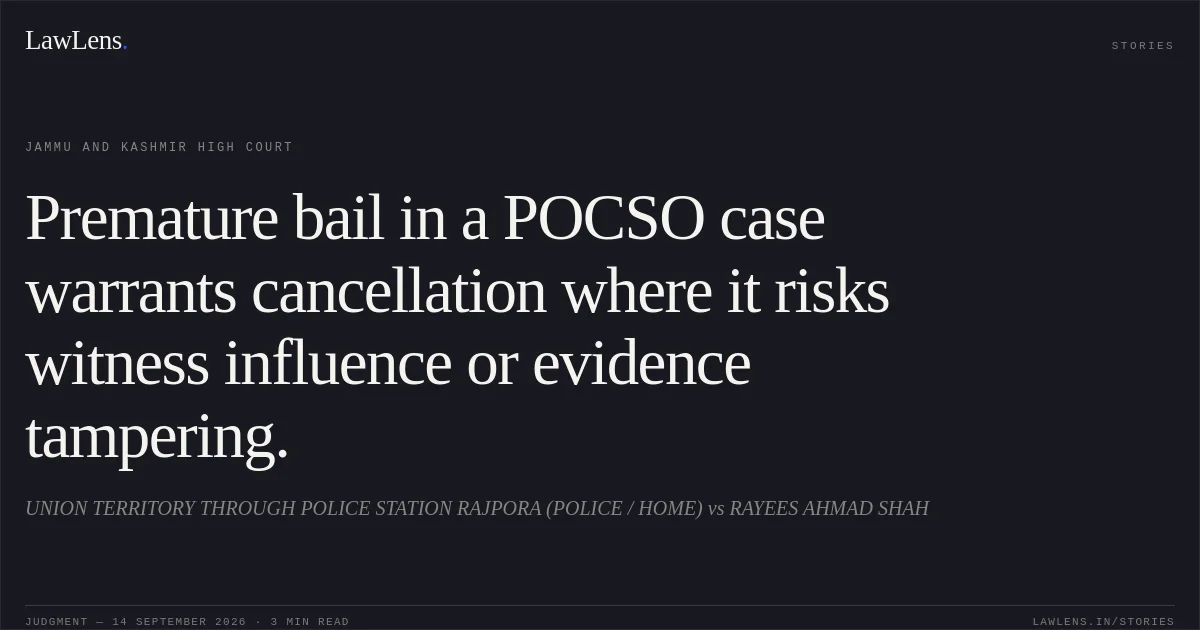
¶ 3 · p. 3 · ¶ 4, 8–10 · pp. 4–5The Union Territory challenged the bail order under Section 483(3) read with Section 528 of the Bharatiya Nagarik Suraksha Sanhita, 2023 (“BNSS”), contending that the order was perverse and failed to account for the seriousness of the allegations and the possibility of the respondent influencing the child victim. The respondent argued that there was no allegation of post-release misuse of liberty, witness intimidation, evidence tampering, or abscondence.
¶ 5–6 · pp. 3–402Issues
i.Whether the bail order granted to the respondent during investigation in a POCSO case was legally perverse and liable to be set aside?
¶ 8–13, 16 · pp. 4–7ii.Whether the circumstances of the case—including the respondent’s close relationship with the child victim, the alleged threat, and the stage of investigation—constituted sufficient grounds for cancellation of bail despite the absence of an allegation of post-release misuse of liberty?
¶ 12–15 · pp. 5–603Law Applied
The Court exercised its jurisdiction under Section 483(3) read with Section 528 of the BNSS to examine the legality and propriety of the bail order.
¶ 1 · p. 1It applied Sections 7 and 9 of the POCSO Act, concerning sexual assault and aggravated sexual assault respectively, and considered the protective object of the POCSO Act in cases involving sexual violence against children.
¶ 1, 10, 12 · p. 1, 5The Court also referred to Sections 29 and 30 of the POCSO Act, which create presumptions regarding the commission of specified offences and culpable mental state, while clarifying that those presumptions ordinarily operate after framing of charge and are not directly determinative of bail at the pre-charge stage.
¶ 11 · p. 5The governing principle for cancellation of bail is that “very cogent and overwhelming circumstances” are required; interference with the administration of justice, attempts to influence witnesses or tamper with evidence, evasion of justice, abuse of the concession of bail, or a real possibility of abscondence may justify cancellation.
¶ 14 · p. 6Provisions in the judgment · 7 · Linked ones open on LawLens
Protection of Children from Sexual Offences Act, 2012 Section 3Section 5Section 7Section 8Section 9Section 29Section 30
04Reasoning
The Court found that the Sessions Court had granted bail during investigation without adequately considering the nature and context of the accusation.
¶ 8, 12 · pp. 4–5The victim had allegedly been sexually assaulted in the house of a close relative, and the respondent was the husband of her maternal aunt, thereby placing him in a position of trust and access.
¶ 8, 12 · pp. 4–5The allegation that the respondent threatened the victim was present in the original complaint, and the victim’s statement before the Magistrate materially supported the prosecution version.
¶ 12 · p. 5Although the Court acknowledged that cancellation of bail requires more than a mere reappraisal of the merits, it held that the premature grant of bail—before completion of investigation and before the victim’s examination at trial—created a substantial possibility that the respondent could pressure or influence the child witness and hamper the prosecution.
¶ 13–15 · pp. 5–6In these circumstances, the bail order was held to suffer from perversity.
¶ 16 · p. 705Holding
The High Court allowed the Union Territory’s petition and set aside the Sessions Court’s order dated 11 July 2025 granting bail to the respondent.
¶ 17 · p. 7The bail granted to Rayees Ahmad Shah was cancelled.
¶ 17 · p. 7He was directed to surrender before the Station House Officer, Police Station Rajpora, if investigation was continuing, or before the competent trial court if the charge-sheet had been filed, within one week of the judgment; failing surrender, coercive steps were authorised to secure his custody.
¶ 17 · p. 7Original Court PDF
UNION TERRITORY THROUGH POLICE STATION RAJPORA (POLICE / HOME)vsRAYEES AHMAD SHAH
Click to open original judgment
Original judgment, available to read, download and summarize on LawLens.in