Facts
The petitioner-landlord challenged the Principal District Judge, Chengalpattu’s order allowing the tenant’s appeal and dismissing the eviction proceedings.
Source reference: paras. 1–4The tenancy had commenced in November 2008, and the last lease agreement expired in November 2018.
Source reference: paras. 1–4No fresh written tenancy agreement was entered into under Section 4(2) of the Tamil Nadu Regulation of Rights and Responsibilities of Landlords and Tenants Act, 2017 (“TNRRRLT Act”).
Source reference: paras. 1–4The landlord thereafter sought vacant possession, but the tenant filed a civil suit for permanent injunction alleging threatened dispossession otherwise than by due process of law.
Source reference: paras. 1–4The landlord instituted proceedings under Sections 21(2)(a) and 21(2)(c) of the TNRRRLT Act, initially numbered RLTOP No. 1 of 2019 and later renumbered as RLTOP No. 67 of 2023.
Source reference: para. 3The Rent Court ordered recovery of possession on 27 November 2023, but the Rent Tribunal reversed that order on 6 September 2024, holding, inter alia, that the eviction petition had been filed before expiry of the statutory 575-day period for entering into a tenancy agreement.
Source reference: paras. 1, 7–8The landlord consequently invoked the High Court’s supervisory jurisdiction under Article 227 of the Constitution.
Source reference: Prayer; para. 1Issues
Whether a landlord’s application for recovery of possession under Section 21(2)(a) of the TNRRRLT Act is premature and not maintainable merely because it was filed before expiry of the 575-day period contemplated under Section 4(2) of the Act
Source reference: paras. 10–13Whether the tenant can rely on the statutory period for execution of a fresh tenancy agreement as a defence where no fresh agreement was entered into and the landlord had no inclination to enter into one
Source reference: paras. 10, 15, 18Whether the divergent decisions concerning the effect of the 575-day period required reference of the matter to a larger Bench, particularly in light of the Division Bench decision in Hemalatha v. Jeevanantham
Source reference: paras. 7, 10, 14–17Law Applied
The Court applied Sections 4(2), 21(2)(a), and 21(2)(c) of the TNRRRLT Act.
Source reference: paras. 3, 10–12Section 4(2), including its amended transitional period of 575 days, concerns the requirement and period for entering into a written tenancy agreement, while Section 21(2)(a) permits recovery of possession upon failure to enter into such an agreement.
Source reference: paras. 3, 10–12The Court relied on Habeeb Hardware v. M.D. Gajarajakumar , Mangilal Ranka v. S. Shohan Singh , Gagan Bothra v. Balamanian , Pushpavalli Suresh Babhu v. M/s. Sopos Technology Pvt. Ltd. , Babitha Devi v. Rajendra Kumar , and V.S. Mohan v. Sarath Naseera for the principle that premature invocation of Section 21(2)(a) is not, by itself, a valid defence where the failure to enter into the tenancy agreement is established.
Source reference: paras. 5–6, 13, 15, 18The Court also considered Ramesh Salunke v. Pramila Jain , Lalith Kumar v. Pramila Jain , and Top Kapi v. S. Sarath Babu , which had taken a contrary or distinguishable view concerning the 575-day period.
Source reference: paras. 7, 13It further considered the Division Bench ruling in Hemalatha v. Jeevanantham , but held that its effect was prospective, applying the principle actus curiae neminem gravabit .
Source reference: paras. 14–17The Court also referred to S.R. Venkatesh v. Union of India and the Supreme Court’s decision in V. Ganesh v. S. Balaji in support of maintainability in comparable circumstances.
Source reference: paras. 14–17Reasoning
The Court found that the tenancy, rent, and failure to execute a fresh tenancy agreement were undisputed.
Source reference: para. 10Although the RLTOP had been filed before expiry of 575 days, the Court held that the statutory period did not permit a tenant to defeat an eviction proceeding where the landlord had clearly declined to enter into a fresh agreement and the statutory failure had occurred.
Source reference: paras. 11–13, 18The Court treated the failure to execute the agreement as legally significant irrespective of whether the tenant was willing to execute one while the landlord avoided doing so.
Source reference: para. 15It distinguished the earlier contrary authorities and held that the Division Bench ruling in Hemalatha operated prospectively and therefore did not govern the already-pending revision petition.
Source reference: para. 14The Court also noted that subsequent authority, including the Supreme Court’s order in V. Ganesh , supported the maintainability of proceedings where the previous lease had expired before commencement of the statutory regime.
Source reference: paras. 16–17Accordingly, the tenant’s objection that the eviction petition was premature was rejected.
Source reference: para. 18Holding
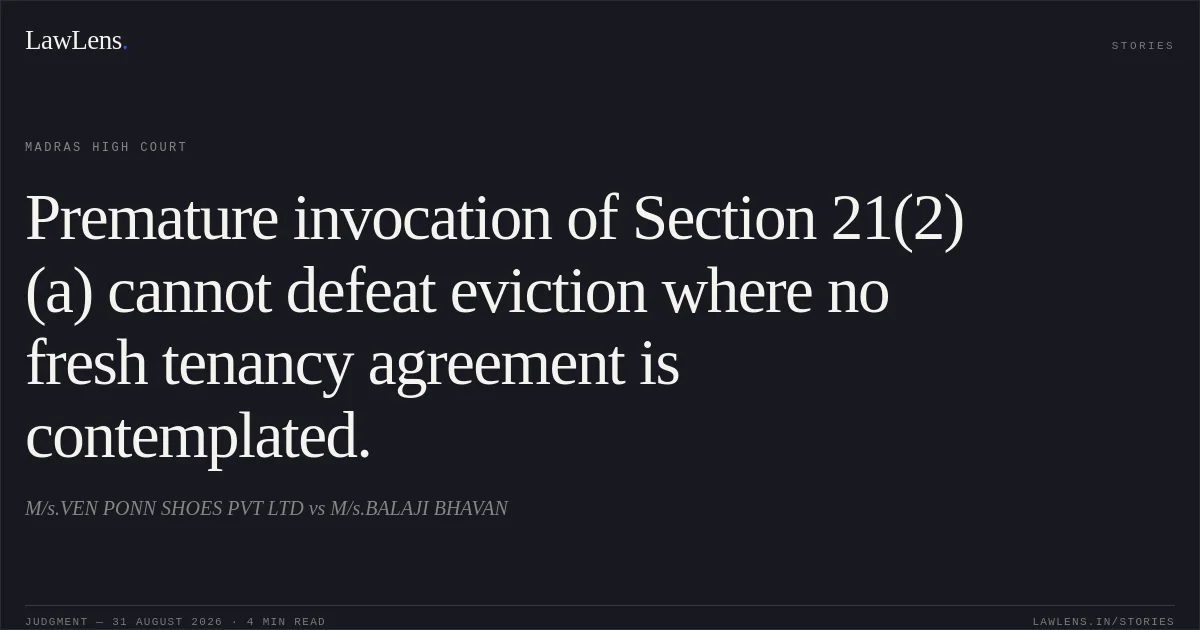
The High Court held that the landlord’s petition under Section 21(2)(a) of the TNRRRLT Act was maintainable notwithstanding its filing before expiry of the 575-day period, particularly since no fresh tenancy agreement had been executed and the landlord was not willing to enter into one.
The Civil Revision Petition was allowed; the Rent Tribunal’s order dated 6 September 2024 in RLTA No. 3 of 2020 was set aside, and the Rent Court’s order dated 27 November 2023 directing recovery of possession in RLTOP No. 67 of 2023 was restored.
Source reference: para. 19The respondents were directed to vacate and hand over vacant possession to the petitioner on or before 30 November 2026.
Source reference: para. 19No costs were awarded, and the connected miscellaneous petition was closed.
Source reference: para. 19Acts & Sections Cited
2 provisions across 1 statute referred to in this judgment. Linked provisions open on LawLens.
Tamil Nadu Regulation of Rights and Responsibilities of Landlords and Tenants Act, 20172
Original Court PDF
M/s.VEN PONN SHOES PVT LTDvsM/s.BALAJI BHAVAN
Click to open original judgment
Original judgment, available to read, download and summarize on LawLens.in