Facts
The petitioner challenged Detention Order No. 18/DMA/PSA/DET/2025 dated 29 April 2025, passed by the District Magistrate, Anantnag under the Jammu and Kashmir Public Safety Act, 1978 (“PSA”), on the ground that his activities were prejudicial to the security of the State/UT of J&K.
Source reference: para. 1The detention was substantially founded on FIR No. 60/2016 registered at Police Station Srigufwara for offences under Sections 147, 148, 149, 336, 332, 353, 307 and 427 RPC; the petitioner had been granted bail in that case.
Source reference: paras. 2, 8He contended that the detention grounds reproduced the police dossier, relied on stale material, failed to disclose a live and proximate connection with any future prejudicial activity, and used vague descriptions such as his being an “OGW” of the LeT outfit.
Source reference: paras. 2, 13–15The respondents maintained that preventive detention was distinct from criminal proceedings and could be ordered despite the pendency of a criminal case or the grant of bail.
Source reference: para. 3Issues
1. Whether the detention order was vitiated by non-application of mind because the detaining authority failed to meaningfully consider the petitioner’s grant of bail in the principal criminal case relied upon for detention?
Source reference: paras. 8–9, 192. Whether the reliance on stale antecedents, particularly FIR No. 60/2016, established a live and proximate nexus between the petitioner’s past conduct and the necessity for present preventive detention?
Source reference: paras. 6–7, 17, 193. Whether the substantial reproduction of the police dossier and the use of vague expressions such as “OGW” rendered the grounds of detention insufficiently specific and indicative of non-application of mind?
Source reference: paras. 10–15, 194. Whether the detention order violated the constitutional and statutory safeguards under Article 22(5) of the Constitution and Section 13 of the PSA by failing to provide grounds enabling an effective representation?
Source reference: paras. 15–16Law Applied
Preventive detention is an exceptional, preventive—not punitive—power and must satisfy Articles 21 and 22(5) of the Constitution and Section 13 of the PSA.
Source reference: paras. 5, 15The detaining authority’s subjective satisfaction is subject to judicial review to determine whether it rests on relevant material, reflects genuine application of mind, excludes extraneous considerations, and maintains a live and proximate link between past conduct and the apprehended future conduct, as held in Khudiram Das v. State of West Bengal, (1975) 2 SCC 81.
Source reference: para. 6Under Rekha v. State of Tamil Nadu, (2011) 5 SCC 244, preventive detention cannot substitute ordinary criminal law; under Sama Aruna v. State of Telangana, (2018) 12 SCC 150, stale conduct cannot justify detention once the live nexus has disappeared.
Source reference: paras. 7, 17Vijay Kumar v. State of J&K, (1982) 2 SCC 43, requires careful application of mind to circumstances relevant to preventive detention.
Source reference: para. 9Jai Singh v. State of J&K, AIR 1985 SC 764, prohibits the detaining authority from acting as a mere conduit for the police dossier.
Source reference: para. 11Vinod Bihari Lal v. State of Uttar Pradesh, 2025 INSC 767, reiterates that failure to consider pertinent and vital material vitiates the detention.
Source reference: para. 12The grounds must be clear, definite and sufficiently detailed to enable an effective representation under Article 22(5) and Section 13, consistent with Ram Krishan Bhardwaj v. State of Delhi, AIR 1953 SC 318, and Thahira Haris v. Government of Karnataka, (2009) 2 SCC 46.
Source reference: para. 15Reasoning
The Court found that although FIR No. 60/2016 was relied upon in the detention dossier, the detaining authority had not meaningfully considered the petitioner’s grant of bail, which was a vital intervening circumstance requiring examination.
Source reference: para. 8The mere presence of the FIR in the record did not establish actual application of mind.
Source reference: para. 8The Court further found that the material relied upon was stale and that no sufficient live and proximate nexus had been demonstrated between the 2016 antecedent and the need for detention in 2025.
Source reference: paras. 17, 19The substantial similarity between the police dossier and the detention grounds suggested that the District Magistrate had adopted the police version without independent evaluation.
Source reference: paras. 10–12Additionally, general assertions that the petitioner was an “OGW” of LeT and posed a danger to law-abiding persons were unsupported by sufficiently concrete and proximate particulars, thereby impairing his ability to make an effective representation.
Source reference: paras. 13–15The subsequent rejection of the petitioner’s representation could not cure defects existing in the original detention order.
Source reference: para. 16Holding
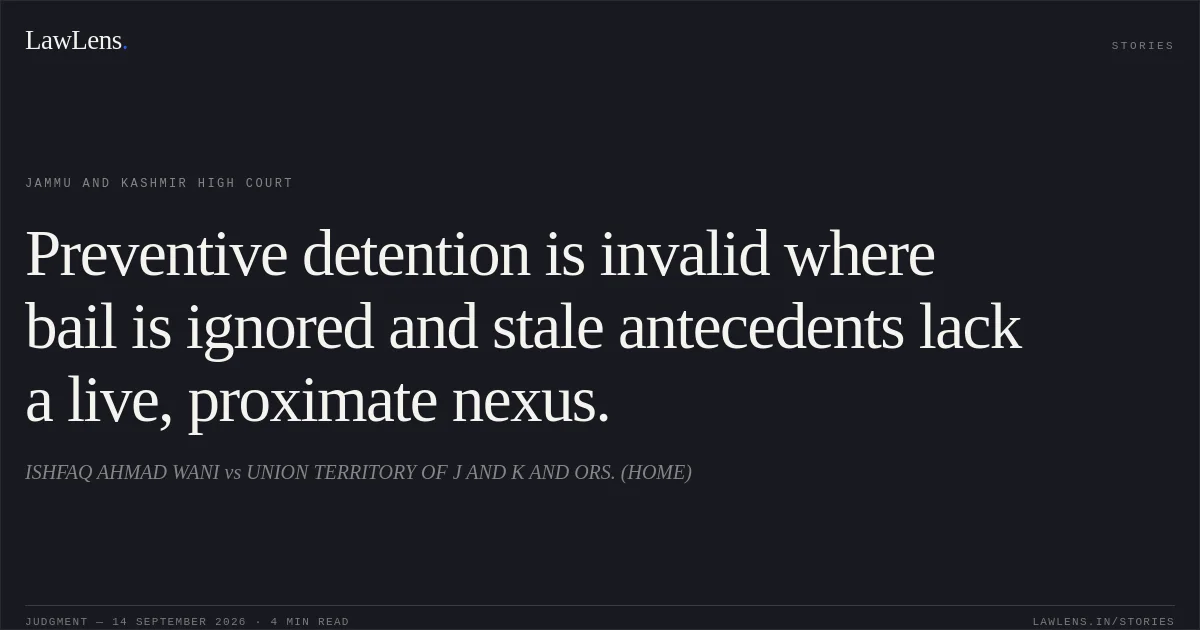
The Court held that the detention order suffered from non-application of mind, reliance on stale and materially weakened antecedents, failure to consider the petitioner’s grant of bail, absence of a live and proximate nexus with the apprehended future conduct, and inadequate specificity in the grounds of detention.
Detention Order No. 18/DMA/PSA/DET/2025 dated 29 April 2025 was therefore quashed.
Source reference: para. 20The respondents were directed to release the petitioner forthwith from preventive detention, unless his custody was required in any other case.
Source reference: para. 20The petition was disposed of accordingly.
Source reference: para. 21Acts & Sections Cited
9 provisions across 2 statutes referred to in this judgment. Linked provisions open on LawLens.
Jammu And Kashmir Public Safety Act, 19781
Ranbir Penal Code, 19898
Original Court PDF
ISHFAQ AHMAD WANIvsUNION TERRITORY OF J AND K AND ORS. (HOME)
Click to open original judgment
Original judgment, available to read, download and summarize on LawLens.in