Facts
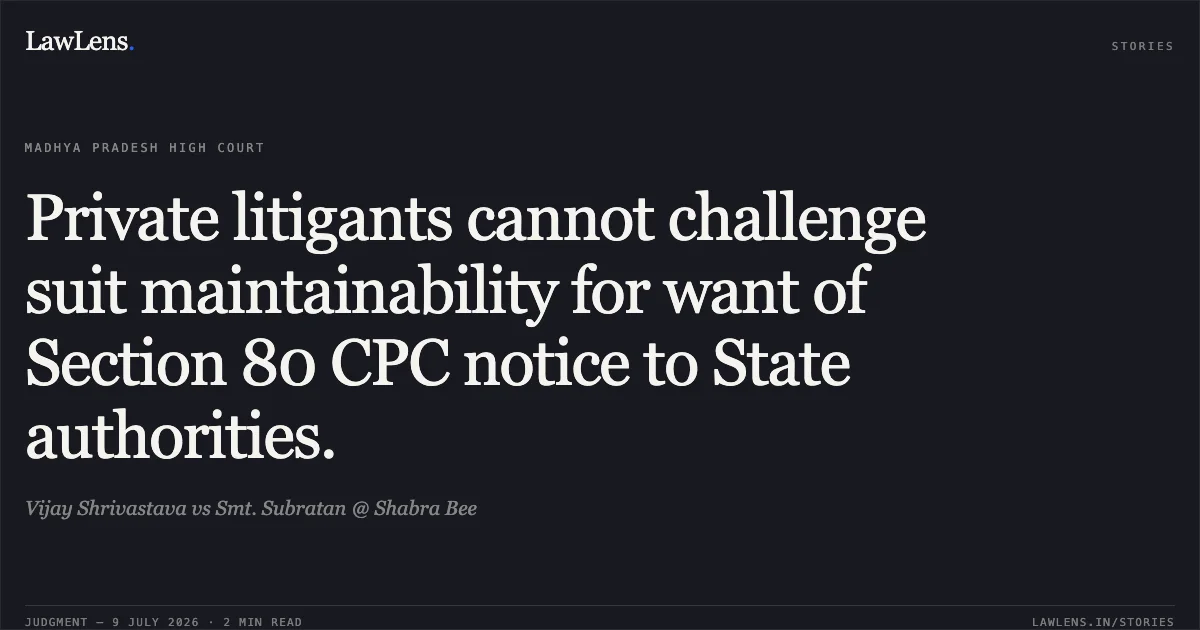
The petitioner (Defendant No. 4) challenged an order dated 12.12.2023 passed by the trial court, which rejected his application for rejection of the plaint under Order 7 Rule 11 of the CPC, as well as a subsequent review rejection dated 18.01.2023.
Source reference: para. 1The dispute primarily concerned a land matter between private parties (the plaintiff and a Cooperative Society), but State authorities (Tahsildar and others) were impleaded as Defendants No. 1 to 4 because they allegedly threatened demolition at the instigation of Defendant No. 4.
Source reference: paras. 7-8The petitioner argued the suit was barred by law for failing to serve a mandatory 60-day notice to the State under Section 80 of the CPC.
Source reference: paras. 2-4Issues
1. Whether a private litigant has the standing to seek rejection of a plaint on the ground of non-compliance with Section 80 of the CPC when the State authorities themselves have not raised such an objection.
Source reference: para. 102. Whether the failure to serve notice under Section 80 CPC is a jurisdictional defect that can be waived by the State authorities.
Source reference: para. 12-14Law Applied
The court applied Section 80 of the CPC, which mandates notice to the Government or public officers before instituting a suit.
Source reference: para. 4It relied on Gaja v. Dasa Koeri (AIR 1964 All 471) and Raj Kumari v. Board of Revenue (1984 SCC OnLine All 664), which establish that the protection of Section 80 is for the benefit of the State and can be waived.
Source reference: paras. 10-11It cited Gangappa Gurupadappa Gugwad v. Rachawwa (1970 3 SCC 716) regarding the court's duty to scrutinize whether Section 80 is necessary when no direct relief is claimed against the State.
Source reference: para. 12It cited Bishandayal and Sons v. State of Orissa (2001 1 SCC 555), confirming that such notice does not go to the root of jurisdiction and is waivable.
Source reference: para. 13Reasoning
The court reasoned that the legislative intent of Section 80 CPC is to protect public money and time by allowing the State to settle claims without litigation.
Source reference: para. 9Consequently, this protection is a "shield" for the State, not a "weapon" for private litigants.
Source reference: para. 9The court observed that the State authorities in this case remained ex-parte despite being served, which constitutes an implied waiver of their right to notice.
Source reference: para. 14Since the primary dispute was between private parties and no relief of title was sought against the State—only a consequential injunction based on the State acting at the petitioner's behest—the lack of notice did not mandate a rejection of the plaint.
Source reference: paras. 7, 12, 14The court held that an application under Order 7 Rule 11 CPC on these grounds is only maintainable if filed by the State or the public officer concerned, not by a third-party private defendant.
Source reference: para. 15Holding
The court answered that the petitioner (a private party) lacked the standing to plead the bar of Section 80 CPC.
Finding no jurisdictional error in the trial court's decision, the High Court dismissed the civil revision.
Source reference: para. 16Acts & Sections Cited
1 provisions across 1 statute referred to in this judgment. Each provision opens on LawLens.
Code of Civil Procedure, 19081
Original Court PDF
Vijay ShrivastavavsSmt. Subratan @ Shabra Bee
Click to open original judgment
Original judgment, available to read, download and summarize on LawLens.in