Facts
The Delhi Subordinate Services Selection Board (DSSSB) conducted recruitment examinations for Primary Teachers (Post Codes 16/17 and 1/18) in four phases between September and October 2018.
Source reference: p. 3After the fourth phase, DSSSB discovered that several questions were repeated across different phases.
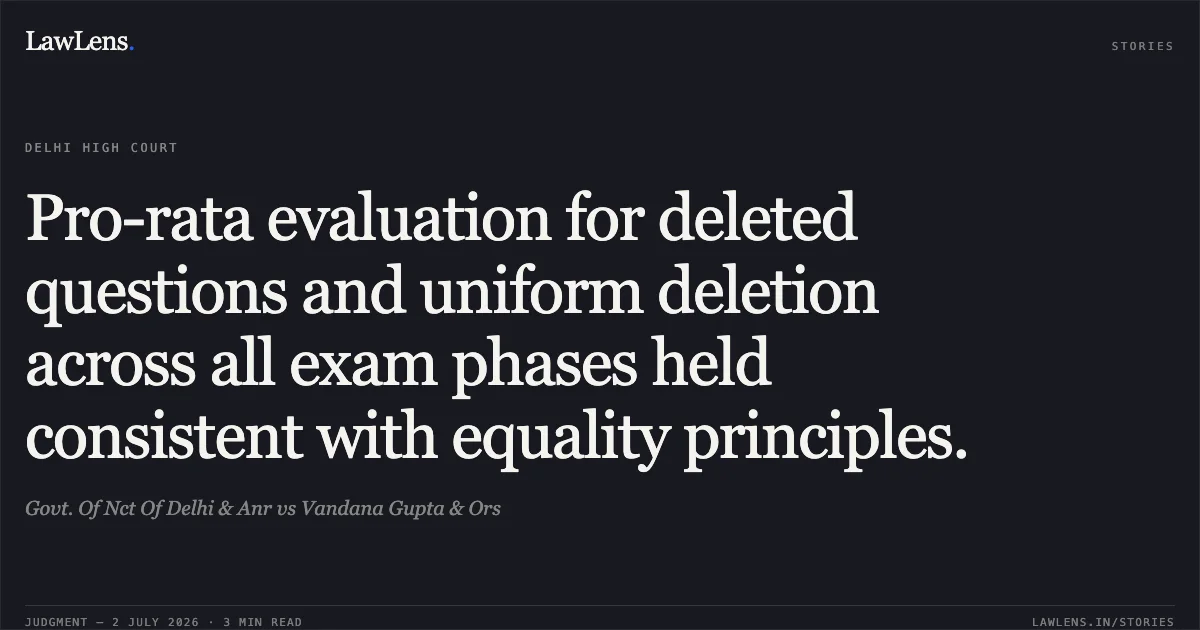
Source reference: p. 10Consequently, DSSSB issued notices to delete these repeated questions from evaluation and applied a "pro rata" marking method and a normalization formula to balance variations in difficulty levels.
Source reference: p. 10-11Some candidates challenged the deletion and marking method (OA 612/2019), while others challenged the rejection of their objections to the Draft Answer Keys (OA 815/2019 & OA 2151/2019).
Source reference: p. 3-4The Central Administrative Tribunal (CAT) set aside DSSSB’s notices, holding the pro rata method and the deletion of questions from Phase I (where they were first appearing) to be illogical.
Source reference: p. 13CAT also directed a re-evaluation of answer key objections by experts.
Source reference: p. 13-14The GNCTD filed these writ petitions against the CAT orders.
Source reference: no citationIssues
1. Whether the DSSSB’s decision to delete repeated questions from all phases and apply the pro rata marking method was legally sustainable
Source reference: p. 5, para. 9(i)2. Whether the Tribunal was justified in directing a reconsideration of objections to the Draft Answer Key after experts had already evaluated them
Source reference: p. 5, para. 9(ii)Law Applied
The Court primarily applied the principle of judicial restraint in academic/examination matters as established in Ran Vijay Singh v. State of Uttar Pradesh, which discourages courts from re-evaluating answer sheets or questions.
Source reference: p. 16-17It further relied on the precedent set in Vikas Pratap Singh v. State of Chhattisgarh, where the Supreme Court upheld the "pro rata" method for deleted questions as a valid evaluation procedure.
Source reference: p. 20The Court also applied Article 14 (Equality before Law) and Article 16 (Equality of Opportunity in Public Employment) of the Constitution of India to ensure a uniform and non-discriminatory evaluation process for all candidates across multiple shifts.
Source reference: p. 21Reasoning
The Court found that while CAT deemed deleting Phase I questions "illogical," such a selective deletion would actually cause discrimination.
Source reference: p. 21If repeat questions were deleted only from later phases, candidates in Phase I would be evaluated on a different total number of questions than others, violating Articles 14 and 16.
Source reference: p. 21To maintain a "level playing field," the same set of questions had to be excluded from evaluation across all four batches.
Source reference: p. 22Regarding the pro rata marking method (calculating marks based on performance in remaining questions), the Court held it was a recognized mechanism supported by the Supreme Court in Vikas Pratap Singh and was not inherently illegal.
Source reference: p. 20-21Regarding the answer key objections, the Court examined the expert opinions placed on affidavit and found them to be reasoned and supported by relevant texts.
Source reference: p. 23The Court emphasized that since the recruitment process was closed and candidates had been serving for years, revisiting minor controversies regarding expert-verified answers was unwarranted.
Source reference: p. 23Holding
The High Court set aside the Tribunal’s orders and dismissed the original OAs.
The deletion of repeated questions from all phases was necessary to ensure uniformity and prevent discrimination.
Source reference: p. 21-22The pro rata method for awarding marks against deleted questions is a valid and lawful objective mechanism.
Source reference: p. 21In the presence of reasoned expert opinions, the Court would not interfere with the finality of the Answer Keys, especially after the appointments had been finalized.
Source reference: p. 23The writ petitions were allowed with no orders as to costs.
Source reference: p. 24Original Court PDF
Govt. Of Nct Of Delhi & AnrvsVandana Gupta & Ors
Click to open original judgment
Original judgment, available to read, download and summarize on LawLens.in