Facts
The case involves banking frauds committed between 1972 and 1975 by three firms: M/s Guru Prasad Ram Prasad, M/s MT and Company, and M/s MT Agencies
Source reference: para. 5The prosecution alleged that the partners and managers of these firms conspired with State Bank of India officials to make cheques disappear or to forge/interpolate them when accounts lacked sufficient funds
Source reference: para. 7, 8On July 30, 1998, the Special Judge, Anti Corruption (West), Lucknow, convicted five appellants for criminal conspiracy (Section 120-B IPC) to commit offences under Section 5(2) and 5(1)(d) of the Prevention of Corruption (PC) Act, 1947
Source reference: para. 2They were sentenced to one year of rigorous imprisonment and a fine of Rs. 4,00,000
Source reference: para. 2During the pendency of the appeal, three appellants died, leaving only Appellant No. 3 (Onkar Nath Mehrotra, aged 90) and Appellant No. 5 (Smt. Neera Mehrotra, aged 88)
Source reference: para. 4, 11The surviving appellants did not challenge the conviction but requested the benefit of the Probation of Offenders Act, 1958
Source reference: para. 11, 12Issues
1. Whether the bar contained in Section 18 of the Probation of Offenders Act, 1958, applies to persons convicted of criminal conspiracy to commit an offence under the Prevention of Corruption Act, 1947, who are not themselves public servants
Source reference: para. 152. Whether the advanced age of the appellants and the long duration since the commission of the offence (over 50 years) warrant the grant of probation instead of incarceration
Source reference: para. 12, 20Law Applied
Section 4 of the Probation of Offenders Act, 1958, which empowers courts to release offenders on probation for good conduct in cases not punishable by death or life imprisonment
Source reference: para. 14Section 18 of the same Act, which excludes the benefit of probation for substantive offences under Section 5(2) of the PC Act, 1947
Source reference: para. 14, 15The court relied on Lakhvir Singh v. State of Punjab (2021) and Tarak Nath Keshari v. State of W.B. (2024), which establish that probation can be extended in fit cases despite the passage of time or the nature of the offence
Source reference: para. 16, 17The court further invoked the principles from Sunita Devi v. State of Bihar (2024) and Chellammal v. State (2025), emphasizing that sentencing must be reformative and that judges have a mandatory duty to consider probation under Section 360 CrPC and the Probation of Offenders Act
Source reference: para. 18, 19Reasoning
The court observed that the appellants were convicted of criminal conspiracy under Section 120-B IPC, rather than the substantive offences under the PC Act
Source reference: para. 15Since the appellants were not public servants and could not be held guilty of the substantive PC Act charges, the court held that the statutory bar in Section 18 of the Probation Act did not apply
Source reference: para. 15In applying the "Rule of Law" to the "Facts," the court noted that the surviving appellants are 90 and 88 years old, suffering from age-related ailments, and the offence dates back over half a century
Source reference: para. 11, 12Relying on Supreme Court precedents, the court reasoned that sentencing must include reformative elements and that placing octogenarians and nonagenarians in custody after such a delay would serve no preventive or deterrent purpose
Source reference: para. 18, 20The court found that since the appellants had no previous criminal history and had remained on bail for decades without further incident, they were ideal candidates for probation
Source reference: para. 11, 21Holding
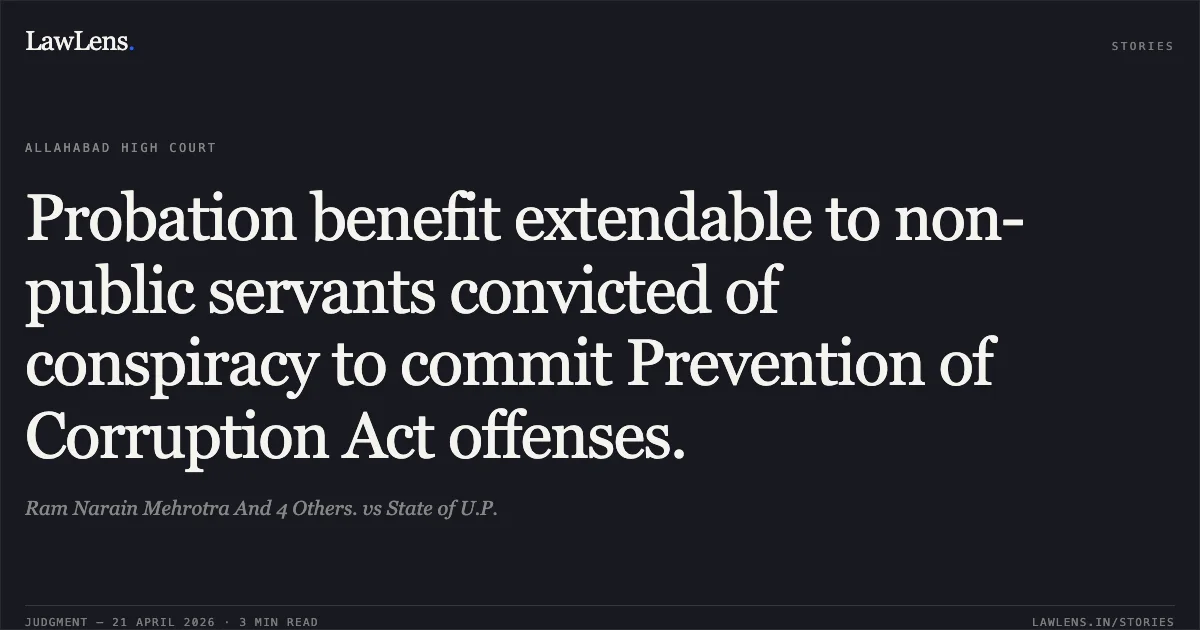
The court upheld the conviction of Appellant Nos. 3 and 5 but modified the sentence
It granted them the benefit of the Probation of Offenders Act, 1958, and ruled that given the lapse of nearly forty years since the original sentence without any subsequent offences, there was no necessity to place them under active supervision or a further probation period
Source reference: para. 21The appeal was disposed of accordingly, effectively waiving the requirement for incarceration and the recovery of fine
Source reference: para. 20, 21Acts & Sections Cited
8 provisions across 4 statutes referred to in this judgment. Each provision opens on LawLens.
Indian Penal Code, 18601
Probation of Offenders Act, 19585
Code of Criminal Procedure, 19731
Essential Commodities Act, 19551
Original Court PDF
Ram Narain Mehrotra And 4 Others.vsState of U.P.
Click to open original judgment
Original judgment, available to read, download and summarize on LawLens.in