Facts
The Appellants, originally appointed as Peon and Sweeper-cum-Peon in 1996 and 2000 respectively, were permanent employees of the Apparel Training and Design Centre (ATDC).
Source reference: p.3-4On June 19, 2020, during the COVID-19 pandemic, their services were terminated via termination letters without specific reasons or the mandatory three-month notice period.
Source reference: p.4, para. 5The Writ Court dismissed the petitions on a technicality, stating the Appellants had filed for a "Writ of Mandamus" instead of "Certiorarified Mandamus" and thus failed to properly challenge the termination letters.
Source reference: p.3, para. 2Issues
1. Whether a Writ Petition is maintainable against the Apparel Training and Design Centre (ATDC).
Source reference: p.3, para. 32. Whether the Writ Court erred in dismissing the petitions on the hyper-technical ground of praying for the wrong nature of Writ.
Source reference: p.3, para. 33. Whether the termination of the Appellants' services was legally sustainable under the General Service Rules, 2011.
Source reference: p.5-6Law Applied
Principle that a body owned and funded by the Government of India is an "Authority" under Article 12, making it amenable to Writ jurisdiction.
Source reference: p.3General Service Rules, 2011, which mandate a three-month notice period for the termination of regular employees.
Source reference: p.5Delhi High Court in W.P.(C) No. 4289 of 2020, which held that the ATDC performs public functions and cannot terminate permanent employees in an arbitrary or discriminatory fashion without complying with statutory notice requirements.
Source reference: p.4-5Reasoning
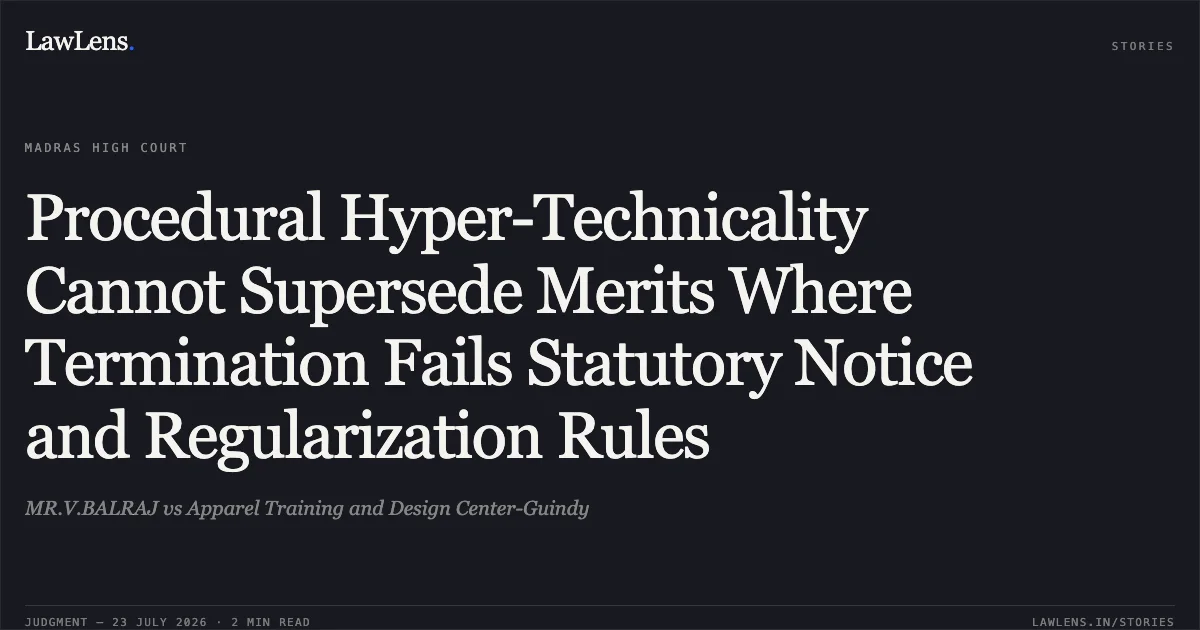
The Court reasoned that the Writ Court should not have dismissed the petitions based on a "hyper-technical mistake" in the nomenclature of the Writ sought, as the underlying merits regarding the challenge to termination letters were clear.
Source reference: p.3, para. 3On the merits, the Court found that the ATDC failed to provide the three-month notice required under the General Service Rules, 2011 for regular employees.
Source reference: p.6, para. 8While the respondent cited financial crisis during COVID-19, the Court noted that the organization had since resumed activities and retained other employees; therefore, "picking and choosing" certain permanent employees for termination was arbitrary and discriminatory.
Source reference: p.5-6The termination was found to be a termination simplicitor issued in violation of mandatory procedural rules.
Source reference: no citationHolding
The High Court allowed the Writ Appeals and set aside the orders of the Writ Court, holding that the terminations were untenable due to non-compliance with the three-month notice rule.
The Respondents were directed to: (i) reinstate the Appellants within two weeks; (ii) grant continuity of service; (iii) pay 50% back wages; and (iv) provide notional refixation of pay from the date of termination until reinstatement, with actual monetary benefits starting prospectively.
Source reference: p.6-7Original Court PDF
MR.V.BALRAJvsApparel Training and Design Center-Guindy
Click to open original judgment
Original judgment, available to read, download and summarize on LawLens.in