Facts
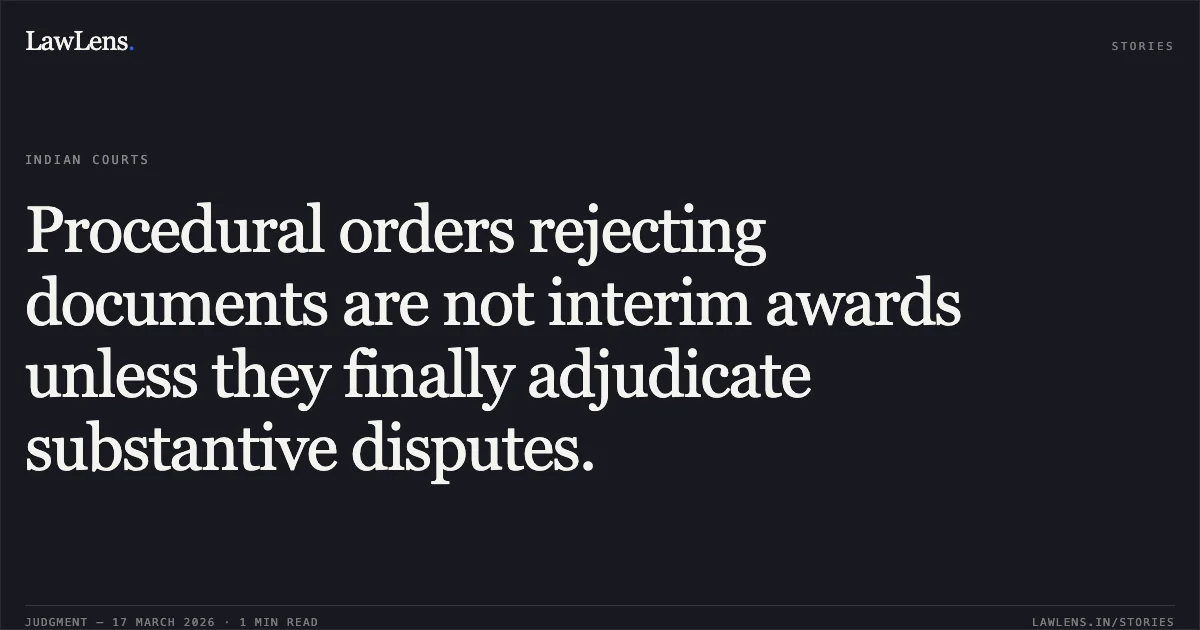
The Petitioner filed a petition under Section 34 of the Arbitration and Conciliation Act, 1996, seeking to set aside an order dated 26.11.2024, characterized by the Petitioner as an "Interim Award".
Source reference: para. 1During the arbitral proceedings, the Tribunal refused to take two documents (Ex. C-93 and Ex. C-94) on record.
Source reference: para. 2The Tribunal reasoned that Ex. C-93 was a new document created after the completion of admission/denial, and Ex. C-94 was a contract-specific recommendation rather than a general policy circular.
Source reference: para. 2The Petitioner contended that by refusing these documents, the Tribunal entered into the merits of the claims, specifically regarding the formula for prolongation costs, thereby rendering the order an "Interim Award".
Source reference: para. 3-6Issues
1. Whether an order passed by an Arbitral Tribunal refusing to take additional documents on record constitutes an "Interim Award" amenable to challenge under Section 34 of the Arbitration and Conciliation Act, 1996.
Source reference: para. 3, 11Law Applied
The court primarily applied Sections 2(1)(c), 31(6), and 34 of the Arbitration and Conciliation Act, 1996.
Source reference: para. 10It relied on the Supreme Court’s decision in IFFCO Ltd. v. Bhadra Products, which clarifies that an interim award must conclusively determine "any matter" or point of dispute between the parties.
Source reference: para. 10/para. 68-69Furthermore, the court adopted the "governing test" established in H.S. Nag and Ors v. Asian Hotel (North) Ltd, which stipulates that for an order to be an interim award, it must: (a) finally adjudicate a substantive dispute or claim; (b) attain finality/binding effect on that issue; and (c) render the Tribunal functus officio regarding that specific issue.
Source reference: para. 10/para. 106-107Reasoning
The Court examined the impugned order against the three-pronged test formulated in H.S. Nag.
Source reference: para. 11-12It noted that an interim award requires "finality" and "substantive issue determination," whereas a procedural order merely regulates the conduct of proceedings.
Source reference: para. 10/para. 75The Court observed that the Tribunal's decision to exclude Ex. C-93 and Ex. C-94 was based on procedural timelines (post-admission/denial) and the nature of the evidence (contract-specific vs. general policy).
Source reference: para. 2, 12The Court found that these reasons did not constitute a final adjudication of the Petitioner's substantive claims for prolongation costs or entitlement.
Source reference: para. 13Because the Tribunal had not rendered itself functus officio regarding the underlying claims and the order merely preserved the status of the pleadings, it failed to transcend the realm of a procedural order into an "Interim Award".
Source reference: para. 10/para. 108, para. 13Holding
The Court held that the impugned order did not satisfy the essential legal requirements of an interim award as it did not adjudicate a substantive dispute or claim.
Consequently, the petition under Section 34 was held to be non-maintainable.
Source reference: para. 14The Court dismissed the petition along with all pending applications.
Source reference: para. 15Acts & Sections Cited
4 provisions across 1 statute referred to in this judgment. Each provision opens on LawLens.
Arbitration and Conciliation Act, 19964
Original Court PDF
M/S Scl-Crc21B JvvsRail Vikas Nigam Limited
Click to open original judgment
Original judgment, available to read, download and summarize on LawLens.in