Facts
The Respondent, a lessee under a 29-year and 11-month lease from a public charitable trust, applied for registration of its commercial project 'Samrajya' under the Real Estate (Regulation and Development) Act, 2016 (RERA).
Source reference: para. 3-5The U.P. RERA (Appellant) rejected the application, questioning the lessor's authority to grant sub-leasing rights and the non-permanent nature of the lease.
Source reference: para. 7, 11On appeal, the Real Estate Appellate Tribunal (REAT) set aside the rejection and directed RERA to grant registration.
Source reference: para. 15RERA challenged this before the High Court, arguing that because the Respondent only holds leasehold rights and cannot "sell" units, it does not qualify as a "promoter" and the project is not a "real estate project" under the Act.
Source reference: para. 12, 23Issues
1. Whether a real estate project can be developed and registered with RERA under Section 5 on land taken on lease for 29 years and 11 months in light of Section 4(2)(l)(A) of the Act.
Source reference: para. 16, 242. Whether the Regulatory Authority can be termed an ‘aggrieved person’ under Section 58 to prefer an appeal.
Source reference: para. 16Law Applied
The Court primarily applied Section 2(zk) of the RERA Act, 2016, which defines a "promoter" as a person constructing or developing land for the purpose of selling apartments or plots.
Source reference: para. 30Section 2(zn), defining a "real estate project" as development for the purpose of selling.
Source reference: para. 30Under Section 105 of the Transfer of Property Act, 1882, a lease is a transfer of a right to enjoy property, whereas Section 54 defines "sale" as a transfer of ownership.
Source reference: para. 31-32The principle of A Verbis Legis Non Est Recedendum (no departure from plain words of law), as affirmed in Hardeep Singh v. State of Punjab and M/s Newtech Promoters and Developers vs. State of U.P., holding that statutes must be read literally.
Source reference: para. 40-41Reasoning
The Court reasoned that the statutory definitions of "promoter" and "real estate project" under RERA are strictly predicated on the intent to "sell".
Source reference: para. 35, 37Upon examining the lease deed, the Court found that the Respondent only possessed conditional leasehold rights and the power to sub-lease, but lacked the legal authority to transfer ownership through sale.
Source reference: para. 33-34Since the element of "sale" is indispensable to the Act's jurisdiction, the Court determined that a developer who can only assign leasehold rights does not satisfy the mandatory criteria of a "promoter".
Source reference: para. 37-38The Court accepted the Appellant’s own admission in its stay application—that the project was beyond the purview of the Act because it lacked a sale component—as the "best proof" of facts.
Source reference: para. 23, 27Consequently, the project does not qualify for registration under Section 5 because the regulatory framework of RERA is intended to protect consumers in transactions involving the sale of real estate, not mere rental or sub-lease arrangements.
Source reference: para. 35, 47Holding
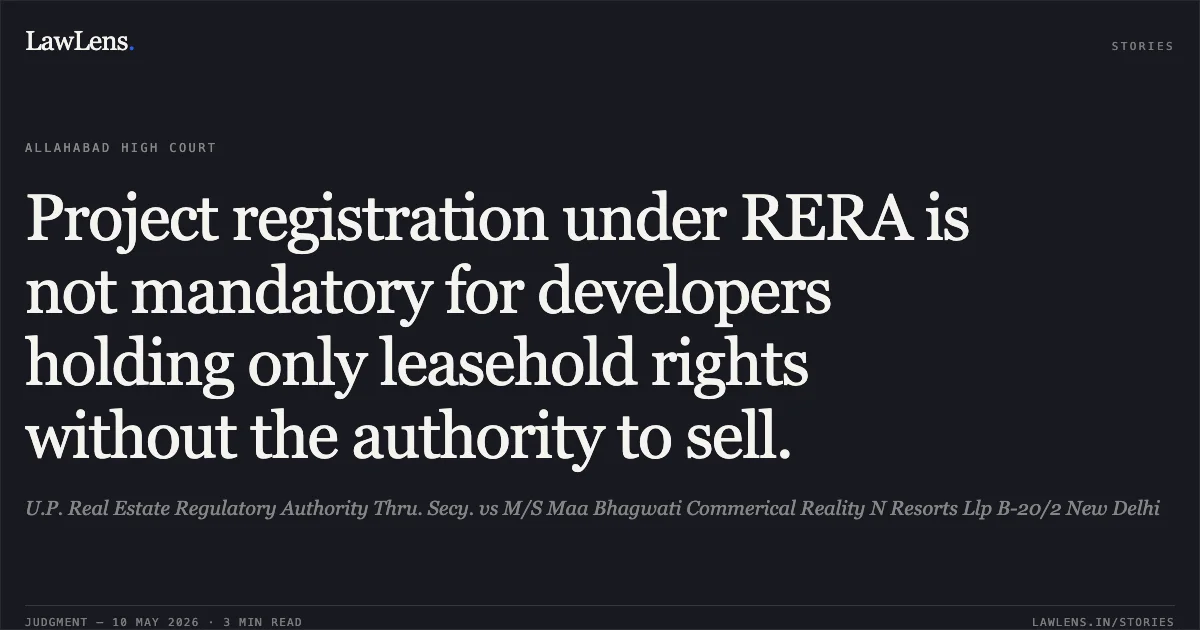
The Court answered the third issue by holding that the project is not required to be registered under RERA because the Respondent lacks the right to sell units, placing it outside the definition of a "promoter".
The High Court disposed of the appeal, setting aside the REAT’s direction to RERA to grant registration and directed the U.P. RERA to withdraw its "Form-D" communication containing prohibitory/restrictive clauses.
Source reference: para. 51-52Acts & Sections Cited
22 provisions across 3 statutes referred to in this judgment. Each provision opens on LawLens.
Real Estate (Regulation and Development) Act, 2016.7
Transfer of Property Act, 1882
Code of Civil Procedure, 19081
Original Court PDF
U.P. Real Estate Regulatory Authority Thru. Secy.vsM/S Maa Bhagwati Commerical Reality N Resorts Llp B-20/2 New Delhi
Click to open original judgment
Original judgment, available to read, download and summarize on LawLens.in