Facts
The appellant, Kundan Kumar (A-28), was arrested on 19.07.2021 following an investigation by the NIA into an attack near Tetariakhand colliery involving the burning of vehicles, firing at police, and extortion by the Sujit Sinha and Aman Sahu gang
Source reference: paras. 3-7The NIA alleged that the appellant was a gang member who arranged a flat in Namkum, Ranchi, to harbor terrorists (specifically Shahrukh Ansari) and manage arms consignments
Source reference: paras. 33, 44During a raid on said flat, the appellant was arrested in the presence of six pistols and 27 cartridges
Source reference: para. 19The appellant’s previous bail application was rejected on merits by the High Court in 2023
Source reference: para. 7The current appeal challenges the order dated 20.09.2025 passed by the Special Judge, NIA, Ranchi, which rejected a renewed prayer for bail based on long incarceration (approx. 4.5 years), delay in trial, and parity with other co-accused who were granted bail
Source reference: paras. 16-17, 37Issues
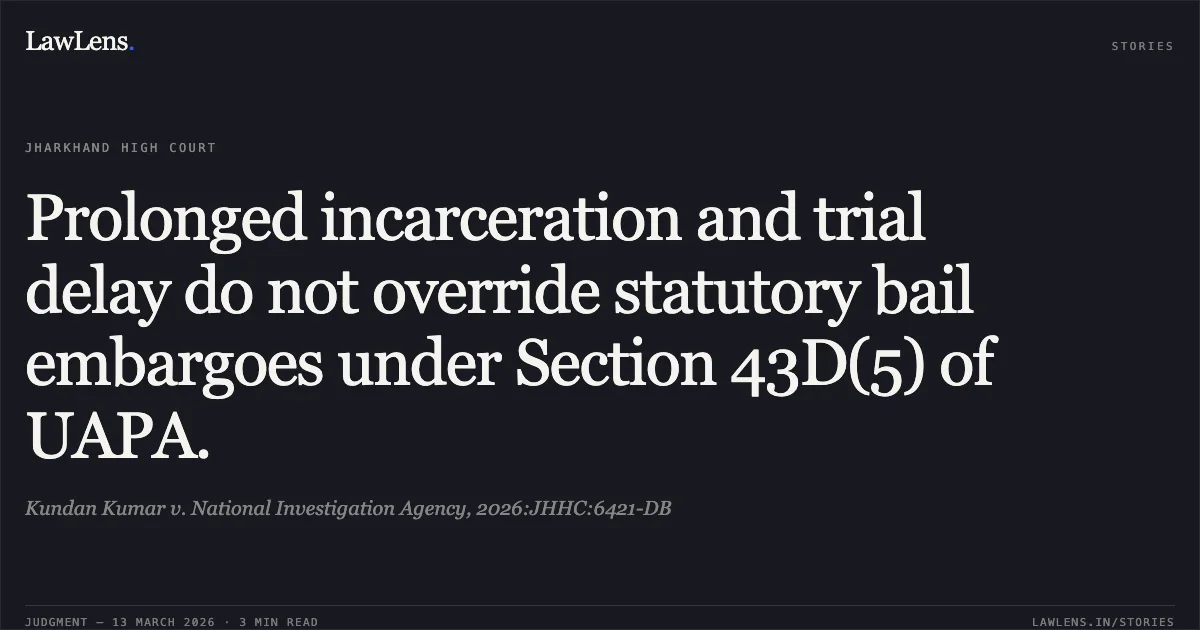
Whether the appellant is entitled to bail on the grounds of long incarceration and delay in trial despite the embargo under Section 43D(5) of the UA(P) Act
Source reference: para. 40Whether the principle of parity applies to the appellant in light of bail granted to other co-accused
Source reference: para. 61Law Applied
The court applied Section 43D(5) of the Unlawful Activities (Prevention) Act, 1967, which prohibits bail if the court, on perusal of the case diary or charge-sheet, is of the opinion that the accusations are prima facie true
Source reference: para. 41It relied on *Gurwinder Singh v. State of Punjab* (2024), establishing that for UAPA offences, "jail is the rule and bail is the exception," and mere delay in trial is not a sufficient ground for bail
Source reference: paras. 24, 48The court further cited *Gulfisha Fatima v. State (Govt. of NCT of Delhi)* (2026), holding that Article 21 does not provide a "trump card" to displace statutory restraints in cases involving national security
Source reference: para. 49On parity, it followed *Tarun Kumar v. Assistant Director, ED* (2023) and *Ramesh Bhavan Rathod v. Vishanbhai Hirabhai Makwana* (2021), stating that parity is not an absolute law and must focus on the specific role of the accused
Source reference: paras. 68-69Reasoning
The Court observed that internal judicial discipline required giving weight to its previous 2023 order which found a prima facie case against the appellant
Source reference: paras. 35, 45It noted that the appellant's role was not merely peripheral; he was apprehended from a flat where arms were recovered and was accused of actively harboring a terrorist
Source reference: paras. 43-44Regarding delay, the Court found the NIA had "pruned" the witness list from 345 to 129, and 26 witnesses had already been examined, indicating a progressing trial
Source reference: paras. 57, 80The Court rejected the parity argument, distinguishing the appellant's case from those granted bail (like Santosh Kumar) because the appellant was caught in possession of arms and was similarly placed to Akash Kumar Roy (A-27), whose bail had already been rejected
Source reference: paras. 34, 75-76It concluded that societal and national security interests outweigh individual liberty under Article 21 when grave charges under UAPA are prima facie true
Source reference: paras. 53-56Holding
The High Court dismissed the appeal, holding that no fresh grounds or change in circumstances existed to warrant bail
The court answered that mere long incarceration cannot override the statutory embargo of Section 43D(5) when the accusations are prima facie true, and the principle of parity is inapplicable due to the distinct and serious role attributed to the appellant
Source reference: paras. 77-78The impugned order of the Special Judge, NIA, Ranchi, was upheld
Source reference: para. 80Acts & Sections Cited
26 provisions across 5 statutes referred to in this judgment. Each provision opens on LawLens.
National Investigation Agency Act, 20083
Indian Penal Code, 1860
Arms Act, 19594
Unlawful Activities (Prevention) Act, 19675
Original Court PDF
Kundan Kumar v. National Investigation Agency, 2026:JHHC:6421-DB
Click to open original judgment
Original judgment, available to read, download and summarize on LawLens.in