Facts
The petitioner, an advocate, sought regular bail in connection with FIR No. 208/2021 involving Sections 170/384/385/388/419/420/506/120B of the IPC, Section 66D of the IT Act, and Sections 3 and 4 of the Maharashtra Control of Organised Crime Act, 1999 [MCOCA].
Source reference: para. 1The prosecution alleged that the main accused, Sukesh Chandra Shekhar, extorted ₹217 crores from the complainant while in custody.
Source reference: para. 6(d)The petitioner was accused of being a member of the organized crime syndicate [OCS] by facilitating the purchase of benami properties and luxury cars using proceeds of crime, as evidenced by confessional statements under Section 18 of MCOCA.
Source reference: para. 6(k)-(l)This was the petitioner's second bail application before the High Court; the first was dismissed in July 2023.
Source reference: para. 2The petitioner has been in custody since 05.09.2021.
Source reference: para. 6(h)Issues
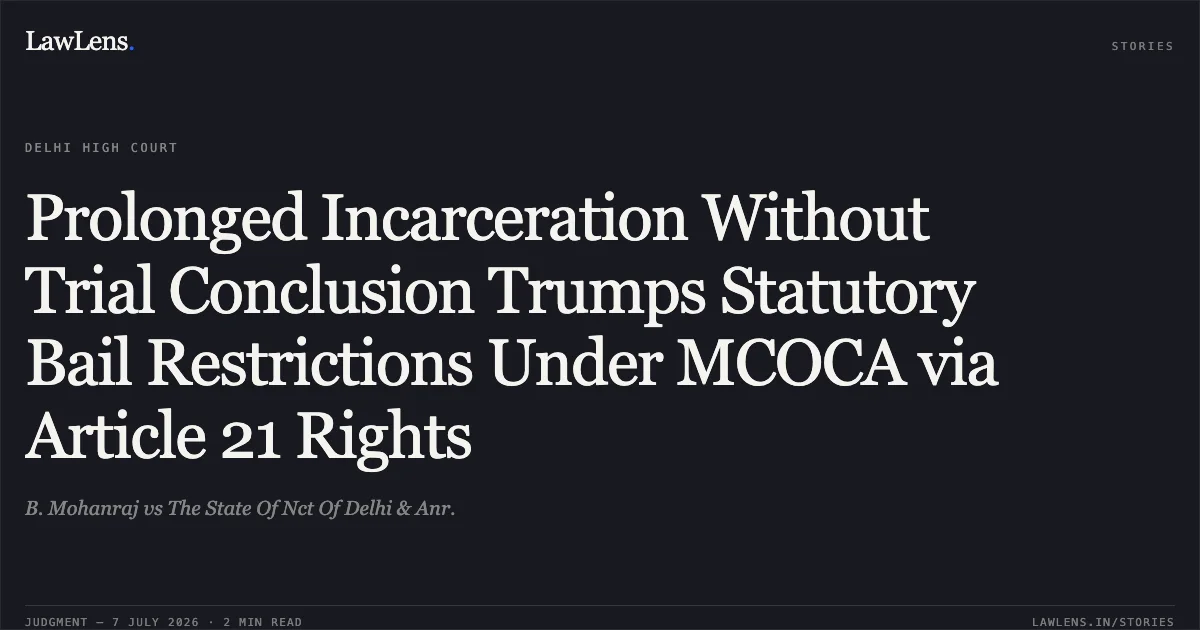
1. Whether prolonged pre-trial incarceration and the unlikely conclusion of a trial within a reasonable timeframe entitle the accused to bail despite statutory restrictions under Section 21(4) of MCOCA.
Source reference: para. 16, 212. Whether the specific role ascribed to the petitioner (money management vs. core extortion) warrants the grant of bail after nearly five years of custody.
Source reference: para. 20-21Law Applied
Section 21(4) of MCOCA, which mandates that bail cannot be granted unless the court is satisfied there are reasonable grounds to believe the accused is not guilty and not likely to commit further offences.
Source reference: para. 7(g)The Supreme Court’s ruling in Union of India v. K.A. Najeeb, which held that statutory restrictions on bail "melt down" when there is no likelihood of a trial concluding within a reasonable time, as this violates Article 21 of the Constitution.
Source reference: para. 8, 14The principles established in Gulfisha Fatima v. State (Govt. of NCT of Delhi) and Syed Iftikhar Andrabi v. NIA, providing that while Article 21 rights must be balanced against the gravity of the offence, prolonged incarceration is a critical factor for bail.
Source reference: para. 17-18Reasoning
The court noted that while the 2023 judgment found a prima facie case against the petitioner regarding his role in facilitating the OCS's financial transactions, circumstances had changed due to the passage of time.
Source reference: para. 7(h)-(i), 15The court observed that the trial involves 24 accused persons and 403 witnesses, making an expeditious conclusion highly unlikely even though charges were recently framed.
Source reference: para. 8, 21Applying a "surface evaluation," the court distinguished the petitioner’s role—allegedly managing funds and purchasing assets—from the core acts of coercion or extortion.
Source reference: para. 20The court reasoned that in such cases, the constitutional right under Article 21 must outweigh the statutory rigors of Section 21(4) of MCOCA to prevent indefinite incarceration without trial.
Source reference: para. 17, 21Holding
The court held that the length of the petitioner's undertrial detention, coupled with the complexity and anticipated delay of the trial, rendered further incarceration inappropriate.
The court allowed the application and granted regular bail to the petitioner subject to a personal bond of ₹2,50,000, two sureties, the surrender of his passport, and conditions ensuring his presence during trial and prohibiting contact with witnesses.
Source reference: para. 23Acts & Sections Cited
3 provisions across 3 statutes referred to in this judgment. Each provision opens on LawLens.
Bharatiya Nagarik Suraksha Sanhita, 20231
Code of Criminal Procedure, 19731
Narcotic Drugs and Psychotropic Substances Act, 19851
Original Court PDF
B. MohanrajvsThe State Of Nct Of Delhi & Anr.
Click to open original judgment
Original judgment, available to read, download and summarize on LawLens.in