Facts
The Petitioner, a former Motor Vehicle Inspector, was charged under Section 13(2) r/w 13(1)(e) of the Prevention of Corruption Act, 1988, and Section 109 of the IPC following a 2016 search that allegedly revealed assets disproportionate to his known sources of income (₹1,74,74,110/-).
Source reference: p. 2The Petitioner contended that the valuation included properties belonging to his father-in-law and ancestral estate.
Source reference: p. 3-4Despite a 2024 High Court direction in a previous CRLMC to expedite the probe and exclude non-contributed assets, the Petitioner sought quashing of the proceedings on the grounds of a decade-long delay (violating Article 21) and failure of the agency to follow judicial directions.
Source reference: p. 4-5, 12During the pendency of this petition, the investigating agency completed the probe and submitted a charge-sheet.
Source reference: p. 17-18Issues
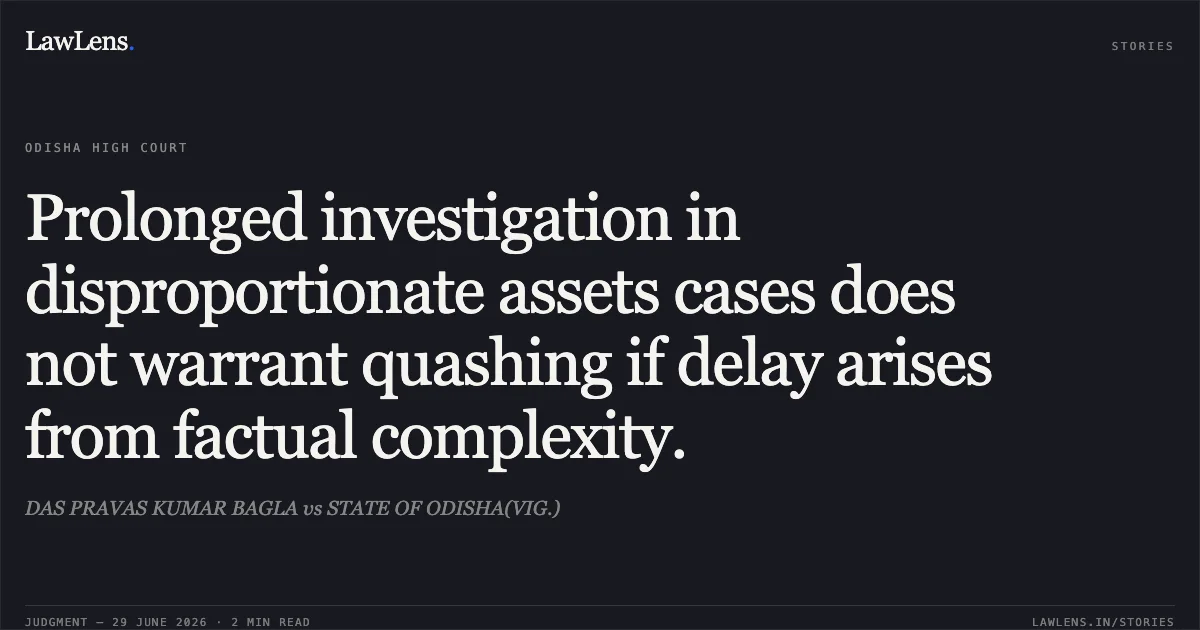
1. Whether the prolonged pendency of the investigation (nearly ten years) constitutes a violation of the right to a speedy trial under Article 21 sufficient to quash the proceedings.
Source reference: p. 12 / para. 8-102. Whether the investigating agency failed to comply with the court's prior directions regarding the exclusion of third-party assets from the disproportionate assets computation.
Source reference: p. 16 / para. 16-173. Whether the High Court, under Section 482 of the Cr.P.C. (Section 528 of BNSS), can adjudicate disputed questions of fact regarding the ownership and source of alleged assets.
Source reference: p. 18 / para. 22-25Law Applied
The court primarily applied Section 482 of the Criminal Procedure Code, 1973 (corresponding to Section 528 of the Bharatiya Nagarik Suraksha Sanhita, 2023) regarding the High Court's inherent power to prevent abuse of process.
Source reference: p. 1, 12The court relied on the Constitutional mandate of Article 21 for a speedy trial but noted that delay must be evaluated contextually.
Source reference: p. 13It followed the principles in A.R. Antulay v. R.S. Nayak and Niranjan Hermchandra Sashittal v. State of Maharashtra, holding that no fixed time limit can be set for complex economic offences like corruption, as they require meticulous scrutiny of camouflaged assets.
Source reference: p. 13-15Reasoning
The court reasoned that the decade-long delay was not "deliberate or mala fide" but was necessitated by the complexity of verifying international fund transfers (from the USA), multi-district property records, and disruptions caused by the COVID-19 pandemic.
Source reference: p. 15-16The court observed that the investigating officer had, in fact, complied with the 2024 judicial directions by re-assessing the assets and representations prior to filing the charge-sheet.
Source reference: p. 16-17Crucially, the court noted that once a charge-sheet is filed, the argument of "perpetual stagnation" fails.
Source reference: p. 18The Petitioner’s claims regarding independent business income and third-party ownership of flats and vehicles were deemed "intrinsically factual," requiring a "mini-trial" which is impermissible under Section 482.
Source reference: p. 18-19Holding
The court dismissed the petition, holding that the submission of the charge-sheet established sufficient grounds for the trial to proceed.
The court declined to exercise its inherent jurisdiction, ruling that disputed factual defenses regarding the source of income must be adjudicated by the trial court during a full-fledged trial and all interim orders were vacated.
Source reference: para. 25-27, 29Acts & Sections Cited
4 provisions across 4 statutes referred to in this judgment. Each provision opens on LawLens.
Bharatiya Nagarik Suraksha Sanhita, 20231
Code of Criminal Procedure, 19731
Prevention of Corruption Act, 19881
Indian Penal Code, 18601
Original Court PDF
DAS PRAVAS KUMAR BAGLAvsSTATE OF ODISHA(VIG.)
Click to open original judgment
Original judgment, available to read, download and summarize on LawLens.in