Facts
The Appellants claim to be long-term residents of villages within or near notified Reserve Forests (Barapani, Lutumai, Kaki, etc.) in Nagaon and Golaghat districts
Source reference: p.47, para. 3They asserted rights based on the "Taungya system" initiated in 1970, which permitted displaced families to undertake plantation and temporary cultivation
Source reference: p.47, para. 5Following eviction notices in 2025, the Supreme Court in Abdul Khalek v. State of Assam (2026) directed a fair verification process
Source reference: p.48, para. 12Consequently, joint committees of Forest and Revenue officials conducted scientific verifications (GIS/DGPS) and issued "Speaking Orders" concluding that the Appellants were unauthorized occupants on notified forest land with no legally cognizable title
Source reference: p.48-49, para. 14A learned Single Judge dismissed the Appellants' challenge to these orders on 08.06.2026, leading to this intra-court appeal
Source reference: p.46, para. 1Issues
1. Whether the State complied with the procedural safeguards and verification mechanisms mandated by the Supreme Court
Source reference: p.522. Whether documents like Taungya certificates, Aadhar cards, and Electoral Rolls confer a legally enforceable right to occupy Reserve Forest land
Source reference: p.57, p.593. Whether the inclusion of forest areas within a Gaon Panchayat under the Assam Panchayat Act, 1994, amounts to de-reservation or regularisation of forest land
Source reference: p.614. Whether the Appellants are entitled to protection under the Forest Rights Act, 2006, or the doctrine of Legitimate Expectation
Source reference: p.62-64Law Applied
The court applied the Forest (Conservation) Act, 1980, which prohibits the diversion of forest land for non-forest purposes without central approval
Source reference: p.50, p.61The Scheduled Tribes and Other Traditional Forest Dwellers (Recognition of Forest Rights) Act, 2006, requiring specific statutory recognition of rights for forest dwellers
Source reference: p.62The court followed the procedural fairness doctrine established in Abdul Khalek v. State of Assam (2026 SCC Online SC 184)
Source reference: p.48Procedural principles from Olga Tellis v. Bombay Municipal Corporation (AIR 1986 SC 180) and Sudama Singh v. Govt. of Delhi (2010) regarding livelihood and rehabilitation were considered but distinguished
Source reference: p.65Section 5 of the Assam Panchayat Act, 1994 was interpreted as not overriding forest protection laws
Source reference: p.61Reasoning
The court reasoned that the state successfully discharged its burden by using scientific GIS/DGPS mapping to correlate physical occupation with original Gazette notifications
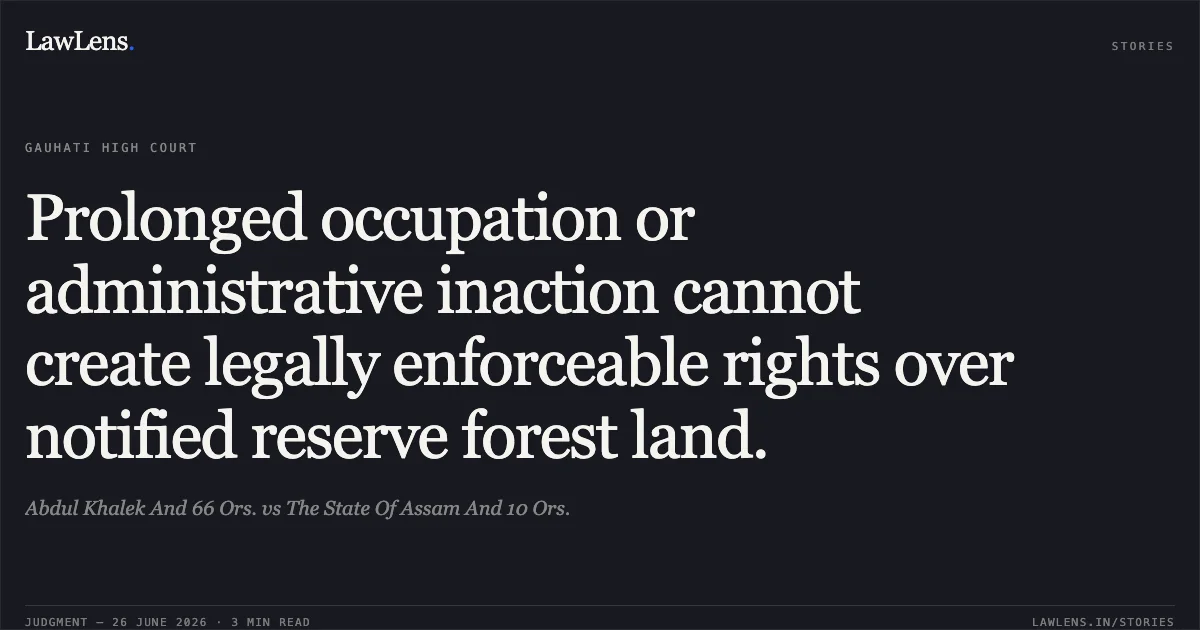
Source reference: p.54-55It held that Taungya arrangements were merely temporary administrative measures for plantation activities and did not create heritable or transferable property rights
Source reference: p.58-59Regarding civic documents (Aadhar, Ration Cards, Voter IDs), the court clarified these establish identity and residence but do not operate as instruments of title for immovable property
Source reference: p.60Crucially, the court found that the constitutional obligation to protect forests under the 1980 Act overrides the doctrine of Legitimate Expectation; administrative inaction or the provision of civic amenities (electricity, schools) does not equate to legal regularisation
Source reference: p.63-64Inclusion in a Gaon Panchayat was deemed insufficient to prove legal title as no central government approval for de-reservation under the Forest Conservation Act was present
Source reference: p.61-62Holding
The Court dismissed the appeals and affirmed the Single Judge's judgment, upholding the Speaking Orders for eviction
It held that the Appellants failed to establish any legally enforceable right to occupy notified Reserve Forest land
Source reference: p.62On humanitarian grounds due to the monsoon season, the court extended the time for eviction to 45 days. It further directed that the dismissal shall not prevent the State from considering eligible Appellants for rehabilitation or relocation under existing government policies
Source reference: p.67, para. 106Acts & Sections Cited
1 provisions across 1 statute referred to in this judgment. Each provision opens on LawLens.
Assam Panchayat Act, 19941
Original Court PDF
Abdul Khalek And 66 Ors.vsThe State Of Assam And 10 Ors.
Click to open original judgment
Original judgment, available to read, download and summarize on LawLens.in