Facts
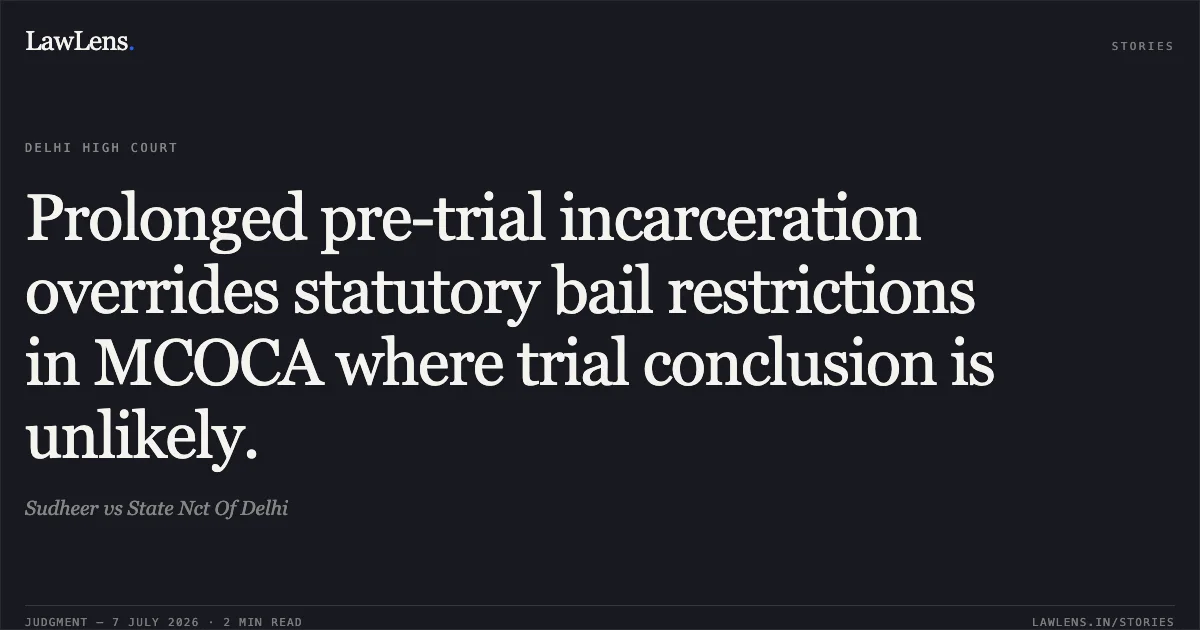
The petitioner filed an application under Section 483 of the Bharatiya Nagarik Suraksha Sanhita (BNSS) seeking regular bail.
Source reference: p. 1-2He was arrested on 20.07.2024 in connection with FIR 208/2021 involving a multi-crore extortion racket allegedly operated by Sukesh Chandra Shekhar from within Rohini Jail.
Source reference: p. 2-4The prosecution alleged the petitioner was a "trusted associate" and a salaried driver for co-accused Leena Paulose, tasked with collecting extorted funds via hawala channels and delivering them to various associates for the purchase of luxury assets.
Source reference: p. 4-5After being named, the petitioner allegedly absconded for nearly three years and was declared a proclaimed offender on 10.04.2024 before his arrest near the Indo-Nepal border.
Source reference: p. 5, 11Issues
1. Whether the petitioner is entitled to bail based on the principle of parity with co-accused Joel Daniel, who performed similar functions as a salaried employee?
Source reference: p. 8-92. Whether the petitioner’s continued incarceration for nearly two years, coupled with the unlikely prospect of an early trial conclusion (due to 403 witnesses and 10,000+ pages of evidence), violates his right to a speedy trial under Article 21?
Source reference: p. 9-103. Whether the statutory bar under Section 21(4) of MCOCA can be overcome by the constitutional guarantee against prolonged pre-trial detention?
Source reference: p. 14Law Applied
The court applied Section 21(4) of the Maharashtra Control of Organised Crime Act (MCOCA), which imposes stringent conditions for bail requiring the court to be satisfied of the accused's innocence and the unlikelyhood of committing future offences.
Source reference: p. 9-10It further relied on the constitutional mandate of Article 21 (Right to Life and Liberty) as interpreted in Leena Paulose v. State and Deepak Ramnani v. State, establishing that statutory embargos cannot eclipse the claim against prolonged incarceration.
Source reference: p. 14The court also considered Section 2(1)(d) and Section 3(4) of MCOCA regarding the definition of "continuing unlawful activity" and "membership" in an organized crime syndicate.
Source reference: p. 10Reasoning
The court found that the petitioner’s role was primarily that of a salaried employee (driver) acting under instructions, similar to co-accused Joel Daniel who was granted bail in 2022.
Source reference: para. 20-21It observed that the petitioner played no role in the planning or execution of the foundational extortion; his involvement was limited to "associative proximity" and the logistical handling of funds.
Source reference: para. 19, 21While the State argued the petitioner was a flight risk due to his history of absconding, the court balanced this against the fact that the trial involves 403 witnesses and 10,000 pages of documents, making an expeditious conclusion impossible.
Source reference: para. 24-25The Court held that even under MCOCA, the "balancing exercise" under Article 21 favors release when the accused's role is menial and the trial is indefinitely delayed.
Source reference: para. 23-25Holding
The court answered the issues in the affirmative, granting the petitioner regular bail.
It held that while past conduct (absconding) is a factor, it cannot justify indefinite pre-trial detention for a menial participant.
Source reference: para. 25The petitioner was ordered to be released on a personal bond of Rs. 2,00,000/- with two sureties, subject to conditions including surrendering his passport, reporting to the police station every Monday and Thursday, and not leaving the country.
Source reference: para. 27Acts & Sections Cited
3 provisions across 2 statutes referred to in this judgment. Each provision opens on LawLens.
Bharatiya Nagarik Suraksha Sanhita, 20231
Maharashtra Control of Organised Crime Act, 19992
Original Court PDF
SudheervsState Nct Of Delhi
Click to open original judgment
Original judgment, available to read, download and summarize on LawLens.in