Facts
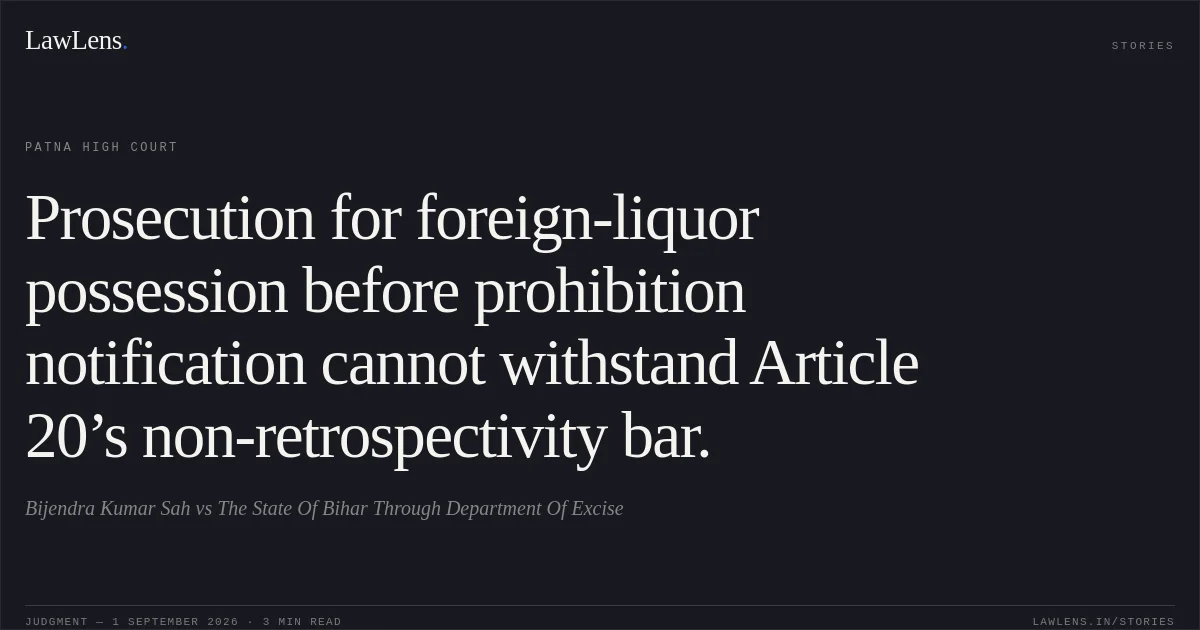
The petitioner challenged the order dated 4 February 2017 by which the A.C.J.M.-II, Purnea took cognizance in Barhara P.S. Case No. 74 of 2016 for offences under Sections 272 and 273 of the IPC and Section 47(A) of the Bihar Excise Act, 1915.
Source reference: para. 2On 3 April 2016, 136.740 litres of foreign liquor were allegedly recovered from the petitioner’s cattle shed.
Source reference: para. 4The petitioner contended that the premises had been rented by his brother, Shankar Kumar Sah, to Alok Kumar Singh, the licensee operating a liquor shop.
Source reference: para. 5He argued that the prohibition concerning foreign liquor was introduced through Excise Policy Notification No. 11 dated 5 April 2016, subsequent to the alleged seizure, and therefore the prosecution violated Article 20(1) of the Constitution.
Source reference: para. 5He further contended that the pre-amendment Section 47(A) applied only to a person concerned with the management of a company, whereas no such allegation was made against him.
Source reference: para. 5.2The State opposed the application, asserting that recovery of such a large quantity of liquor from the petitioner’s possession constituted an offence.
Source reference: para. 6Issues
1. Whether the petitioner could be prosecuted for possession or storage of foreign liquor on 3 April 2016 when the relevant prohibition under the new excise policy was stated to have come into force only on 5 April 2016, consistently with Article 20(1) of the Constitution
Source reference: paras. 5–5.2, 82. Whether the ingredients of Section 47(A) of the Bihar Excise Act, 1915, as applicable before the relevant amendment, were made out against the petitioner in the absence of any allegation that he was concerned with the management of a company.
Source reference: para. 5.23. Whether continuation of the criminal proceeding and the order taking cognizance amounted to an abuse of the process of the court
Source reference: paras. 5.2, 8–9Law Applied
The Court applied Article 20(1) of the Constitution, which prohibits conviction for an act that was not an offence under the law in force when it was committed and prohibits imposition of a greater penalty than that prescribed at that time.
Source reference: para. 4It relied on Rattan Lal @ Ram Rattan v. State of Punjab, AIR 1965 SC 444, for the principle that ex post facto criminal legislation creating or aggravating criminal liability is constitutionally impermissible, although retrospective legislation that mollifies criminal liability may be valid.
Source reference: para. 4It also relied on Basheer v. State of Kerala, (2004) 3 SCC 609, for the rule that statutes are ordinarily prospective unless retrospectivity is expressly provided or necessarily implied, and that retrospective application of a beneficial criminal amendment is not barred by Article 20(1).
Source reference: para. 5.1The Court also considered the Bihar Excise Act, 1915, including Section 47(A), and the Government’s excise-policy notification dated 5 April 2016 concerning the prohibition of sale, consumption and storage of foreign liquor.
Source reference: paras. 5–5.2, 8Reasoning
The alleged recovery took place on 3 April 2016, whereas the notification imposing the prohibition relating to foreign liquor was stated to have taken effect on 5 April 2016.
Source reference: paras. 5, 8Applying Article 20(1), the Court held that the petitioner could not be subjected to criminal liability under a prohibition that was not in force on the date of the alleged act.
Source reference: no citationThe Court further noted the petitioner’s submission that Section 47(A), in its then-applicable form, contemplated liability of a person concerned with the management of a company, and that the prosecution contained no such allegation against him.
Source reference: para. 5.2In the absence of a legally enforceable prohibition applicable on 3 April 2016 and in view of the asserted failure to satisfy the statutory ingredients of Section 47(A), continuation of the proceeding was considered an abuse of the process of the court.
Source reference: para. 8Holding
The Court answered the issues in favour of the petitioner.
It held that continuation of the prosecution, based on the alleged recovery dated 3 April 2016 and the subsequent prohibition concerning foreign liquor, would amount to an abuse of the process of the court.
Source reference: para. 8Accordingly, the order taking cognizance dated 4 February 2017 passed by the A.C.J.M.-II, Purnea, in Barhara P.S. Case No. 74 of 2016 was quashed insofar as it related to the petitioner.
Source reference: para. 9The criminal miscellaneous application was allowed.
Source reference: para. 10Acts & Sections Cited
4 provisions across 2 statutes referred to in this judgment. Each provision opens on LawLens.
Indian Penal Code, 18602
BIHAR PROHIBITION AND EXCISE ACT, 20162
Original Court PDF
Bijendra Kumar SahvsThe State Of Bihar Through Department Of Excise
Click to open original judgment
Original judgment, available to read, download and summarize on LawLens.in