Facts
On 22 September 2010, workman Ram Kumar Deshmukh died after an under-construction wall collapsed within the factory premises of Orient Ispat Private Limited.
Source reference: para. 2The factory owner, Rajesh Ahuja, and factory manager, R.P. Sahu, were issued a show-cause notice under Section 41 read with Rules 73C and 73E of the Factories Rules, 1962, and Section 7-A(1) of the Factories Act, 1948.
Source reference: para. 2Following an inquiry, the Deputy Director, Industrial Health and Safety, Durg, filed a complaint and charge-sheet under Section 105 of the Factories Act before the Judicial Magistrate First Class/Labour Court, Rajnandgaon.
Source reference: para. 2The Trial Court dismissed the complaint on 22 April 2013. The appellate court dismissed the State’s appeal under Section 65(1)(c) of the Chhattisgarh Industrial Relations Act, 1960, on 8 September 2014.
Source reference: para. 4Issues
Whether the Trial Court and the Appellate Court erred in dismissing the prosecution against the factory owner and manager for alleged violations of Section 41 read with Rules 73C and 73E, and Section 7-A(1) of the Factories Act, 1948?
Source reference: paras. 5–11Whether the existence of an agreement with Civil Engineer Hemant Shrivastava, without impleading him as an accused or issuing him a show-cause notice, established criminal liability or a sufficient nexus between the respondents’ acts and the wall collapse?
Source reference: paras. 3, 5–6, 9–10Law Applied
The Court applied Section 41 of the Factories Act, 1948, which authorises the State Government to prescribe additional safety measures in factories; Rules 73C and 73E of the Factories Rules, 1962, which prohibit construction, maintenance, or performance of work in a manner creating a risk of bodily injury; and Section 7-A(1) of the Act, which imposes on the occupier the duty to ensure, so far as reasonably practicable, the health, safety, and welfare of workers.
Source reference: para. 8The Court further proceeded on the principle that criminal liability cannot be imposed merely on the basis of an agreement or status; the prosecution must establish specific acts, omissions, or a legally demonstrable nexus connecting the accused with the alleged contravention.
Source reference: para. 9A person against whom allegations are relied upon must also be given proper notice and an opportunity of hearing.
Source reference: para. 9Reasoning
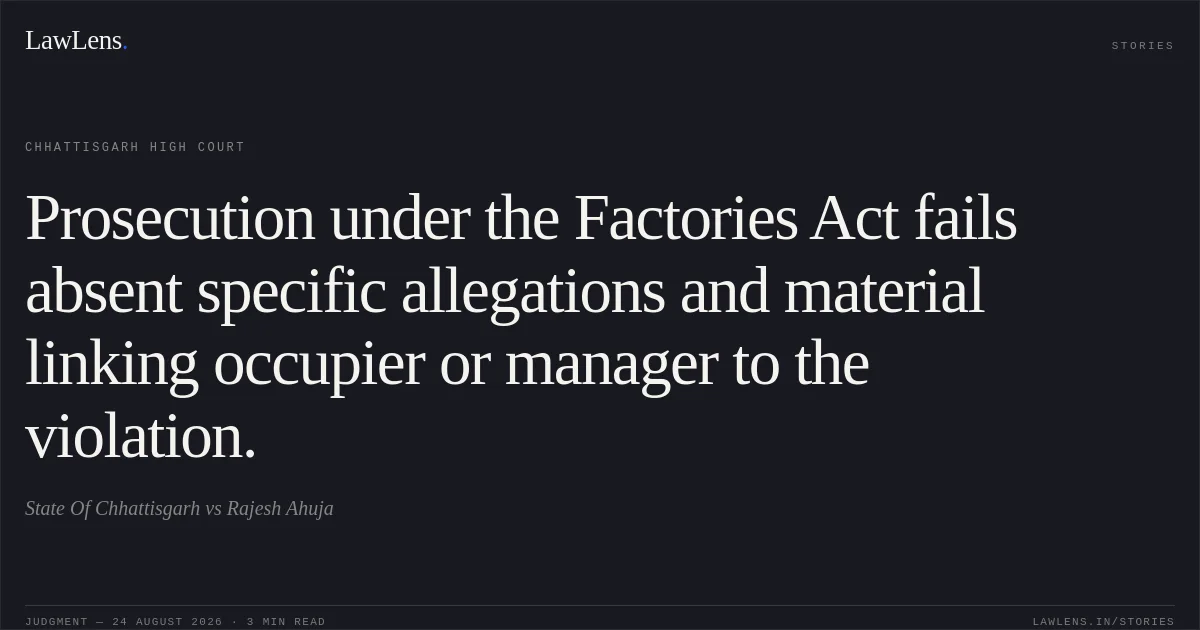
The High Court found that the complaint and charge-sheet did not contain specific allegations against Rajesh Ahuja or R.P. Sahu, nor did they disclose material establishing a nexus between any act or omission attributable to them and the collapse of the wall.
Source reference: para. 9Although the prosecution relied on an agreement between the factory management and Civil Engineer Hemant Shrivastava, the mere execution of that agreement did not establish culpability for the accident.
Source reference: para. 9The Civil Engineer was neither impleaded as an accused nor issued a show-cause notice, and therefore could not be proceeded against without compliance with principles of procedural fairness.
Source reference: para. 9The Court also observed that the complaint did not contain allegations against the respondents or the Civil Engineer corresponding to the requirements of Rules 73C and 73E.
Source reference: para. 10Consequently, the concurrent findings of the courts below were neither unsupported by evidence nor legally erroneous so as to warrant interference in writ jurisdiction.
Source reference: paras. 9–11Holding
The High Court held that the prosecution failed to establish specific allegations or a sufficient causal and legal nexus between the respondents and the collapse of the wall.
The Trial Court had rightly dismissed the complaint, and the Appellate Court had correctly affirmed that decision.
Source reference: paras. 9, 11The writ petition was accordingly dismissed, with no order as to costs.
Source reference: para. 12Acts & Sections Cited
4 provisions across 2 statutes referred to in this judgment. Linked provisions open on LawLens.
Factories Act, 19483
Chhattisgarh Industrial Relations Act, 19601
Original Court PDF
State Of ChhattisgarhvsRajesh Ahuja
Click to open original judgment
Original judgment, available to read, download and summarize on LawLens.in