01Facts
Petitioner No. 1, a real estate developer, constructed "Mayfair Sweet Haven" in Vile Parle, and Petitioners 2–4 are its directors.
¶ 2 · p. 1 · ¶ 3.1 · p. 2Respondent No. 1 (the complainant) and his mother bought Flat No. 201 under a registered Agreement for Sale dated 09.02.2010 and were put in possession on 13.03.2010.
¶ 3.1 · p. 2The complainant alleged that he paid an extra ₹12 lakhs for two stilt car parking spaces (Nos. 1 and 2) and that promised amenities were not provided.
¶ 3.1 · p. 2 · ¶ 8 · p. 9The Petitioners contended that the flat was a sample flat, that no car parking spaces were sold to the complainant, and that the Agreement shows no such allotment.
¶ 4 · p. 4 · ¶ 4.1 · p. 4Complaints were filed with the police (07.11.2012) and the Deputy Commissioner of Police (02.01.2013). Both were not registered because the dispute was civil in nature.
¶ 3.2 · p. 3The complainant then moved the Magistrate under Section 156(3) CrPC. By order dated 02.08.2014 in C.C. No. 340/SW/2014, the Metropolitan Magistrate, 10th Court, Andheri, directed registration of an FIR, which was registered as MECR No. 22 of 2014 for offences under Sections 406, 420, 465, 467, 469 and 471 IPC.
¶ 2 · pp. 1–2 · ¶ 4.4 · pp. 6–7Parallel civil suits over the same car parking spaces are pending, and a 29.04.2014 order of this Court regulating use of the spaces became final after the Supreme Court dismissed the SLP on 25.07.2014.
¶ 4.3 · pp. 5–6 · ¶ 11 · pp. 12–14The Petitioners argued that the Magistrate's order was cryptic and passed without application of mind.
¶ 4.4 · pp. 6–7Mediation failed.
¶ 5 · p. 702Issues
i.1. Whether the Magistrate's order dated 02.08.2014 directing registration of MECR No. 22 of 2014 was passed without application of judicial mind and without recording reasons, despite two police reports finding only a civil dispute.
¶ 13 · pp. 14–15 · ¶ 14 · p. 15ii.2. Whether the complaint discloses the essential ingredients of criminal breach of trust (s. 406 IPC), cheating (s. 420 IPC), and forgery (ss. 465, 467, 469, 471 IPC), or whether the dispute is purely civil and contractual.
¶ 19 · p. 17 · ¶ 23–27 · pp. 20–22 · ¶ 28 · p. 22iii.3. Whether the criminal proceedings should be quashed in exercise of powers under Article 226 and Section 482 CrPC (now Section 528 BNSS).
¶ 20 · pp. 17–18 · ¶ 29 · pp. 22–23 · ¶ 30 · p. 23iv.4. Whether costs should be imposed on the complainant for filing a frivolous and vexatious complaint.
¶ 31–34 · pp. 23–2603Law Applied
Under Article 226 of the Constitution and Section 482 CrPC (now Section 528 BNSS), the High Court may quash proceedings to prevent abuse of process or secure the ends of justice. The Court applied categories 1, 3, 5 and 7 of State of Haryana v. Bhajan Lal.
¶ 20 · pp. 17–18Under Maksud Saiyed v. State of Gujarat, a Magistrate acting on a complaint under Section 156(3) or 200 CrPC must apply his mind and examine whether the averments disclose an offence.
¶ 16 · p. 16Under Priyanka Srivastava v. State of U.P., the Magistrate must remain vigilant, and applications under Section 156(3) must be supported by an affidavit.
¶ 17 · pp. 16–17Iqbal alias Bala v. State of U.P. holds that vexatious or frivolous proceedings require the court to read between the lines.
¶ 18 · p. 17Edelweiss Asset Reconstruction Co. Ltd. v. State of NCT Delhi requires the court to read the complaint as a whole without appreciating disputed evidence.
¶ 15 · pp. 15–16Indian Oil Corporation v. NEPC India Ltd. permits quashing where the allegations, taken at face value, do not prima facie constitute an offence.
¶ 21 · p. 19Criminal breach of trust under Section 406 IPC requires entrustment, dishonest misappropriation, and violation of a legal direction or contract, as stated in Prof. R.K. Vijayasarathy v. Sudha Seetharam and Delhi Race Club (1940) Ltd. v. State of U.P.
¶ 23–24 · p. 20Cheating under Section 420 IPC requires deception and dishonest inducement at the time of the transaction, and a mere breach of contract is not criminal unless dishonest intention exists at the outset, per Hridaya Ranjan Prasad Verma v. State of Bihar.
¶ 26–27 · pp. 21–22Costs may be imposed where proceedings are used as a recovery or settlement tool and waste public and judicial resources.
¶ 31–33 · pp. 23–25Provisions in the judgment · 12 · Linked ones open on LawLens
Code of Criminal Procedure, 1973 Section 482Section 156Section 200Section 155
Indian Penal Code, 1860 Section 403Section 406Section 420Section 465Section 467Section 469Section 471
Bharatiya Nagarik Suraksha Sanhita, 2023 Section 528
04Reasoning
The principal grievance, the allocation of car parking spaces Nos. 1 and 2, arose only after another flat purchaser was allotted them, and the complainant's dispute over them is a civil matter that is already before the civil courts.
¶ 11 · pp. 12–13 · ¶ 12 · p. 14Since the complainant accepted possession of the sample flat without demur, no grievance about in-flat amenities could sustain a criminal complaint.
¶ 12 · p. 14Two police authorities, after enquiry, had found the dispute civil.
¶ 13 · pp. 14–15The Magistrate's order of 02.08.2014 did not refer to those reports or record reasons for rejecting them, and so was held to be an order without application of mind that cannot be sustained under Section 156(3) CrPC.
¶ 13 · pp. 14–15 · ¶ 14 · p. 15On the offences, the Court found that the Agreement for Sale and correspondence reflect a purely contractual relationship with no entrustment of property, so criminal breach of trust is not made out.
¶ 28 · p. 22 · ¶ 23–24 · p. 20No dishonest intention at the inception of the transaction was shown, so cheating under Section 420 is also not made out, and the forgery counts were not supported by any facts.
¶ 27 · pp. 21–22 · ¶ 28 · p. 22The complainant's own civil suit of 2013 undermined his criminal case.
¶ 19 · p. 17Costs were imposed because the complainant had used criminal process to pursue a civil claim, with the attendant waste of police and judicial resources.
¶ 31–34 · pp. 23–2605Holding
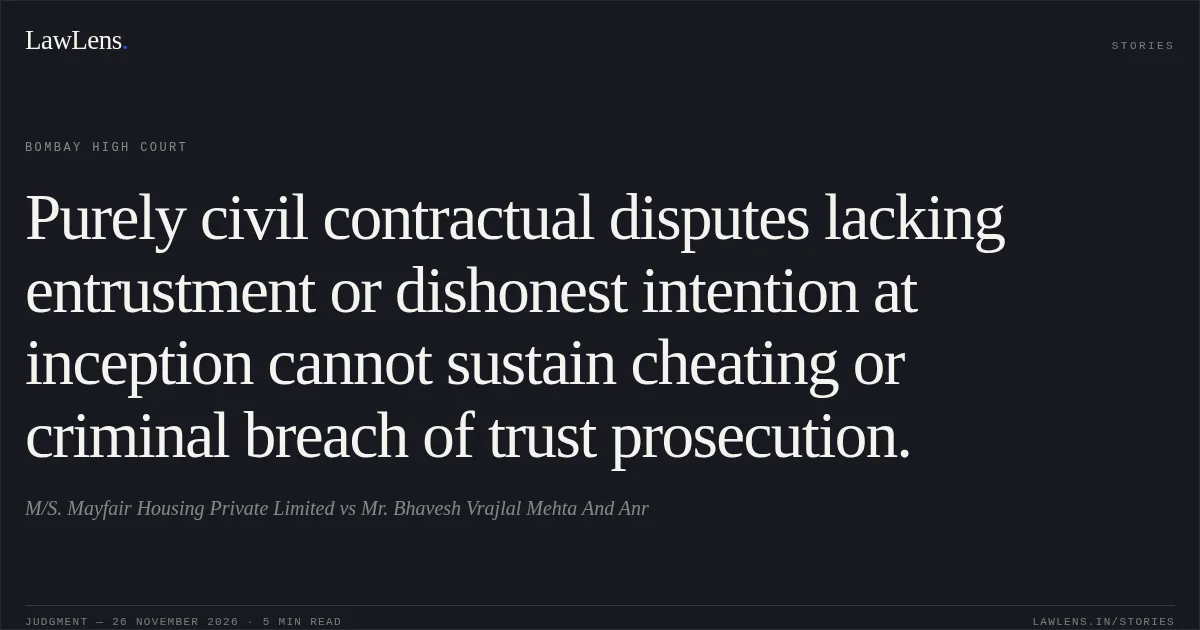
The complaint is purely civil in nature, the ingredients of Sections 406, 420, 465, 467, 469 and 471 IPC are not disclosed, and the Magistrate's order dated 02.08.2014 was passed without application of mind.
¶ 13–14 · pp. 14–15 · ¶ 28 · p. 22The Writ Petition was allowed under prayer clause (b), quashing MECR No. 22 of 2014 and the arising order dated 02.08.2014.
¶ 29 · pp. 22–23The complainant was directed to pay ₹10,000 as costs to the Corpus of A.K. Munshi Yojana within two weeks, with compliance to be shown on 16 December 2026.
¶ 34 · pp. 25–26 · ¶ 35–36 · p. 26Interim Application No. 4376 of 2024, permitting the complainant's Constituted Attorney to argue, was allowed and disposed of.
¶ 10 · p. 12 · ¶ 37 · p. 26Original Court PDF
M/S. Mayfair Housing Private LimitedvsMr. Bhavesh Vrajlal Mehta And Anr
Click to open original judgment
Original judgment, available to read, download and summarize on LawLens.in