Facts
The marriage between petitioner No.1/husband and respondent No.2 was solemnized on 12 May 2022.
Source reference: paras. 1–3, pp. 1–4Respondent No.2 alleged that petitioner Nos.1 and 2 subjected her to mental and physical cruelty and demanded dowry of ₹5,00,000.
Source reference: paras. 1–3, pp. 1–4She alleged that, after petitioner No.1 left her at her parental home on 22 October 2022, both petitioners visited her parental home on 5 November 2022, demanded ₹5,00,000 for taking her back, and threatened that petitioner No.1 would marry another woman if the amount was not arranged.
Source reference: paras. 1–3, pp. 1–4An FIR was registered on 20 December 2022 as Crime No.656/2022 at Police Station Sohagpur, District Hoshangabad, under Sections 498-A and 34 of the IPC and Sections 3 and 4 of the Dowry Prohibition Act, 1961.
Source reference: paras. 1–3, pp. 1–4Following investigation, a charge-sheet was filed.
Source reference: paras. 1–3, pp. 1–4The petitioners sought quashing of the FIR and consequential criminal proceedings under Section 528 of the BNSS, 2023, read with Section 482 of the CrPC.
Source reference: paras. 1–3, pp. 1–4The State and respondent No.2 opposed quashing, relying on the specific allegations, statements of independent witnesses, and evidence that ₹50,000 had been transferred by respondent No.2’s father to petitioner No.1.
Source reference: paras. 4–6, pp. 4–5Issues
1. Whether the FIR and consequential criminal proceedings disclosed a prima facie commission of offences under Sections 498-A and 34 of the IPC and Sections 3 and 4 of the Dowry Prohibition Act, warranting interference under Section 528 of the BNSS read with Section 482 of the CrPC.
Source reference: paras. 11–13, pp. 5–102. Whether the filing of proceedings for restitution of conjugal rights, the alleged inconsistencies in the complainant’s version, and the petitioners’ challenge to the evidentiary material justified quashing the criminal proceedings.
Source reference: paras. 3, 8–10 and 16, pp. 2–6, 12–133. Whether the High Court could assess the reliability, admissibility, or evidentiary value of the prosecution material and the petitioners’ defence at the stage of a quashing petition.
Source reference: paras. 12–16, pp. 6–13Law Applied
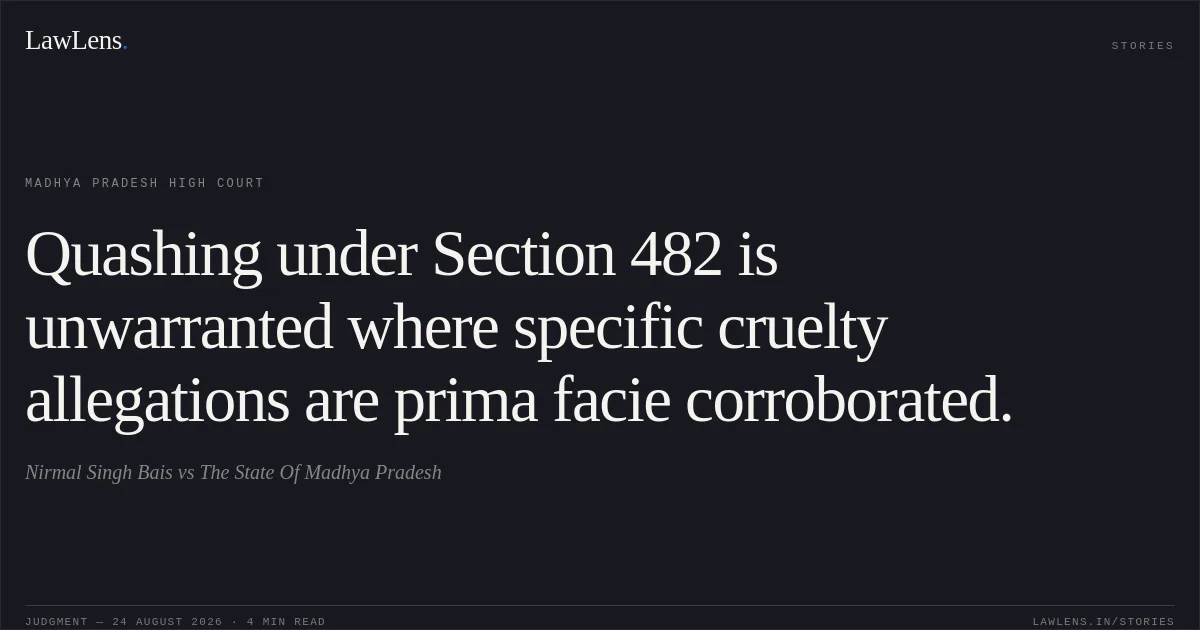
The Court applied the inherent jurisdiction under Section 528 of the Bharatiya Nagarik Suraksha Sanhita, 2023, read with Section 482 of the Code of Criminal Procedure, and considered the offences under Sections 498-A and 34 of the IPC and Sections 3 and 4 of the Dowry Prohibition Act, 1961.
Source reference: para. 1, p. 1Under State of Haryana v. Bhajan Lal, 1992 Supp (1) SCC 335, and Neeharika Infrastructure (P) Ltd. v. State of Maharashtra, (2021) 19 SCC 401, quashing is an exceptional remedy; the Court must ordinarily permit investigation or prosecution to proceed where the allegations disclose a cognizable offence and cannot test the genuineness, reliability, or truth of the allegations at that stage.
Source reference: para. 12, pp. 6–10Smt. Chand Dhawan v. Jawahr Lal, 1992 AIR 1379, establishes that proceedings should not be quashed where the complaint prima facie constitutes an offence and continuation would not amount to abuse of process.
Source reference: para. 9, p. 6Under Pratibha v. Rameshwari Devi, 2007 AIR SCW 5933, civil or matrimonial proceedings arising from the same facts do not, by themselves, terminate or justify quashing independent criminal proceedings.
Source reference: para. 10, p. 6Teeja Devi v. State of Rajasthan, (2014) 15 SCC 221, and Mohd. Akram Siddiqui v. State of Bihar, (2019) 13 SCC 350, further establish that the High Court should not conduct a mini-trial, appreciate the defence, or ordinarily assess the veracity of documents while exercising inherent jurisdiction.
Source reference: paras. 14–15, pp. 10–12Reasoning
The Court found that the FIR contained specific allegations that both petitioners had visited respondent No.2’s parental home, demanded ₹5,00,000, and linked payment of that amount to her return to the matrimonial home.
Source reference: para. 11, p. 5These allegations were prima facie corroborated by the statements of independent witnesses, Ramkumar Kurariya and Brajmohan, and by documentary material concerning the transfer of ₹50,000 to petitioner No.1.
Source reference: para. 11, p. 5The Court held that petitioner No.1’s filing of a petition for restitution of conjugal rights shortly after the FIR did not constitute a ground for quashing, since civil and criminal proceedings are legally independent.
Source reference: paras. 8–10, pp. 5–6The alleged discrepancy between 5 November and 6 November 2022, the petitioners’ assertion that the ₹50,000 transfer was a gift, and the objection regarding the absence of a certificate under Section 65-B of the Evidence Act were matters of evidence for trial, not grounds for exercising inherent jurisdiction.
Source reference: paras. 3, 5–6 and 16, pp. 2–5, 12–13Since the prosecution material disclosed a prima facie case and the petitioners’ arguments required appreciation of evidence, the Court declined to undertake a mini-trial or examine the defence at the quashing stage.
Source reference: paras. 11–16, pp. 5–13Holding
The Court held that the FIR and charge-sheet disclosed specific allegations and sufficient prima facie material connecting the petitioners with the alleged offences.
The restitution proceedings, alleged inconsistencies, and challenges to the evidentiary material did not establish that the criminal prosecution was false, baseless, or an abuse of process.
Source reference: paras. 11–16, pp. 5–13The petition under Section 528 of the BNSS read with Section 482 of the CrPC was therefore dismissed as meritless, and the FIR dated 20 December 2022 and all consequential criminal proceedings were not quashed.
Source reference: paras. 16–18, pp. 12–13The Court clarified that its observations were limited to deciding the quashing petition and would not affect the merits of the trial.
Source reference: paras. 16–18, pp. 12–13Acts & Sections Cited
10 provisions across 6 statutes referred to in this judgment. Linked provisions open on LawLens.
Bharatiya Nagarik Suraksha Sanhita, 20231
Code of Criminal Procedure, 19733
Indian Penal Code, 18602
Dowry Prohibition Act, 19612
Hindu Marriage Act, 19551
Indian Evidence Act, 18721
Original Court PDF
Nirmal Singh BaisvsThe State Of Madhya Pradesh
Click to open original judgment
Original judgment, available to read, download and summarize on LawLens.in