Facts
The petitioner challenged a series of orders: the initial order by the Sub-Divisional Officer (SDO) dated 19.03.2012, the Additional Commissioner’s order dated 04.10.2017, and the Board of Revenue’s revision order dated 06.03.2018.
Source reference: p.1-2The primary grievance was that the SDO entertained a matter filed after a 12-year delay without passing a specific order on the application for condonation of delay.
Source reference: p.1-2The petitioner contended that the SDO's order was non-speaking and lacked any legal reasoning.
Source reference: p.2The appellate and revisional authorities subsequently upheld the SDO's order without addressing these procedural and jurisdictional infirmities.
Source reference: p.4-5Issues
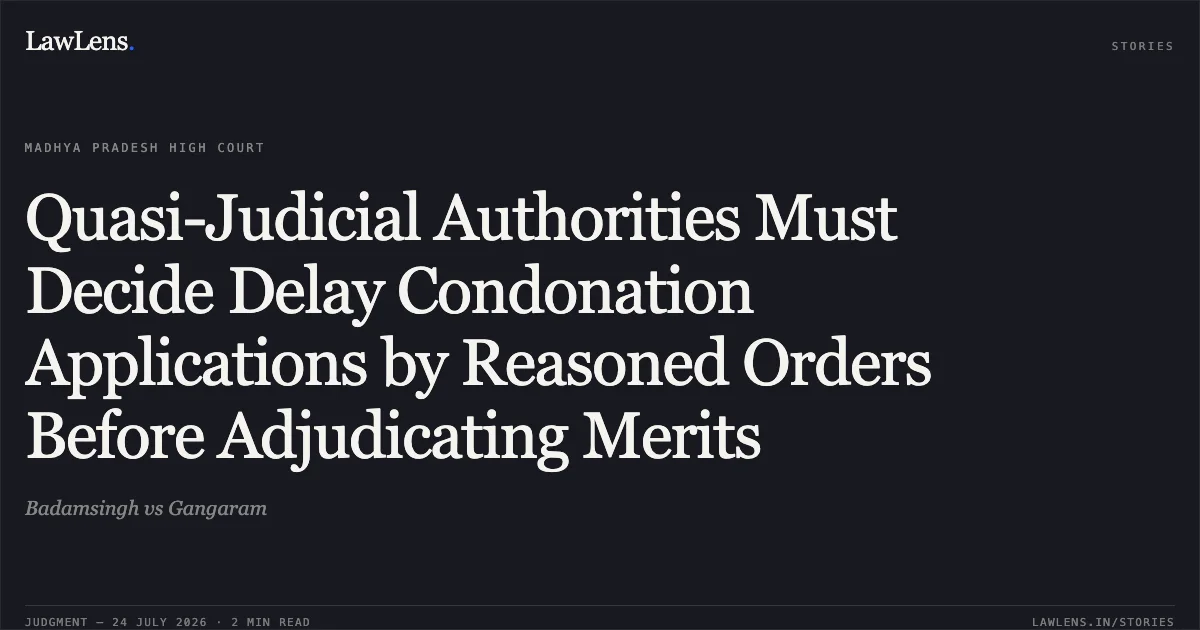
1. Whether a quasi-judicial authority can decide a matter on merits without first adjudicating a pending application for condonation of delay
Source reference: p.42. Whether the failure to record reasons in a quasi-judicial order violates the principles of natural justice and renders the order legally unsustainable
Source reference: p.2-4Law Applied
The court primarily applied the principles of natural justice and the "due process" requirement for reasoned decisions as summarized in Kranti Associates Pvt. Ltd. & Anr. v. Masood Ahmed Khan and others (2010) 9 SCC 496.
Source reference: p.3Recording reasons is a "life blood" of judicial decision-making, ensuring transparency, preventing arbitrariness, and facilitating judicial review.
Source reference: p.3-4An application for condonation of delay must be settled as a preliminary issue before the merits of a time-barred proceeding can be addressed.
Source reference: p.4Reasoning
The High Court found the SDO’s order suffered from "dual infirmity". First, the SDO bypassed the jurisdictional requirement of deciding the 12-year delay which was a prerequisite for maintaining the proceedings.
Source reference: p.4The order was "bereft of reasons," violating the fundamental facet of fair procedure that requires reasons as the "heartbeat" of any judicial order.
Source reference: p.2The court noted that the appellate and revisional authorities "mechanically affirmed" the SDO’s order without scrutinizing these fundamental procedural lapses, such as the absence of a "reasoned adjudication" or a finding of "sufficient cause" for the delay.
Source reference: p.4-5Applying the criteria from Kranti Associates, the court held that a "rubber-stamp" or non-speaking order cannot be equated with a valid decision-making process.
Source reference: p.4Holding
The Court allowed the petition and set aside the orders dated 19.03.2012 (SDO), 04.10.2017 (Additional Commissioner), and 06.03.2018 (Board of Revenue).
The matter was remitted to the Sub-Divisional Officer with directions to first decide the application for condonation of delay through a reasoned and speaking order. Adjudication on merits shall only proceed if the delay is found liable to be condoned after hearing all parties.
Source reference: p.5The petition was disposed of without expressing any opinion on the merits of the case.
Source reference: p.5Original Court PDF
BadamsinghvsGangaram
Click to open original judgment
Original judgment, available to read, download and summarize on LawLens.in